Mike Koetting October 13, 2036
I recently ran across an article that argued that the United States had far too many premature deaths. The article called it a crisis. This echoed an article from a couple years ago by Matt Yglesias that America’s shorter life expectancy should be a priority because, as he put it, “Dying is bad.”
Whether it’s a crisis or not, it is clear that life expectancies in the U.S. lag behind those of other developed countries and, over time, seem to be falling further behind. In 1980, the U.S. had the 14th highest average life span of countries with populations above 1 million. It has slipped steadily since then, now ranking 38th among countries with more than 1 million people.
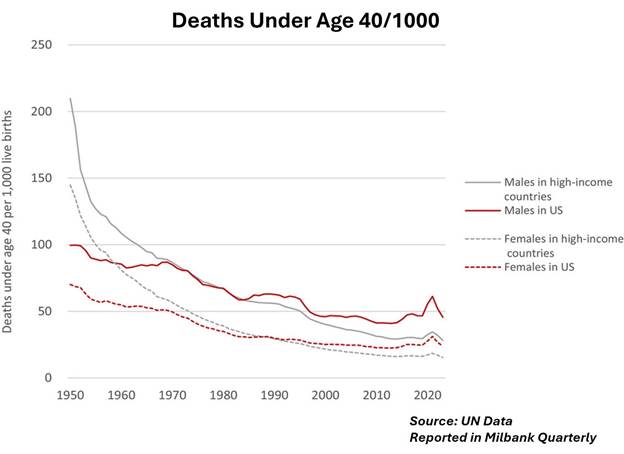
For the most part, life expectancy in the U.S. has continued to increase over this period, just not as fast as the rest of the developed world. The aggregate differences are not large—U.S. average life expectancy was about 79 whereas, say, European countries were typically two to four years higher. The differences between an average life expectancy of 79 and 82 may not seem like a critical difference in the course of long lives. But these numbers disguise what’s going on. In fact, longevity at older ages has generally improved in relation to other countries. The difference in the overall rates arises from higher mortality among young and middle-age people–people who could be expected to live longer and whose shorter lives make a difference.
The following chart compares projected mortality rates before the age of 40 in the US versus an average of high-income countries.