By Mike Koetting September 29, 2025
Today is five weeks from the election day…although, in fact, the election is well under way in many states. Increasingly, “election day” could be better characterized as “disclosure day”—an announcement of the results that have been building for weeks.
I have been reading polls, poll analytics and poll pundits. From all this reading, I see the experts converging on one idea: “Well, we’ll just have to see.”
There is, of course, much more thought behind this and all concede that there is plenty of reason for Democratic optimism and Republican concern. But the overall composition of the next Congress will come down to a whole lot of individual races that are hard to predict. The hardening of the country into Red and Blue (most of it reinforced by gerrymandering to make small majorities larger majorities) structurally dampens the likelihood of change.)
Polling Less About Polling
I recently saw an article that crystalized something I have been sensing for a while. Over time, it has become increasingly difficult, and correspondingly more expensive, to obtain actual respondents. Response rates to polling inquiries are now somewhere in the 2% range. At the same time, the number of factors that a pollster might want to take into account has increased. If that were to be achieved by polling alone, accuracy would require even larger numbers of respondents. Instead, what is called polling seemingly has as much to do with the underlying statistical adjustments made to what responses have been obtained.
This does not mean polls are useless. Polls still give some sense of broader currents that is independent of not only the self-serving statements of politicians and others, but also the direct filtering impacts embedded in social media. Without independent polling, when Donald Trump says he is the most popular president of all time, it could be countered only by claims from the other side that he is lying. With polling, while we may not know exactly how unpopular he is, we know that he is plainly wrong.
What this does call for is for pollsters to be more honest about the range of uncertainties contained within their estimates. Likewise, it requires consumers of polls to be realistic about what a poll can be expected to deliver. For openers, we all need to keep in mind that polls are best in mapping broad currents. The narrower the focus—in time and event—the greater the likelihood of error. Elections are one-time events, in the future, and can happen at very granular levels. Thus, while polls give us the best information available, they require several grains of salt.
Understanding the limits of what can be known, let’s take a look at what we have to work with.
Democrats Likely to Win the House
There is a broad consensus that Democrats are likely to win the House. Donald Trump is deeply unpopular. One recent national poll has shown a 10-point lead for Democrats among voters who say they are likely to vote. (This same poll shows remarkably few voters who are undecided. Whichever side they are on, people have made up their mind.)
But it is hard to say how this will translate into specific votes. Races for House seats are not decided on broad trends but on the make-up of the specific districts, the individual candidates, and the issues of particular salience to the district at that time. Voters may be deeply unhappy with the national direction, but that doesn’t mean they will in fact vote against “their” party in a House race.
And, as we all know, districts slice and dice the population to maximize the dominant party’s share. This gerrymandering hit new depths over the past year as Republicans struggle to find more seats. About 10% of the country’s population was impacted by this year’s gerrymandering alone. Some of this may backfire. In order to create more nominally Republican districts, they had to redistribute voters from particularly strong Republican areas to districts that were otherwise closer. In some cases, they may have cut too finely.
In theory, all 435 seats in the House are up for election. The practical reality is that upwards of 90% of them are non-competitive. That is, the odds of someone from the minority party (Republican or Democrat) breaking through are low. According to the Cook Political Report, there are only 37 competitive House seats. Democrats will have to win 22 of the 37 competitive seats to have a bare majority of 218 seats.
This seems doable. Sentiment is running against Republicans. It is also the case that some of the races deemed “non-competitive” will in fact prove competitive. G. Elliott Morris has offered analysis showing many composite predictions of what will be competitive has over the past several election cycles underestimated votes for the out-party (Democratic or Republican) in the mid-term.
Still, the degree to which American politics have become polarized makes it hard to see how Democrats will achieve a commanding majority, which I arbitrarily pick at something like 230 seats. (As the margin of difference grows smaller, it becomes harder for the nominally controlling party to actually control outcomes. The most likely result of such small margins is a do-nothing Congress as we have now.) To get 230 Democratic seats, they would need to win 34 of the 37 competitive seats. Or for a number of seats not expected to become competitive to become competitive. This is not impossible. But it is a climb.
Some observations about campaign financing. Republicans are pouring money into campaigns, including places where they might not have expected to spend money. They are significantly outspending Democrats. But three considerations. First, more money helps, but there are any number of races that show money does not always triumph. Second, it appears Republicans have the money to spend because of donations from various SuperPACs run by and on behalf of the billionaire class. Just 10 billionaires have already invested $730 MILLION into the 2026 midterms. This could present its own problems. Finally, it is likely that the purpose of these expenditures is less to change the minds of anyone but to make sure that Republicans who are discouraged by the Trump clown show in fact turnout to prevent the perfidious Democrats from delivering the country to godless socialism. Not clear who is biting.
Senate Looks Similar
There are 35 seats in play. The Cook report suggests that only 13 of those are competitive as shown below.
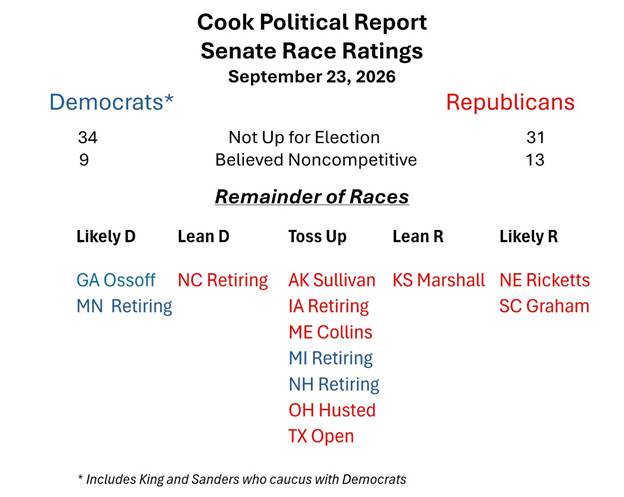
Democrats have 34 seats not up for election and 9 seats deemed noncompetitive. Thus, in order to capture control of the Senate, they must win 8 out of the remaining 13 competitive seats. That clearly looks possible. Henry Olsen, a conservative columnist at the Washington Post, thinks Democrats could win as many as 10 of these 13 seats. That would give Democrats a 53-47 margin. But 10 is a tall order. For instance, Texas is in his list. Yes, Talarico is ahead in numerous polls, but do we really believe at the end of the day Texas will vote Democrat? Same in Iowa. In Maine, Susan Collins has a Houdini-like record of escaping from tight situations. And in Michigan, El-Sayed has some issues—although his support has been rising since he won the primary. Unless Democrats win at least two of these four—or pick up unexpected seats elsewhere —they would be stuck at 49 votes.
So, while the Democrats have a clear path to a majority, it is by no means a certainty. And even with a small majority and a filibuster in place, there would be real limits on what could be accomplished. Particularly since the Senate is impacted by the mother of all gerrymanders, two Senators per state regardless.
Current Republican Congressmen
I wonder what the Republican Congressmen not scrambling for their political lives are thinking. I remain utterly baffled by their willingness to ignore Trump’s personal corruption, disregard for the rule of law, flagrantly stupid policy choices and penchant for bizarre and divisive expressions. I continue to believe they know better.
A large part of me thinks there are many Republicans who are secretly hoping for a Blue Wave. They know what is going on is not in the best interests of the country but they don’t want their fingerprints on ending the MAGA party.
Ray Valek, a former colleague at the U of C Medical Center, acknowledges that many Republicans understand now that they are out ahead of their skis. They thought they could control Trump to a certain degree and have been willing to acquiesce since he gave cover to get what they have been after since the New Deal—fewer regulations, lower taxes and dollops of old-fashioned punish-the-poor morality. They might have preferred more of a scalpel approach, but Trump’s crazy hammer style has delivered what they want, at least till now. The question becomes whether more won’t have second thoughts as his impulsive and narcissistic style threatens to kill the whole goose.
Context
Like many Americans, I am holding my breath. I believe the Democrats will win the House and am optimistic they will also win the Senate. But it won’t be over until it is over.
There remains the possibility that Trump would try some direct intervention in the election, but I consider that remote. Cracks are beginning to surface in the Trump coalition and anything so overt would be likely to blow up in his face. Moreover, unless my wildest fantasies about this election come to pass, I suspect it unlikely that the election will produce such decisive margins they will be able to fundamentally change the course of the Administration. Smallish Democratic majorities will pester Trump but he will be able to mostly coast out his last two years, continuing to rake in grift. So why would he take the chance of blowing it all up?
Then again, we are talking about Donald Trump.


