By Mike Koetting October 27, 2026
Polling shows that the public support for either political party is limited.
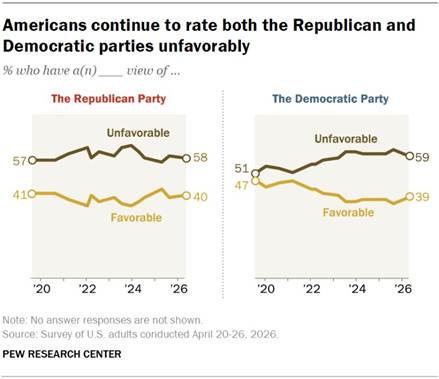
While all kinds of explanations and fixes are proposed, I think the major explanation is that the political parties are mostly irrelevant.
Say What?
To people who pay attention to politics (thank you, loyal readers), the idea is hard to grasp. Our world view is significantly shaped by the familiar duality of American politics: Republicans or Democrats control the Senate, there are Red States and Blue States, governors are either Republican or Democrat. It is hard to imagine the PBS Newshour without the idea of Republican or Democrat.
But truth is, we are a minority of the population. And when you get by the idea of parties as a handy intellectual organizing principle, it’s not clear what’s left.
The Founding Fathers were pretty specific that political parties were a bad idea because they encouraged collaboration that could become undemocratic. But parties nevertheless sprang up within a generation. For most of our history they served as a mechanism by which people of roughly similar political persuasions could organize to capture power for their common ideas. This requires the party to resolve intraparty tensions so as to maintain enough coherence of purpose that even people who were only marginally interested in politics could rally around the brand. It only works for the country if the parties share enough democratic values that they can mitigate differences to accomplish the work of governing.
That process was helped along because the parties provided a second useful function—executing what I call the soft mechanics of elections in a democracy. This involved deciding how candidates happened and under what ground rules they participated.
The Undoing of Parties
Both these functions started to falter in the 1960’s.
For most of the 20th century, Democratic Party identify was maintained by focusing on economic issues that impacted poor and middle-class Whites and simply ignoring the plight of Blacks in the Jim Crow south. Eventually that became impossible to paper over and a material portion of the Democrat Party abandoned ship. For those who remained, the tension between ideas of equality and economic equity has been a persistent fault line. Today’s division between “woke” Democrats and “moderates” is only the latest example.
Until recently, Republicans were able to present a more coherent façade, but underneath a tension was building because the uber-capitalist sentiment of parts of the party could work only with enough sleight of hand to keep fuzzy the underlying commitment to the wealthy. (It is more than a little ironic that the Gilded Age around the turn of the previous century was mostly undone by Republicans—starting with the Progressive movement of Bob LaFollette, a Republican from Wisconsin, and the trust-busting of Teddy Roosevelt. But Republicans quickly returned to form as the party of governmental restraint, which preeminently meant restraint from getting in the way of capital accumulation.)
It is plausible to argue that the current Republican Party isn’t even a party in the traditional sense. In the previous understanding, the foundation of a party was a collection of people holding principles that, while vague at the edges, was discernible, had some consistency over time, and exercised influences in a shared understanding of the country’s foundational principles. What is currently called the Republican Party has shown time and time again that its loyalty is not to any set of principles but to whatever Donald Trump decides. Capricious tariffs, attacking our historic allies, forgoing any commitment to global democracy, using the forms of law to pursue personal agendas and vendettas, and forgetting any concept of fiscal conservancy. That is no longer a group of people coming together with a common philosophy trying to exercise influence in a democracy. It is a clique devoted to maintaining their position regardless of ideology.
Donald Trump, Jr. made it crystal clear. At the “Stop the Steal” rally on the National Mall six years ago. He said that when it came to people who believed in following the rules and the courts: “This isn’t their Republican Party anymore. This is Donald Trump’s Republican Party.”
The second function of parties, deciding how candidates happened, mostly ended with the advent of direct primaries. These happened because of sentiment that the party hierarchy was picking candidates out of synch with the electorate. While the sentiment was understandable, it is not clear the ramifications were thought out. If parties have no control over the candidates that nominally represent the party, what is the party? And what does it actually represent if individual candidates get to decide what the party stands for?
There is an argument that direct primaries allow party positions to more quickly reflect underlying changes in society than waiting from them to be filtered through a party hierarchy. And that may be an okay thing. I don’t, for instance, think Barack Obama gets elected if it weren’t for direct primaries. But, then again, neither does Donald Trump. For better or worse, direct primaries hollow out the role of parties.
And, of course, in the middle of all this, successive Supreme Court rulings have changed the nature of campaigns by allowing unlimited political donations. (In The American Prospect, Harold Meyerson is referencing the Court as “Supreme Court (R-DC)”.) Not only does this give advantage to those who have unlimited funds, it has also led to special interest groups effectively picking candidates because those groups have infinitely more resources than the political parties. Today, most funding comes via the candidate and the individuals who support them; parties are more dependent on funds from the candidate than vice versa.
Does It Matter?
I can’t make up my mind about this. I am generally opposed to reifying fictions because it causes people to confuse the nature of reality. On the other hand, the idea of parties does serve as a useful organizing principle, even if remarkably imprecise.
There is also the possibility that a party could be re-energized, as Ben Wickler suggests happened in Wisconsin. He argues the secret is all-season, all offices organizing by the party around a broad set of principles toward making government oriented to all the people as opposed to the rich. It has made a difference in Wisconsin over the last several cycles, but we will have to see if that lasts and how the results pay out. At least for the moment, Democrats there, as elsewhere, are benefitting from Republican lack of performance on the core issues around affordability. It will remain to be seen if this can be sustained given that major changes will require more than one or two election cycles and the current electorate is impatient. This is one of the symptoms of people voting around immediate needs absent the kind of overarching philosophy a party could provide.
G. Elliott has been arguing that the swing factor in the last several elections is low-information voters (operationalized as voters who don’t know which party controls Congress). They are almost entirely focused on immediate economic issues. In the absence of some party getting a durable enough majority to make real changes, majorities will simply bounce from one party to the other as low-information swing voters remain angry. A differentiating factor would be if one party (Democrat, Republican or other) has a vision that meets people’s perceived needs as well as a convincing argument about why the journey will take a while and what are markers along the way. It will also need enough intermediate, tangible results that illustrate progress to get durability. In this regard, I am very curious to see if Mamdani can sustain enthusiasm over a longer period as he tries to achieve major changes.
I have some sympathy with Lee Drutman’s Breaking the Two Party Doom Loop, which argues that the sharp nature of our partisan warfare is making it excruciatingly difficult to actually govern. But is that split really a result of the two parties or is the division of the polity into those two groups disguising the true nature of the problem—which to me is the inordinate influence of the top 5% of the economy. This is aggravated by a social information network that dispenses decontextualized information and emotions without having to meet with other people and agree on communal responses.
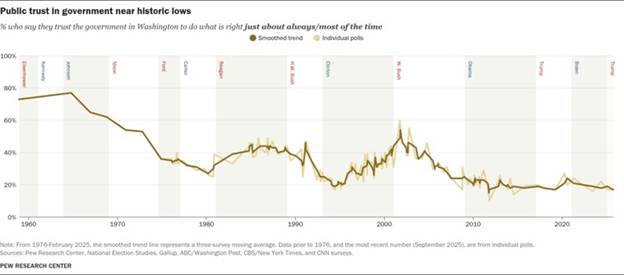
I strongly suspect that the relative disinterest of the population to pollical parties is largely a function of the general sentiment that government does not work for them and can’t be trusted to do the right thing. In 1958, 73% of the population said they trusted government to do the right thing most of the time. By 2025, that number had shrunk to 17%. After all, if you can’t trust government to do the right thing, why care about which party is running it?
It is also unclear to me whether the sharpness of the current political world is caused more by the political parties or by the breakdown of the political parties. Historically, political parties—by their need to build some degree of internal cohesion—were more likely to blunt differences. They were also more able to fashion compromises between the parties because they had some overlapping values. With the loss of party power to pick candidates in the primaries, there is a tendency for more extreme arguments to take over. As that happens, it becomes more difficult for parties to broker compromises. I remain convinced a majority of the Republican Congressional delegation knows how bad Donald Trump is for the nation. But they feel powerless against the cabal organized to support Trump—whose interest in traditional Republican principles only accidentally and periodically coincides with what they are doing. If there were a sense that traditional Republican principles actually had leverage, more Republicans would be willing to stand up.
Where Does It Go?
Good question.
Given the current miasma, I hope more state parties take up the challenge posed by Ben Wickler to reinvigorate parties at the state level. At the same time, I am eager to see more experiments with ranked-choice voting and proportional representation to see where they are going. They might provide a structural fix that is less dependent on the circumstances of particular state parties.
In the meantime, it seems to me that in their current configuration, political parties are more spectators than actors in a world-class political mess.


