Voting Miasmas and Ranked Choice Alternatives

By Mike Koetting April 14, 2026

I’ve written before about how I think the American voting systems are deeply flawed. Current events provide new data to strengthen the case.

The Illinois Primary

The Illinois primary election was held last month. In two of the Representative races that I was watching, the winners had 24 percent and 29 percent respectively. As it happened, my preferred candidate won each, but still the results were not entirely satisfying. These are both districts with overwhelmingly Democratic majorities, so these two candidates are virtually assured of going to Congress. As much as I was happy it was these two, I am uncomfortable with the idea that someone can get elected with less than thirty percent of the primary voters of one party, particularly given that primary participation is lower than in the general election.

This happened because there were large numbers of candidates in both districts. There was a candidate with roughly any shade of nuance a voter might want. The rub is that if a preferred candidate lost, any “information” carried in that vote was also lost. Thus, voters had to consider whether a vote for their favored position opened the door to someone they really didn’t want. A run-off election among the top two finishers would probably be an improvement, but this is extra expense and, in all likelihood, have an even smaller turnout.

The California Quandary

This same dynamic is playing out in California in a different, and possibly even more distorting, way.

In an effort to avoid the kind of situation described above, in 2011 California adopted a different approach to primaries for state office. All candidates run against each other, not just against people in their own party. (Colloquially known as a “jungle primary.”) The top two candidates proceed to the final; those are the only candidates who can run in the final. This guarantees that the eventual winner will have a majority.

While this solves one problem, there is now a real chance it could have a very unexpected outcome in the June election, just six weeks away. Going into last week, there were ten candidates in the race for governor, eight of them Democrats and only two Republicans. With the Democrats splitting up the vote so many ways, last week’s poll showed the two Republicans were the leaders, each with a projected 14% of the vote. The leading Democrat polled only 11% of the vote—although the top three Democrats together had 29%. Altogether, Democratic candidates in this poll were favored by 70% of the respondents, but the Democrats could hypothetically have been shut out of November’s election.

Reality, of course, remains in flux. Since that poll was taken, Eric Swalwell, one of the previously leading candidates, was forced to drop out. It remains to see how this reverberates. A California analyst who has run several thousand simulations says his model estimates the odds of two Republicans in the final at something like 1 in 5, and that was before Swalwell’s exit. While this is not a high likelihood, the reality is still a bit disconcerting. Some people might be cheered by a situation in which any Democrat was barred from being in the election for governor, but this could hardly be considered a blow for democracy. It seems that the desire to weaken the power of parties in the primary process has been so effective there are fewer gatekeepers and no effective way for “the Party” to avoid a train wreck.  

One Way Out

Both these situations would be ameliorated with the use of Ranked Choice Voting (RCV).

I assume, by now, most readers of this blog know what is meant by RCV. Voters rank candidates in order of preference. If no one garners a majority by means of highest rank votes, the lowest scoring candidate is eliminated and the second choice of voters for the eliminated candidate are added to the vote totals of the remaining candidates. And so on, until one candidate gets a majority.

RVC, while not widely used, is also not unknown. Fifteen states use it or allow it in some circumstances. Forty-seven cities use it for municipal elections, most notably New York City, but also Seattle and Salt Lake City. Almost all of the states where RVC is used are Blue states. On the other hand, 19 states have banned its use, virtually all of which are Red states.

There have been some studies of the impact of RVC, although, since the actual number of elections using it is relatively small, all results to date are tentative. It appears that voters generally like it and there is a modest increase in turnout. On the other hand, it is not clear how many of the assumed benefits will play out longer term. Importantly, there is no strong evidence it reduces polarization.

But neither are there any clear warning signs. While it is more complicated, voters seem to adapt relatively easily, especially younger voters. It takes somewhat more time to compute results this way, but as systems for making these calculations get more familiar, this should be a smaller factor, particularly when compared to other factors (e.g. how a given entity handles mail-in ballots).

I find the antipathy to RVC in Red states interesting. One theory is that whichever party is winning assumes the existing systems are fair and, therefore, are reluctant to change the status quo. I note there seems to be a preference for maintaining the status quo among the current political leadership of both parties. Here in Illinois, for instance, several suburban communities are trying to enact RVC and are being opposed by the Cook County Clerk.

Impact on Polarization

Advocates of RVC stress its ability to reduce polarization. I certainly agree with Lee Drutman, a major advocate for RVC, that America is now snared in a “two party doom loop.” I am hopeful RVS will be able to help break out, but we will need more evidence.

Americans have come to take for granted that the country is immutably divided between two parties, each with profoundly different agendas. While this is nominally correct–America has been separated into Republicans and Democrats since the Civil War— it misses the extent to which each of these parties were, for most of this period, more a coalition of groups who agreed on some things and differed on others. This allowed for a fair amount of latitude on positions by any given politician, regardless of what overall label they wore.

In more recent times, however, the two parties sharpened their differences into two “national parties”—each with a distinct, and mutually exclusive, identity. The rise of social media and the coalescence of each party around different attitudes to civil rights cemented these distinctions and greased the way for a more rigorous separation of parties. As the differences hardened, party identities became increasingly existential. People were encouraged to believe that members of the other party were immoral. Which further reinforces the polarization, the essence of a doom-loop.

The question now facing the country is how can we back off this polarization. I don’t see an easy answer. We need to reverse the direction of economic concentration and create cultural moderation in social media. These are big lifts. RCV might be more doable.

Advocates suggest it would create an opportunity for moderate Republicans to have a lane for themselves that breaks out of the stranglehold MAGA extremists have on their party. This might be particularly useful in districts with overwhelming majorities of Republicans (although the dynamic could be the same in Democratic districts). At present, more than half of the Republican Congressional representatives were elected in districts with margins greater than 25%. This means that for all practical purposes, the only meaningful election is the primary which is often dominated by the more extreme elements of the party. Moreover, in most cases this completely shuts out Democrats, who could compose as much as a third of the electorate. Making the primary and the final the same election would increase turnout and potentially open the door for more moderate candidates.

Support RCV

It’s hard to be optimistic about major changes in the American voting system. There is marked lack of support among the established political order for changes such as RCV and they would be vigorously opposed in those places where its advocates suggest it might have the biggest impact.

All that being said, more adoption of RCV would address problems such as described in the Illinois and California primaries and might mitigate some of the polarization. If nothing else, the jolt to the status quo might unleash some different energy. I hope there will be more experimentation with this and similar systems going forward.

People Over Corporate Excess and Excessive Wealth (Seriously)

By Mike Koetting March 31, 2026

In my last blog, I argued that people voted for Donald Trump because they despaired the mainstream of either party were effectively addressing the devolving life situation of the bottom two-thirds of the economy.

There is no surprise about the traditional Republican Party. For the last century or so, it has made the primacy of capital as its raison d’etre. Trump disguised that with populist talk that sounded different from traditional Republicans and tapped into the voter resentment about both economic and cultural issues. Democrats, on the other hand, have talked more about looking out for the middle class and have passed some useful measures, but they have been unable to project a coherent and sustained strategy for changing the fundamentals of the economic structure. Wealth has continued to concentrate and big corporations are running roughshod over the bottom two-thirds of the economy.

The Path Forward

I believe Democrats can break through the fog of division created by the Trumplicans and solidify for themselves the kind of mandate that FDR created with a concerted strategy that unapologetically commits to reining in excesses by corporations and billionaires and to promoting the welfare of the entire economy, not just the 1% on whom the Republicans are currently showering give-aways.

The New Deal and its successors worked because it actively insured that the economy shared productivity increases with the rest of society. Over the last 45 years, corporations and their owners have eroded these protections. Following Reagan, it became gospel that corporations only responsibility is to the shareholders, which has meant that all decisions are seen through the lens of what enriched their owners.

Oren Cass, a traditionally conservative economist, has argued this has led to the “financialization” of the economy, which is the single largest cause of the soaring inequity. He shows how this has infected every corner of our society.

Neither Clinton nor Obama, unfortunately, directly confronted the fact that maintaining the economic well-being of the entire society requires robust government oversight and instead focused on what would grow the overall economy. They missed that while “a rising tide might lift all boats” that it would not lift them equally—or even close to that. In the absence of countervailing efforts, the economic elite will consolidate power to increase its advantages. And then the advantages of economic growth go almost solely to those who already have wealth.

Almost a century ago, U.S. Supreme Court Justice Louis D. Brandeis warned “We can have democracy in this country, or we can have great wealth concentrated in the hands of a few, but we can’t have both.” The current political situation bears this out.

Addressing this will require specific measures to lessen the concentration of wealth in individuals and to narrow the power of corporations to write their own rules for the benefit of their stockholders.

This Is Not an Easy Path

Democrats like to think of themselves as the defenders of the lower two-thirds of the economy. But the growing income and wealth divides make it clear that they have not been able to do so effectively.

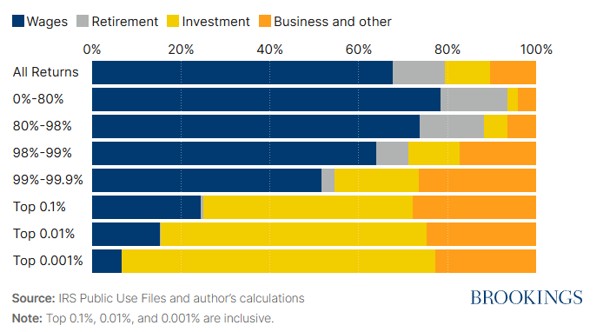
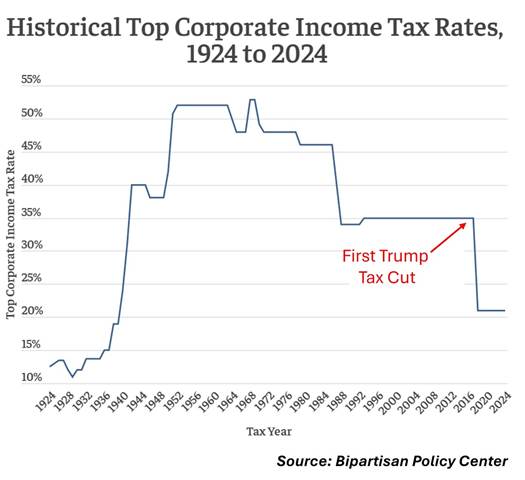
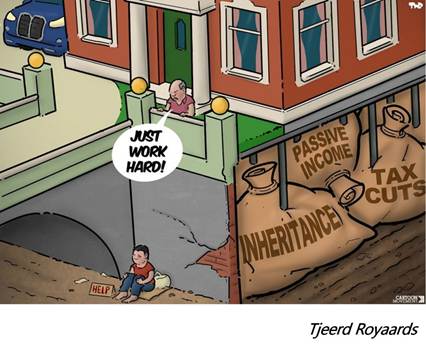
As I suggested above, the biggest problem is that Democratic leaders have been as concerned about maintaining overall economic growth as they have been about the distribution of that wealth. On the one hand, trying to change distribution without continuing economic growth has rarely been a recipe for a successful society. On the other hand, distribution of resources will never become equitable on its own. People who have advantages use them. In many ways this is good for society. But unless limits are created and maintained, a society winds up with the kind of economic distribution shown above.

The tension between overall growth and distribution is regularly played out in debates about how progressive the Democratic agenda should be on economic issues. While this is a real issue, it is apparent that to date, Democrats have not had the right formula. As the distribution of wealth has gotten more extreme, the lack of enthusiasm for the Democratic Party has gotten worse.

While one can (and probably should) be skeptical of any single poll, the number of polls that show the voting public is significantly unhappy with the Democratic Party are so numerous and consistent, it is delusional to pretend this is not a problem. Yes, voters do not like Donald Trump. But unhappiness with Trump is not the same as support for the Democrats. By itself, it is unlikely to lead to a lasting majority, particularly once Trump is gone. An economic reset is going to be a long-term project. Without a big House majority and a veto-proof Senate, it is hard to see how this happens. Neither of these is likely by 2028. Which is why there needs to deep support behind a party that is trying to do this.

But, for instance, a recent NBC poll shows that as much as Trump is “underwater,” the Democratic Party fares worse.

I think this is a function of two things.

First, disappointment that the Democrats have failed to fix the economic situation. Voters don’t expect Republicans to address distribution of income issues. That’s the job of Democrats. And when they don’t do it, they are disproportionately rejected.

Second, there is a sense among many voters (for one example, see this discussion of a focus group in Pennsylvania) that the Democratic Party has become too focused on meeting the needs of various groups at the expense of supporting the broader middle class. The position of once Democratic Ruy Teixeira may be a bit extreme, but clearly reflects a broader sentiment.

Neither of these criticisms are entirely fair but neither are they entirely without basis. And, whether fair or not, these are clearly sentiments about the Democratic Party held by many voters. While one might argue that the success of Democratic Party per se is not important, the problem is that with our current (kind of stupid) political structure, voters need to choose one of two groups. When they turn on the Democratic Party, they wind up supporting a Republican Party—not only against their best interests, but against the interests of the entire society, as is being played out daily.

The Obstacles Ahead

Democrats first obstacle is to achieve some consensus around taking on corporations and the wealthy, something they have not been able to do for generations.

Part of their problem stems from a real understanding of the beneficial effects on society from overall economic growth. But there is also reliance on the wealthy for campaign funds. Republicans are probably more reliant, but this doesn’t cause a problem for them since their core mission is to protect these people. I don’t know how willing Democrats outside certain districts will be to risk support by buying into a campaign against concentrated wealth. Nor do I know how, if they took that risk, it would play out.

Related, Democratic candidates are often psychically and culturally more at home with the top third of the economy in their daily life. The days of Democratic ward bosses and union leaders who were closer to the working class in social terms are gone; the Democratic base has grown to include a large portion of college educated professionals. While these folks hate many parts of the Trumplican agenda, their overall position in society is comfortable and they are wary of radical changes. They rationally recognize the problems that corporate financialization have brought to the country, but they have many reasons to question what might come next.

All of this can become somewhat self-fulfilling. If candidates and would-be candidates fear that there would be pushback from financial supporters and friends, they might hedge their willingness to commit to an economic reset. Same with voters who fear, despite their own analysis of the facts, that coming across as “too far left” on economic issues would cause them to be seen as “fringe.”

What Is the Alternative?

I assume Democrats would continue their juggling act of supporting cultural progress and being sort of progressive on the economy. In the short term, given the Trump backlash, this should be enough to do well this November and might even lead to a Democratic president in 2028. While those are good things, it is hard to see that leading to major changes in our society. Those require a fundamental break with the status quo.

In the absence of that, the two parties will probably continue splitting up small margins and we will lurch from one party to the other as the voters keep thrashing about looking for someone to address the core problem of American society—the growing inequality that is destroying our democracy. Letting that happen seems morally irresponsible.

Closing Note

Getting a party to unite around a high-level strategy is a sine non qua for achieving a meaningful majority. But it is not sufficient. Voters, even the strongest supporters, also need to believe you have defensible ideas behind the grand strategy and the ability to execute those ideas. And you need a candidate who can carry the message. I hope to address these in subsequent posts. But for the time being, Democrats should start by demonstrating a clear commitment to people over excessive wealth and corporate excess.

Donald Trump Is an Act of Desperation

By Mike Koetting March 17, 2026

It’s hardly a newsflash that Donald Trump is so singularly focused on his own interests that anything, or anyone, outside those exists only as a potential obstacle.

This is not normal. I can think of no religion or system of philosophy that doesn’t recognize that humans have something in common, have some universal decency and have certain responsibilities to one another. Donald Trump reflects not a shred of these. He over and over reminds us his world is irreconcilably divided between people who are of use to him and people who are “trash.”

At no point in the history of this country has a man so devoid of common decency—or at least so unwilling to even pretend– been elected to the presidency. Maybe it’s worth spending a minute or so thinking about what it tells us about our society.

I reject the idea that there has always been this great, brooding indifference to humanity lurking specifically in our society. I readily acknowledge that Americans have often in the past defined the category of “fellow human” more narrowly than we do today. But this is true of virtually the entire world. I know of no historical record that reflects a society that sprang into existence with a fully extensive notion of who is indeed a fellow human, and, accordingly, demanded some basic respect. Everywhere this has been a gradual evolution. At some points the US led this struggle, at other times was kicking and screaming to avoid such an expansion. But the complete rejection of the idea of a larger human community is an aberration. Period.

So why have so many people come to accept this behavior from the President of the United States?

My own thinking is that it is a desperate response to both the steady loss of personal agency, primarily due to corporate elites, and to the thinning out of social threads that hold people together. This combination of anger and alienation leads people to lash out on an emotional basis, unrelated to any values or policy.

Loss of Personal Agency

Our lives can be viewed through multiple lenses but perhaps the most pervasive is the economic structures of our day-to-day lives. When we find the economy working for us, life seems manageable. But when that turns every day into a struggle, all the other things in our life are impacted. Riffing a bit off a blog by Dick Dowdell, the underlying machinery of our society has changed over the last fifty years. Three key elements in particular have changed in adverse ways—the richest (and their corporations) exercise more power in individual lives by significantly increasing their role in political life; opportunities for meaningful economic and social mobility have diminished; and individual economic life has become less secure. Whether or not people would articulate these concerns in the same way, a large portion of the society feels the room closing in.

Twelve years ago, political scientists showed empirically what most people feel intuitively: the affluent wield outsize power in determining political outcomes. Citizens United actually went so far as to make this a principle and there is every reason to believe their sway has gotten more powerful since. It is less which party rules and much more that the wealthy are able to maintain the fundamental rule that whatever happens, the rich keep reaping a bigger share.

Again, there has been considerable academic work showing that in the middle of the last century, economic mobility was common. As the century went on, mobility declined. Now it’s a coin flip as to whether you will do as well financially as your parents and, insult to injury, the odds are greater that you will if you start relatively affluent. And, in some sense, the issue is even more blunt than whether you make more or less than your parents; the issue is whether you can afford to have your own home

Underlying economic security is similar. If you feel you’re only one accident away from the whole game spinning out of control, you’re much less inclined to think that the existing political order is worth endorsing. Here again, academics provide documentation that when economic uncertainty overwhelms, political values erode. As the authors of one study put it:

When respondents were financially secure, support for liberal democratic principles increased. When respondents were economically disadvantaged, they became more tolerant of illiberal conditions, including biased media, weakened checks on leaders and unequal treatment under the law.

As all three of the conditions referenced above—elite control of public life, lack of social mobility and persistent economic insecurity—became worse over many years, those most impacted stop trusting mainstream parties because things keep getting worse regardless of which is in charge. People intuitively understand that these trends are a result of policy choices that could have been made differently, indeed, used to be made differently. Republicans have done more to impact these dynamics but Democrats have contributed—and certainly failed to prevent them. Should we be surprised, then, if people are willing to take a chance on anyone who looks like he will break the existing consensus, particularly if he reflects their own sense of grievance.

Weakening the Ties that Bind

These concerns are even greater when paired with the overall weakening of the social ties that should hold a society together.

America has never been a cohesive social whole because, unlike many other countries that grew organically over a long period of time, it was an “assembled” country with pieces from all over. But, generally, there have been various veins of coherence that made it possible for people to see their common elements, or at least to find a way to work together. The last fifty years have been hard on that.

Part of what has happened is in fact the broadening of who deserves to get full respect as a human. This is a good and necessary thing. But like any other major change, it produces secondary effects. The assaults by those who make profit from stoking division, which includes Donald Trump, are designed specifically to narrow the bonds among people, to draw lines between some group and the “unworthies.”  Hate can be used to generate money and profits.

The declining communal nature of our lives makes these divisions easier. The metaphor of Robert Putnam’s book, Bowling Alone, remains powerful—there has been a retreat from activities that bring people together. From civic organizations to bowling leagues, people do fewer things with other people. And this retreat from communal action  has gotten worse in the 25 years since Putnam’s book. The decline in church and unions—organizations with specific communal values—has been particularly steep. Also, this disconnectedness affects the working class more significantly.

These Get Us a Psychopath

The growing anger at the powerless of daily life and the loss of personal connection to the  broader society deadens people sensitivities to what seem like the most basic requirement to be president of the United States—to be a discernibly normal human being.

For some Trump voters, Trump’s indifference to the norms of the broader society was a positive attraction. But I believe these were the minority. More Trump voters were aware of this and accepted it as a downside of his opposition to Democrats–economically, cultural, or both. With various degrees of awareness, they hoped that his pathologies would not go so far as to completely upset the apple cart. Another large group was people who are disappointed at their lives and Donald Trump was apparently offering quick fixes. At the very least he seemed to reflect their visceral sense that something was robbing them. Whether he had correctly identified the people responsible, let alone whether he had either the requisite psychological underpinnings or motivation to successfully change America in their favor, didn’t seem important.

Only the first group got what they bargained for. Oops.

A Modest Strategy of Great Ambition

By Mike Koetting February 17, 2026

While the mid-term elections are ten months off, and ten months is a political eternity, polling suggests it is very likely Democrats will gain a majority in the House and might even eke out a tiny Senate margin. Inshallah.

One hopes this would allow the Democrats to serve as a somewhat greater brake on Donald Trump’s worst impulses. The degree to which that will happen is unclear since so much of what he does is, to be generous, extra-legal. Thus, the ability to slow him will play out in real time when we get there.

Still, having a plan might be good. Here are a broad set of strategies that Democrats might use as a framework for the following two years—if they are willing and able to do so. I think the difficulty of following these strategies will be less a function of Trumplican opposition and more a function of the party’s internal workings, which, by the way, are not unique to Dems but are inherent in the way we allowed our pollical and cultural environments to evolve.

Continue reading “A Modest Strategy of Great Ambition”

The Reality of a Progressive-Populist Alliance

By Mike Koetting November 11, 2025

In my last post, I suggested that at least one way forward is some kind of populist-progressive alliance. Although more thinking about such an alliance raises some concerns, as last week’s election results illustrate, this is probably the way forward.

Obvious Convergence on Economic Issues

The primary basis for such an alliance is the concern over economic issues. We are currently in an anomalous situation where the stock market continues to boom. And while numerous other macroeconomic indicators are not plunging, the underlying realities are increasingly wobbly and the stress for many individuals and families acute.

Continue reading “The Reality of a Progressive-Populist Alliance”

The Unnecessary Scarcity We Tolerate Is Tearing Up the Country

By Mike Koetting October 28, 2025

I’ve been thinking that Abundance, the Ezra Klein-Derek Thompson book, has the right idea but the focus is too narrow.

The Klein-Thompson book starts with the observation that scarcity is a choice. It then proceeds to assume that the way out of the scarcity trap is to make it easier to create more stuff so that all may experience the abundance of what our technology can produce. This clearly has an element of truth. They correctly identify bottlenecks in our current production of social goods and they are right that there is no political appetite for “degrowth.” So power to their suggestions.

That said, however, they miss the urgency of the situation. A large chunk of the population is furious. Trying to remove obstacles to creating greater supply of desired goods, while laudable, is simply not a solution commensurate with the degree of anger in the body politic. I think Michael Hirschorn, in a recent New York Times op-ed piece, has a better handle on where we are: “Trumpism is more than politics. It’s an emotional gas-main explosion, from people who felt unheard, patronized, left behind.”

Continue reading “The Unnecessary Scarcity We Tolerate Is Tearing Up the Country”

The Moment of Truth

By Mike Koetting October 14, 2025

I believe we are approaching a “make-or-break” point for Trump’s authoritarian impulses.

It’s not a question of what he wants to do. That’s clear. In the last several weeks, he has replaced Federal Attorneys until he found one who would pursue an embarrassingly flimsy indictment against one of his enemies, he signed an executive order that raised the possibility almost any kind of dissent could be treated as “treason,” he posted on Truth Social that Democrats are “THE PARTY OF HATE, EVIL, AND SATAN,” and he lectured the leaders of the Armed Services that their mission included fighting the “enemies within”.

His approach to controlling immigration is increasingly inhumane. His masked marauders have grabbed people off the streets with little regard for their situations or actual legal status. Here in Chicago, along with the wanton cruelty and indifference to legality, there has been a major performance element designed to intimidate: armed border guards patrolling the Chicago River, military marches down Michigan Avenue on a Sunday afternoon and ICE agents rappelling from Blackhawk helicopters into apartments filled with sleeping families—separating children from parents and causing total pandemonium. Now Trump is calling for Governor Pritzker and Mayor Johnson to be jailed.

Continue reading “The Moment of Truth”

Attacking Medical Science

By Mike Koetting September 15, 2025

Every once and a while, you’ll run across an article about a bunch of teens absolutely trashing a local school. You’ll shake your head and wonder, “What the hell is this about? Okay, they don’t like school. But this doesn’t make any sense.”

What Trump and his Republican enablers are doing to the American scientific enterprise is remarkably similar, except with results that are going to be a lot worse. It’s a bit hard to tell exactly how great the damage will be given the uncertainty of what actions will withstand court challenges, what administrative actions will be taken to circumvent courts or where the juvenile in charge will change his mind. But working on this essay made it clear to me it is even worse than you probably imagined. Media covers it one event at a time, without stepping back to see the whole catalogue of damage. Likewise, the more you look at it, not only do you realize it’s more dangerous, but you also realize it is even more senseless than appears.

Continue reading “Attacking Medical Science”

Old Political Order Fading; Future Is Scary

By Mike Koetting September 3, 2025

David Brooks, taking anguished stock of the depredations of Trump and the Republicans, on PBS NewsHour, wondered why there aren’t more people in the streets. This is a question I have often asked myself. And am not the only one. What Trump and the Republicans are doing is so destructive of the spirit of democracy as to demand vigorous response.

But if the attack on the ideals of America is so fundamental, why aren’t there more people in the streets?

Continue reading “Old Political Order Fading; Future Is Scary”

Why Do We Tolerate the Crypto Scam?

By Mike Koetting

Republicans in Congress declared the week of July 14 as “Crypto Week” with the intent of passing three bills on crypto currencies as part of a push to boost and legitimize the U.S. cryptocurrency industry by giving it a regulatory framework that’s lighter than what traditional financial assets and institutions face but at the same time creates an aurora of legitimacy. All three of these bills passed. One, the so-called GENIUS Act, had already been passed by the Senate—with 18 Democratic votes– and Trump has signed it into law. The other two also passed, but face an uncertain future in the Senate. Not surprisingly, the value of existing cryptocurrency soared with the attention. Bitcoin, the best known cryptocurrency, hit an all-time high.

The details of these bills aren’t anywhere near as important as the fact that crypto is being treated seriously. There is no compelling reason for cryptocurrencies and profound reasons why they should simply be ignored. Or banned if ignoring them turns out to leave too many risky possibilities in play.

Continue reading “Why Do We Tolerate the Crypto Scam?”