By Mike Koetting April 14, 2026
I’ve written before about how I think the American voting systems are deeply flawed. Current events provide new data to strengthen the case.
The Illinois Primary
The Illinois primary election was held last month. In two of the Representative races that I was watching, the winners had 24 percent and 29 percent respectively. As it happened, my preferred candidate won each, but still the results were not entirely satisfying. These are both districts with overwhelmingly Democratic majorities, so these two candidates are virtually assured of going to Congress. As much as I was happy it was these two, I am uncomfortable with the idea that someone can get elected with less than thirty percent of the primary voters of one party, particularly given that primary participation is lower than in the general election.
This happened because there were large numbers of candidates in both districts. There was a candidate with roughly any shade of nuance a voter might want. The rub is that if a preferred candidate lost, any “information” carried in that vote was also lost. Thus, voters had to consider whether a vote for their favored position opened the door to someone they really didn’t want. A run-off election among the top two finishers would probably be an improvement, but this is extra expense and, in all likelihood, have an even smaller turnout.
The California Quandary
This same dynamic is playing out in California in a different, and possibly even more distorting, way.
In an effort to avoid the kind of situation described above, in 2011 California adopted a different approach to primaries for state office. All candidates run against each other, not just against people in their own party. (Colloquially known as a “jungle primary.”) The top two candidates proceed to the final; those are the only candidates who can run in the final. This guarantees that the eventual winner will have a majority.
While this solves one problem, there is now a real chance it could have a very unexpected outcome in the June election, just six weeks away. Going into last week, there were ten candidates in the race for governor, eight of them Democrats and only two Republicans. With the Democrats splitting up the vote so many ways, last week’s poll showed the two Republicans were the leaders, each with a projected 14% of the vote. The leading Democrat polled only 11% of the vote—although the top three Democrats together had 29%. Altogether, Democratic candidates in this poll were favored by 70% of the respondents, but the Democrats could hypothetically have been shut out of November’s election.
Reality, of course, remains in flux. Since that poll was taken, Eric Swalwell, one of the previously leading candidates, was forced to drop out. It remains to see how this reverberates. A California analyst who has run several thousand simulations says his model estimates the odds of two Republicans in the final at something like 1 in 5, and that was before Swalwell’s exit. While this is not a high likelihood, the reality is still a bit disconcerting. Some people might be cheered by a situation in which any Democrat was barred from being in the election for governor, but this could hardly be considered a blow for democracy. It seems that the desire to weaken the power of parties in the primary process has been so effective there are fewer gatekeepers and no effective way for “the Party” to avoid a train wreck.
One Way Out
Both these situations would be ameliorated with the use of Ranked Choice Voting (RCV).
I assume, by now, most readers of this blog know what is meant by RCV. Voters rank candidates in order of preference. If no one garners a majority by means of highest rank votes, the lowest scoring candidate is eliminated and the second choice of voters for the eliminated candidate are added to the vote totals of the remaining candidates. And so on, until one candidate gets a majority.
RVC, while not widely used, is also not unknown. Fifteen states use it or allow it in some circumstances. Forty-seven cities use it for municipal elections, most notably New York City, but also Seattle and Salt Lake City. Almost all of the states where RVC is used are Blue states. On the other hand, 19 states have banned its use, virtually all of which are Red states.
There have been some studies of the impact of RVC, although, since the actual number of elections using it is relatively small, all results to date are tentative. It appears that voters generally like it and there is a modest increase in turnout. On the other hand, it is not clear how many of the assumed benefits will play out longer term. Importantly, there is no strong evidence it reduces polarization.
But neither are there any clear warning signs. While it is more complicated, voters seem to adapt relatively easily, especially younger voters. It takes somewhat more time to compute results this way, but as systems for making these calculations get more familiar, this should be a smaller factor, particularly when compared to other factors (e.g. how a given entity handles mail-in ballots).
I find the antipathy to RVC in Red states interesting. One theory is that whichever party is winning assumes the existing systems are fair and, therefore, are reluctant to change the status quo. I note there seems to be a preference for maintaining the status quo among the current political leadership of both parties. Here in Illinois, for instance, several suburban communities are trying to enact RVC and are being opposed by the Cook County Clerk.
Impact on Polarization
Advocates of RVC stress its ability to reduce polarization. I certainly agree with Lee Drutman, a major advocate for RVC, that America is now snared in a “two party doom loop.” I am hopeful RVS will be able to help break out, but we will need more evidence.
Americans have come to take for granted that the country is immutably divided between two parties, each with profoundly different agendas. While this is nominally correct–America has been separated into Republicans and Democrats since the Civil War— it misses the extent to which each of these parties were, for most of this period, more a coalition of groups who agreed on some things and differed on others. This allowed for a fair amount of latitude on positions by any given politician, regardless of what overall label they wore.
In more recent times, however, the two parties sharpened their differences into two “national parties”—each with a distinct, and mutually exclusive, identity. The rise of social media and the coalescence of each party around different attitudes to civil rights cemented these distinctions and greased the way for a more rigorous separation of parties. As the differences hardened, party identities became increasingly existential. People were encouraged to believe that members of the other party were immoral. Which further reinforces the polarization, the essence of a doom-loop.
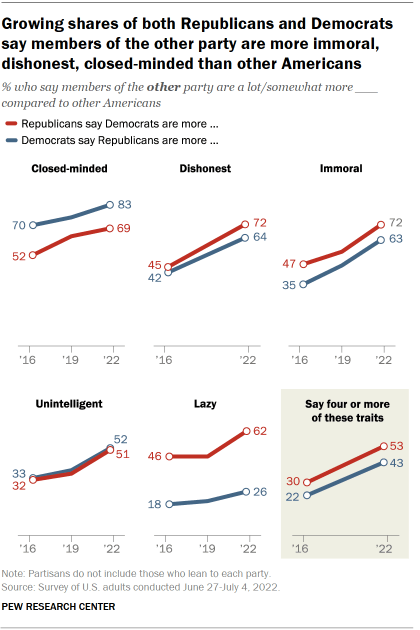
The question now facing the country is how can we back off this polarization. I don’t see an easy answer. We need to reverse the direction of economic concentration and create cultural moderation in social media. These are big lifts. RCV might be more doable.
Advocates suggest it would create an opportunity for moderate Republicans to have a lane for themselves that breaks out of the stranglehold MAGA extremists have on their party. This might be particularly useful in districts with overwhelming majorities of Republicans (although the dynamic could be the same in Democratic districts). At present, more than half of the Republican Congressional representatives were elected in districts with margins greater than 25%. This means that for all practical purposes, the only meaningful election is the primary which is often dominated by the more extreme elements of the party. Moreover, in most cases this completely shuts out Democrats, who could compose as much as a third of the electorate. Making the primary and the final the same election would increase turnout and potentially open the door for more moderate candidates.
Support RCV
It’s hard to be optimistic about major changes in the American voting system. There is marked lack of support among the established political order for changes such as RCV and they would be vigorously opposed in those places where its advocates suggest it might have the biggest impact.
All that being said, more adoption of RCV would address problems such as described in the Illinois and California primaries and might mitigate some of the polarization. If nothing else, the jolt to the status quo might unleash some different energy. I hope there will be more experimentation with this and similar systems going forward.


Good of you to revisit this issue. RCV would be a clear improvement over what’s currently in place for most elections.
LikeLike