By Mike Koetting April 28, 2026 (Amended)
In a relatively recent post, I suggested that if Democrats won a majority in both houses in November, it might be possible to pass a bi-partisan immigration agreement. The Trumplicans have so badly overplayed their hand that the time might be ripe.

However, as I tried to sort through what such a deal might actually look like, I realized how many pockets of interest benefited from the ambiguity that had existed before Trump launched his crusade. His lizard brain could only see the electoral advantages. He didn’t recognize–or didn’t care–that upsetting this ambiguity would spin into a chaos of unanticipated consequences. (You would think he would have a better feel for the issue, since as a businessman, he benefited from hiring illegal workers. Of course, no one ever accused Trump of an overabundance of self-awareness.)
Benefits from Immigration Ambiguity
Most of these benefits were clear to all involved but, in the nature of deals that can exist only because of their ambiguity, could not be publicly acknowledged.
Probably the biggest benefit was that it allowed for a significant number of people willing to work at wages below what native born workers would demand or at jobs that the native born just didn’t want. Whole industries—farming and meat processing, for instance–are completely reliant on immigrants, many of dubious legal status. Healthcare, food service and construction are also heavily reliant, not to mention home service and childcare workers. Ending illegal immigration would have materially inflationary effects. It is not clear, in fact, it would be possible to find native workers for all these positions at any plausible wage.
In theory, all employers were already required to check the immigration status of workers. However, enforcement was lax and many of the dealings operated in cash transactions outside of usual channels. (The strenuous opposition of employers to recent attempts to actually enforce these rules underlines the reality.) Far and away, the most efficient way for society was to wink at the rules, with occasional enforcement for the most flagrant abuses, and let legal and illegal immigration run their course. That only works if the rules remain relatively stable, including vigorous and visible enforcement of border security. Biden’s change of asylum rules at the border was a different sort of destabilizing move. The resulting spike in border crossings exceeded the bounds of ambiguity and was decisively rejected at the polls. I do not expect that kind of overt change in the foreseeable future.
The immigrants themselves were often exploited relative to native workers, but that was not necessarily their frame of reference. They were better off than wherever they would have been. Or at least they could imagine a trajectory that was better. This was probably not universally true. Some people surely found conditions much worse than they anticipated and were bitter at the choice they made. But not enough to materially dampen the tide of immigration. I doubt we have reliable information, but I suspect that more people in other countries would prefer a world where immigration to America was theoretically possible, even if not certain, to one where the opportunities to get to America were virtually zero.
Both political parties were able to use the ambiguity to their advantage. For Republicans, whipping up anti-immigrant fever was a potent tool. This was obvious when Trump scuttled the bipartisan deal worked out in the spring of 2024 because he didn’t want to lose it as a campaign issue. Beyond the 2024 elections, Republican have such an active portion of their base obsessed about immigration, that making compromises on key issues, is politically treacherous, even though material parts of their constituency relies on immigration, legal or otherwise.
Democrats have a milder version of the same problem, just in the opposite direction. Key portions of their base are deeply committed to pro-immigrant provisions and would object to many of the concrete steps within the scope of what might realistically be negotiated.
Take a key example. Any comprehensive resolution around immigration should include establishing a road to citizenship for people who have been in the country for some time. There is strong public support for such a provision. But I don’t expect either party to agree on this because the consequences of actually making a decision would anger a significant number of activists in both parties. Some people would be furious that “illegals are getting away with it” and others that “we are turning our back on those good people outside the pathway.” Not to mention the practical problems of figuring out what to do with people in the country who haven’t met the threshold.
Immigration Issues Are Insoluble
Another factor against a clear deal is that it is not possible to actually “resolve” the immigration issue.
Given a world in which some places are demonstrably better places to live than others, people will want to move from the worse places to the better places. And as the worse places get even worse, the pressure to move will get greater. These are virtually laws of physics. Since all available evidence suggests a world that will continue to be starkly unequal with many uprooted by violence or increasingly unfavorable environmental conditions, people will continue coming, to some extent regardless of obstacles.
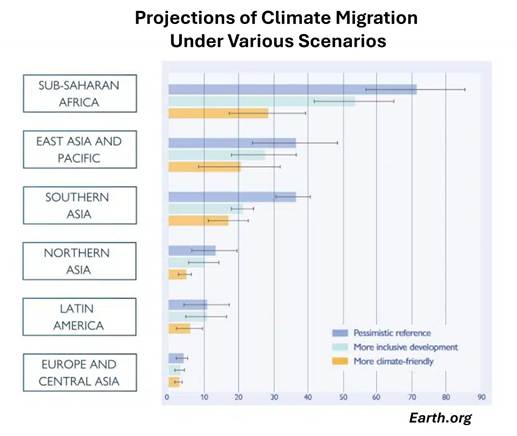
On the other hand, people in better off countries will want to put limits on sharing their own good fortune with others. If demand is virtually unlimited, even the best-intentioned country will eventually draw lines as to how much of their economy they will share with immigrants. As David Frum put it, even before Trump-2, “If liberals won’t control borders, fascists will.”
Moreover, in “receiving” countries, immigrants will remain a potent cultural issue. It’s easy for people like me to dismiss this as “xenophobia,” particularly since they have a racial overtone. For me, immigrants mean a budget analyst from Nigeria or a physician from Egypt or a cleaning lady from Poland. This a different situation from that experienced by close contact with a concentration of immigrants from one place sufficiently large enough to highlight the differences between their culture and more mainstream American culture. A Mexican community in Texas or a Haitian community in Ohio or an Arab community in Michigan should not be automatically alienating. But it is worth acknowledging this is a qualitatively different experience than mine, particularly once it starts to impact the schools.
There is also the economics of the matter. In general, it is pretty well beyond arguing that under current conditions, immigrants are a net contributor to the nation’s economy. Conversely, the kind of mass deportation that the Trumplicans have been implementing is a drag on the overall economy. The problem, however, is that what is true on average is not necessarily true in every particular circumstance. When a community gets a major influx of immigrants, it will experience disproportionate costs addressing the situation. The evidence also suggests that immigration by relatively low skill workers can adversely affect low skill native born workers. (But, as noted above, the very adverse effect on native-born workers, typically lower wages, is seen as a good thing by employers who may be more than willing to turn a blind eye.)
In all events, there will be portions of the electorate who have tangible reasons to be unhappy about immigration.
To further complicate matters, all this is played out in a situation of broader cultural/demographic uncertainty. Shrinking fertility rates are causing population declines among the native born. In recent years, these have been largely offset by immigration. But without immigration, American population will shrink. Historically, declining populations have created all manner of problems. The most immediate is the shifting balance between current workers and the nonworkers, mostly elderly, who need support. Maybe in the future if AI really does reduce the requirement for workers, absolute population size won’t be such a problem. This will create a host of other thorny problems, not least of which will be creating a functional system for connecting AI generated profits with nonworkers–without destroying the social fabric of the society. Demographic tends will continue to roil the conversation around immigration, even if people don’t acknowledge the connection.
Not with a Bang, but a Wimper
In short, I doubt a truly substantial deal is possible. I suspect there will be some deal. At this point, all but the hardcore MAGA want a détente. Anything that rebukes the Trump overt attack on immigration will be welcome, but I suspect what does emerge will leave a lot unresolved. Too much specificity, let alone purity, is impossible on this issue. That might, however, not be the worst thing. In some circumstances, an imperfect deal is better than the alternatives. Maybe a lot better.
**************
Note: This updated post clarifies that the benefits of ambiguity require maintaining consistency in rules around the implicitly agreed upon status quo. I left that out of the earlier version.


