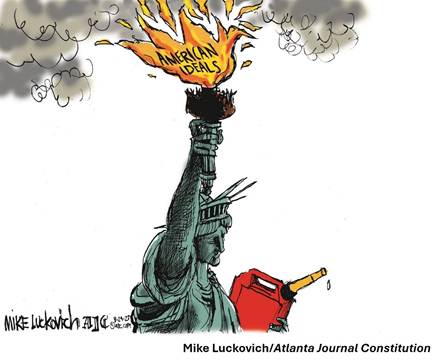
Deterioration in Political Discourse Leads to Deteriorated Thinking

By Mike Koetting July 7, 2026

A recent Pew Center poll found Republicans were much more skeptical of emerging climate problems than Democrats. I wasn’t at all surprised—and I’ll bet you’re not either.

My second thought was to wonder why this should be. After all, if I asked a random sample of Chicagoans whether the White Sox will make the playoffs this year, I would not expect to see a marked difference in response by political parties. And while there are no end of uncertainties, the factual bases for arguments about environmental predictions are much stronger than predicting baseball outcomes. But here we are with political leaning outstripping other considerations.

Wasn’t Always So

In the 1970’s, as we first started to understand the problems we had unleased, the environment was a totally bi-partisan concern. Richard Nixon enthusiastically presided over the creation of the EPA. By 1997, there was starting to be a spread between Democrats and Republicans on core climate issues—whether climate warming was happening and whether it was caused by humans—but it was only a modest 8%. By 2024, that gap had climbed to 35%.

It’s hard to imagine a completely rational explanation for this sea change. It’s not like there has been news of substantially improving conditions.

It is true that the Intergovernmental Panel on Climate Change (IPCC), the UN-sponsored collection of scientists for assessing the climate situation, eliminated the worst scenario that previous projection models had included. But if there is any celebration there, it should be extremely modest. The “worst scenario” was exactly that. It assumed everything went as bad as could possibly be imagined. It was never considered particularly likely and even scientists who were concerned about where we are going have been pointing to its irrelevance for a number of years now. That is not to say, as Donald Trump has claimed, that the “IPCC admitted its own projections were WRONG! WRONG! WRONG!” Rather, in the context of updating model parameters, that are part of all sensible predictions, they acknowledged that not all the bad things that could possibly be imagined were happening. (They also acknowledged that not all the good things they had hoped for happened either.) Their overall conclusion remains quite troubling, and the most likely projected outcome is not far from the most likely outcome in the last model. In short, exactly opposite Trump’s assertion, they argue we are still on a path to a warmer world than can currently be imagined as sustainable.

More specific evidence of problems continues to mount. Icebergs are melting more quickly than predicted, ocean temperatures are rising, and heat waves are killing more and more people. These are measurements, not subjective opinions.

But that information seems less likely to reach Republicans. Take one of the most fundamentally objective measures—the actual temperature. The ten warmest years in the historic record are the last ten years. Only one year prior to 2004 was warmer than the coolest year in the following twenty-one years. There is an indisputable, steady climb in temperatures since 1850 and the rate of warming since 1982 is three times as fast as the previous 130 years.

The majority of Republicans simply deny this. In one 2024 poll, only 43% of people who identified themselves as Republican believed the world’s temperature has been increasing over the last 100 years. This is a decline from 76% of Republicans who in 2006 believed that temperatures were rising, despite the intervening twenty years including the largest rise in temperatures since we’ve been keeping detailed records.

How Does This Happen

The simple answer is the increased nature of tribalism in American politics, both in the general sense and as it specifically relates to environmental issues. On an issue-by-issue basis, there are specific factors that can be identified. In environmental issues, the fact that the non-elite media provide virtually no coverage of environmental issues, the fact that that the major media provide dramatically different coverage by general political leaning, or the fact that more than half of Americans get some or all of their news from social media, which is subject to no meaningful standard of accuracy, all make it easier for Republicans to tout memes removed from reality.

It is also the case that as a business decision, extractive industries have put their support behind the Republican party, Republicans, in turn, have reciprocated by obfuscating or simply denying scientific evidence. Republicans have also contributed significantly to the bottom lines of these companies by supporting policies to enrich them—either directly through various mechanisms or by weakening or eliminating regulations that would impact their business.

It is hard to overstate the role Donald Trump has played in accelerating this tribalism. It is particularly true for environmental issues—his ranting that climate change is a hoax, his open willingness to tailor policies to oil (even coal) for contributions and his relentless attack on instruments of government meant to address environmental issues.

But, as awful as he has been, I think it would be a mistake to blame it all on Trump. These issues are also structural. The increase in tribalism started much earlier. For instance, Republican desertion of climate issues has been a long, continual decline since Reagan removed the solar panels from the White House after defeating Carter. The direction became obvious in the 90’s when Newt Gingrich replaced substantive legislative staff with people devoted to the party and to “messaging”. Parties became national in scope and the cost of running for office virtually required more fealty to the central party brand, which in turn sharpened the divide between the two parties. All this is amplified by the Internet, making each party appear more extreme to their rivals. Leaders find it harder and harder to have discussions on complex issues. Polling suggests strongly that on the fundamentals of most issues, there is typically a core sentiment around some non-extreme solution. It has become too hard to get to that because statesmanship has been abandoned in favor of ever louder attempts to engage the base by demonizing the other side and carefully crafted messages to get a few more swing voters.

Consequences Are Serious

In the realm of environment, the most obvious causality of this retreat from reality is climate action itself. With half the country opposing environmental action as unnecessary, it is virtually impossible to pass legislation that addresses the issue. It’s even worse than that. The issue has become so divisive that Democrats have become reticent to even mention environmental issues, what one advocacy group calls “climate hushing”. There is abundant evidence of widespread concern about environmental issues, even among Republicans. But they don’t want to engage on this concern. As a think tank founded by centrist Democratic strategist Adam Jentleson put it, voters all think it is someone else’s problem, and, correspondingly, anything that impinges on them—or might impinge on them–is anathema. Their advice to candidates is to never mention climate change.

This is deleterious not simply because refusing to address an issue of this magnitude is a dereliction of representative government, but also because discussing issues is an essential part of resolving them. No one—and I mean no one—has a complete answer on this one. Democrats have some specific policy solutions. I have great sympathy for these, particularly as opposed to the corrupt and stupid Republican policies. But the Democratic  policies are incomplete, frequently inconsistent, and typically overstate how much impact their solution will have. In effectively removing one of the greatest crises facing our society from the list of issues we can discuss, we are stoking the locomotive straight to hell. Literally.

Even more fatal, if such an expression is even possible, deciding that facts don’t matter and that honest discussion is impossible completely undercuts the idea of democracy as a way to run a government that will optimize the common good. It is probably true that the electorate has always been inclined toward simplistic answers. But the idea of representative democracy is that those who actually make decisions will foster an Enlightenment approach to problem solving, not throw that over for pandering. If facts, discussion, negotiation and compromise aren’t the basis of our government, then we are little better than primitive tribes yelling insults at each other across a big river.

This is not what the Founders risked lives and fortunes for.

Deflating the Future

By Mike Koetting February 3, 2026

This is the third, and for the moment, final post in my series on how we are failing to prepare the next generation for a fulfilling life. The first two posts focused on broad, but tangible issues, the economy facing young people and the confusion of post-secondary education. Today’s post is about something more diffuse but arguably more important—failing to create a sense of a robust future in young people.

Brief History of the Future

The idea of “the future” is a relatively new idea in history. All the ancient religions had some sense of the magic and mystical beyond day to day, mundane life. And all had a broad notion that fate served some people better than others. To create some degree of protection against the fickle fingers of fate, they conjured rituals and rules. But this was not “future” as we think of it; it was simply the awareness of the random distribution of events from a relatively limited set of possibilities.

Continue reading “Deflating the Future”

The Moment of Truth

By Mike Koetting October 14, 2025

I believe we are approaching a “make-or-break” point for Trump’s authoritarian impulses.

It’s not a question of what he wants to do. That’s clear. In the last several weeks, he has replaced Federal Attorneys until he found one who would pursue an embarrassingly flimsy indictment against one of his enemies, he signed an executive order that raised the possibility almost any kind of dissent could be treated as “treason,” he posted on Truth Social that Democrats are “THE PARTY OF HATE, EVIL, AND SATAN,” and he lectured the leaders of the Armed Services that their mission included fighting the “enemies within”.

His approach to controlling immigration is increasingly inhumane. His masked marauders have grabbed people off the streets with little regard for their situations or actual legal status. Here in Chicago, along with the wanton cruelty and indifference to legality, there has been a major performance element designed to intimidate: armed border guards patrolling the Chicago River, military marches down Michigan Avenue on a Sunday afternoon and ICE agents rappelling from Blackhawk helicopters into apartments filled with sleeping families—separating children from parents and causing total pandemonium. Now Trump is calling for Governor Pritzker and Mayor Johnson to be jailed.

Continue reading “The Moment of Truth”

Old Political Order Fading; Future Is Scary

By Mike Koetting September 3, 2025

David Brooks, taking anguished stock of the depredations of Trump and the Republicans, on PBS NewsHour, wondered why there aren’t more people in the streets. This is a question I have often asked myself. And am not the only one. What Trump and the Republicans are doing is so destructive of the spirit of democracy as to demand vigorous response.

But if the attack on the ideals of America is so fundamental, why aren’t there more people in the streets?

Continue reading “Old Political Order Fading; Future Is Scary”

How Many Deaths for Congressional Republicans?

By Mike Koetting May 13, 2025

In Julius Caesar, Shakespeare writes: “Cowards die many times before their deaths; The valiant never taste of death but once.”

Republicans in Congress are today playing out their own version. By failing to take on any of the winnable small battles, they are slipping toward a situation where the entire foundation of the country could be up for grabs. Most Congressional Republicans understand that Donald Trump is playing fast and loose with the separation of powers—and in the process taking away Congressional power.

Continue reading “How Many Deaths for Congressional Republicans?”

Lots to Blame on Elites….But This Isn’t the Best Case

By Mike Koetting October 30, 2024

A speaker at a University of Chicago event two weeks ago said that the rising level of political polarization is among the elite and not shared by the mass electorate. Just a few days earlier, David Books made a similar, though goofier, argument that the polarization is primarily a function of the “high priests” of the right and left insisting on orthodoxy. Both arguments imply that the voters are mostly innocent bystanders, maybe even victims, and left to their own devices, we wouldn’t have this polarization. While there are elements of truth here, this argument is more wrong than right and masks how difficult it will be to address the sources of our polarization.

Continue reading “Lots to Blame on Elites….But This Isn’t the Best Case”

Causes versus Institutions

By Mike Koetting September 17, 2024

Just before taking off on a short trip with our grandson, I read a review in the Washington Post of a political thriller, Charles McCarry’s Shelley’s Heart, that it described as “unnervingly prescient.” While written 25 years ago, plot elements include a highly contested vote count, renegade Arab terrorists, impeachments and a rogue Supreme Court. Sounded just like the thing for a trip to Washington DC.

It was, as promised, an exciting thriller that I had a hard time putting down. It also turned out to be an interesting meditation on the philosophical orientations toward politics and government, specifically, what is the right balance between strongly-held values and maintaining the institutions of governing?

Continue reading “Causes versus Institutions”

Are the Rule of Law’s Foundations Eroding…Or Being Dismantled?

By Mike Koetting June 18, 2024

Over the last several years, I have realized that “the rule of law” is only secondarily related to laws. It is a lot more inchoate and contingent than anything as concrete as a law. At root, it is nothing more—and nothing less—than a vague agreement among a populace that they are willing to share a common project of governing under some loosely agreed upon rules, even if—indeed, because—there are other values they don’t share. Absent that agreement, no laws or no courts can make democracy work.

I suspect at any given time over the last 150 years, there were a discernible number of citizens who viewed some social error so fundamental that this agreement to govern jointly in toleration should be dissolved. But as long as the number willing to carry on was a substantial majority, the agreement sustained and bumbled on to its next crisis.

Continue reading “Are the Rule of Law’s Foundations Eroding…Or Being Dismantled?”