By Mike Koetting November 5, 2026
Well…that was refreshingly clear.
A very large part of the population said “Stop pissing on my boots and telling me it’s raining.”
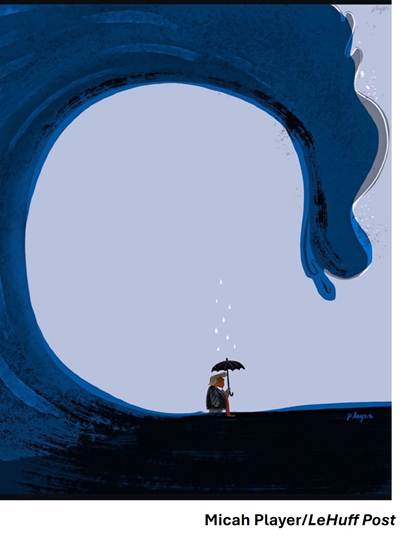
While an excellent development, plenty of uncertainty ahead.
Immediate Aftershocks
It seems to me the most immediate issues for the country sit with the Republicans in Congress. Two things I worry about are Trump re-escalating in Iran and either or both Alioto and Thomsas resigning.
Regardless of whether they have any principles about the war in Iran, Republicans know that played an outsized role in their shellacking. Although I can’t imagine any enthusiasm for expanding it, their options aren’t great. A War Powers resolution that, in theory, would curtail the ability to wage war has already been passed by the House. It would only take a few Republicans to join with the Democrats to pass it in the Senate. Presumably, however, it would be vetoed. Given the election, maybe there would be enough Republicans to override. It’s not like they are seeing any remaining Trump coattails. J.D. Vance, always the alert opportunist, has already blamed GOP losses on the war.
But it would be messy to implement. Moreover, if Congress did override a veto and Trump simply ignored it, it could lead to a serious Constitutional impasse, even before the new Congress is seated.
Another possible avenue is via the need for a continuing resolution to keep government running. The current CR expires December 11. The issues over Defense spending will be salient. Trump has asked for huge increases in the Defense budget, among other things to finance the Iran war. Trump may try to pass these now, knowing they will have no chance in the new Congress. But there was already considerable Republican concern about these budgets, so it will be interesting to see how this plays out.
On the Supreme Court front, while both Alioto and Thomas have said they do not plan to retire, pressure on them to do so will surely increase. While Republicans would be glad to cement a couple youngsters into those seats, they can surely see far enough ahead to understand that if they do it in this manner, it will raise the odds of Supreme Court term limitation to something close to 100%–and possibly even a change in the size of the Court. Of course, both of those might happen anyway, so maybe they would take their shots now and worry about the long term later.
Consideration of these issues along with the election results again raises in my mind the possibility of a Nixon deal. Namely, Republicans promise Trump and his family immunity if he resigns. It is, however, not clear if there is a Republican leader who has the status to pull this off. Mitch McConnell of two years ago could, but not now.
It is also an interesting question as to how Democrats would respond to such a deal. Proposing this deal in my circle of friends has inevitably led to heated discussions. It seems to me this is a much less attractive deal for Democrats than it was last week.
Then What
There is no shortage of people identifying the problems that Democrats face. They are typically described as struggles between Progressive and Moderates. Others discuss how much attention Democrats should give to impeachments and investigations. I would prefer—with a major exception that I’ll get to in a minute—that Democrats focus very heavily on the things people asked them to fix.
As overwhelming as the election results were, Democrats need to remember that this “Blue-nami” benefited greatly from people who two years ago voted for Donald Trump. To point out that they don’t have a clear political philosophy (or indeed any political philosophy) seems almost redundant. Rather, they have needs. It is very hard to see how these voters will care much at all about impeachments and other activities that to them appear simply as politicians arguing among themselves. Focus instead on things that make a direct difference.
One set of investigations that might, however, be useful is looking at the bold face corruption. No one likes corruption. While corruption gets mentioned in some election analyses I’ve seen, I don’t think most give sufficient credit to revulsion at the epic level of Trump’s grift. According to the last CNBC poll before the election, voter concern about government corruption exceeded all other concerns, even high prices. Multiple other polls found very high levels of concern about Trump’s corruption. A Fox News poll showed voters’ top issue was corruption–even more than inflation. Interestingly enough, the narrative surrounding the chart with this finding does not so much as mention the issue.
I am not sure what the Trumplicans were thinking. Did they expect Americans to simply ignore dozens of scandals, each of which would have ended any other presidency? Did they believe Americans were simply too jaded to care? Perhaps they believed that no matter how bad Trump got, Americans’ dislike of woke culture and progressive governance would always make the Republicans the lesser of two evils.
In any event, people noticed and really didn’t like it.
With that in mind, I think it makes sense for the Democrats to keep up a steady stream of investigations into the business dealing of Trump and his family. I agree there is a discouraging amount of willingness to slough this off with “they all do it.” But, for better and worse, Trump is so brazen that the indifference threshold has been pierced. By all means, keep the spotlight on that. Two months before Orban lost his election in Hungary, Anne Appelbaum suggested that the corruption by Orban and his regime was so open, that a large portion of the population was tying it to the erosion of their life situation. It did in Orban and it is doing so to Trump.
In my next post, I will expand on my ideas for where Democrats should focus and what are the obstacles they will have to overcome.
Campaign Expenses
One more immediate comment on the election. Good lord it was expensive.
OpenSecrets, a non-partisan, non-profit which tracks campaign expenditures, estimates that expenses for federal races alone will exceed $12 billion, not including primaries for federal offices or any state and local elections. I am inclined to agree with David Brooks’ assessment that once you get beyond the level of expenditure that introduces the candidate and their perspectives, further expense has rapidly diminishing returns. It is certain that there are many high-profile races where the candidate spending the most money did not win. For instance, both Paxon and Rogers outspent their opponents and lost. Regardless of effectiveness, I believe this degree of election spending is simply wrong, never mind who spent it.
My primary objection is this spending does not improve the lives of citizens. $12 billion would cover one year of SNAP for about 3.75 million people or a year of subsidized housing for 750,000 to 1 million people. If the choice were put to the populace, I would bet the farm that that they would overwhelmingly—like overwhelmingly, overwhelmingly—chose aid over advertising.
Beyond that fundamental issue, the large amount of money going into elections gives the rich a legal way to curry favor with the people running government. It also creates an environment where, to break through the noise, people compete against the other side to shock and disparage, which has the overall effect of souring people on all politics.
I believe one of the things a Democratic Congress should do is move to limit the amount of expenses for elections. McCain-Feingold was a bi-partisan effort. It could be again. I am not sure how to get around a Supreme Court dedicated to making the world safe for absurd levels of political funding, but there must surely be a way to skin that cat. Virtually every other developed country has strict limits on campaign financing. It makes the world better.
On Balance
The country is so much better where we are than where we were. Even if there is still work to do, we should celebrate. At least for the rest of the week.