By Mike Koetting November 17, 2026
I have seen several variants of the idea that Democrats face three major tasks—holding Trump and the Trukmplicans accountable, responding to the needs to fix things and getting themselves ready for the future, most immediately 2028.
I think the Democrats are going to have to think very carefully, and quickly, about how to approach fixing things. They have put themselves in a bit of a trick box because the more they campaigned on fixing things that the American people want fixed, the more they will be judged on their ability to actually fix them. Which is understandable, but glosses over the difficulty of doing so.
Structural Issues
These have been fairly well discussed. Donald Trump will be president for two more years. The appointment of Stephen Miller suggests he will be as truculent as ever. He will presumably veto most things the Democrats want most to do. There will not be enough Democrats to override a veto if the Republicans oppose. While we don’t know for sure, it is likely they will stick with Trump, particularly since the Republicans who remain will generally be those from districts so Red they could survive even this Blue Wave. The election of Jim Jordan as Minority Leader shows they are digging in their heels.
It may be possible to get some concessions around budget issues, Or, Trump, with little left to lose, may be willing to shut down the government indefinitely.
Two years of substantive gridlock seems very possible.
Substantive Issues
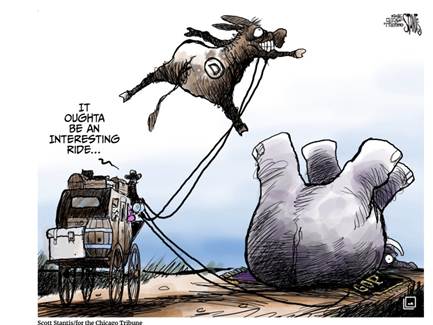
Then there is the issue of what exactly you would put into legislation—and how you would address the subsidiary impacts. Things that sound simple and straightforward on the campaign trail are in reality brutally complicated. Even were it not for the structural issues, I think the Democrats would have trouble with these simply because they are difficult. People acknowledge this difficulty, but I don’t think it gets nearly the discussion it needs.
To be sure, there are some things that are relatively straightforward. I think legislation to prevent some of the most obviously problematic practices—e.g. stricter regulations on stock market activity by members of Congress—would enjoy broad support and might even get into law. It looks like the new Congress is ready to undertake investigations to support such legislation.
There may be issues, however, where progress is impossible, particularly when it comes to making things more affordable. Energy prices, for instance, are a topic of constant focus. It is clear that the war on Iran caused prices to soar. It is much less clear how far, or how quickly, they will drop by achieving some “end” to this war. It will probably be at least a year before they approximate the pre-war price, perhaps longer depending on what it takes to get to that “end.” Factors include the amount of infrastructure damage, the degree to which global reserves have been depleted, and the residual trust in the stability of the market.
Beyond that, there are a whole set of gnarly issues about what we need as an energy policy going forward. Trump’s war on alternative energy sources has put the U.S. on a much slower path to energy stability than the rest of the world. Democrats will have to decide how important immediate reductions in energy prices are in relation to longer term stability. My guess is they will decide in favor of making gas prices lower now, to the extent they can even control. But sooner or later they will have to decide what is their long-term strategy. And “lower energy prices” may be difficult.
Making health care more affordable is another area of potential difficulty. The most immediate problem will be trying to stop the damage from the Republican Budget adopted in 2025, for which many of the most onerous provisions were backloaded until after the midterm. With large majorities, Democrats will try to simply repeal those provisions. I suspect Republicans will opt to uphold veto, although the extent of damage in Red states makes the issue more uncertain. Moreover, unless Democrats pass spending provisions without considering the deficit consequences, it will require changing the tax provisions from that bill. There is no doubt considerable public support for such changes, but it will make Republicans less likely to support
Even something that sounds straightforward, such as ending the tariffs, has complications. Americans oppose the current tariff policies even more strongly than they oppose the war in Iran. Setting aside that Trump would likely veto anything limiting tariffs—or perhaps just ignore new rules as he has existing limitations—Democrats need to keep in mind that tariffs, while an awful policy, are still poised to become between 4% and 5% of federal revenue. Eliminating tariffs without a replacement source of income will add to the deficit. Tolerable in the short run, but sooner or later someone is going to have to take steps to reduce the deficit—or at least keep it from growing.
One could continue with other issues, but Democrats will be sorely challenged to make American life more affordable before the 2028 election.
My Proposals
As many folks have suggested, the Democrats should do two things. For the next two years, pass specific proposals that are relatively self-contained, and, if they are blocked, make it clear who is responsible. Second, make plans for more fundamental changes after 2028 when they can get control of Presidency as well as Congress.
Making sure that Republicans own the problems calls for passing measures that would end war in Iran, curtail the tariffs, repeal the health care provisions and tax cuts of the 2025 Republican budget and crack-down on corruption. There is nothing surprising in this list. The trick will be to make it clear to the American people that if they don’t happen, it is Republicans who are in the way. Again: Republicans. Not Trump. Trump will not be on the ballot in 2028.
There will also be Senate elections again in 2028 with roughly another third of the Senate seats up for election and all of the House seats. This could create a different set of quandaries for Democrats over the next two years if Republicans, contrary to my predictions, try to make some compromises with Democrats to blunt possible retribution in 2028. The issue will be which compromises are enough. (It’s hard to know whether to cheer for a more or less combative GOP.)
Plans for 2028 and beyond are more challenging. Fundamental issues are more difficult and, assuming they win the presidency, Democrats will have full responsibility for setting the agenda.
Most important in my view is a plan for the overall economy. Working on individual subject areas such as health and energy/environment is critical. Social Security is also urgent, as is reimagining America’s place in the world. But all of these need to have a broader view. This is not merely a matter of thinking about the deficit, however important that is, but of tackling the fundamental ways the economy has shifted in the last fifty years. Wages and salaries have now fallen to 43 percent of the nation’s gross domestic income, the lowest since 1929. By contrast, corporate profits have climbed to a record high of 12.4 percent.
These shifts have soured the country and made it ripe for the kind of divisiveness that the Trumplicans have ridden to power. Addressing the fundamentals will require rethinking the tax code—including Social Security, revitalizing anti-trust efforts, and making it easier for workers to unionize. Without a more fundamental reset in the economy, it will be very hard to achieve changes in individual areas both because of insufficient resources and cultural clashes that deflect from the core issues. I think there is broad appetite for this kind of reset, but I worry about getting from here to there.
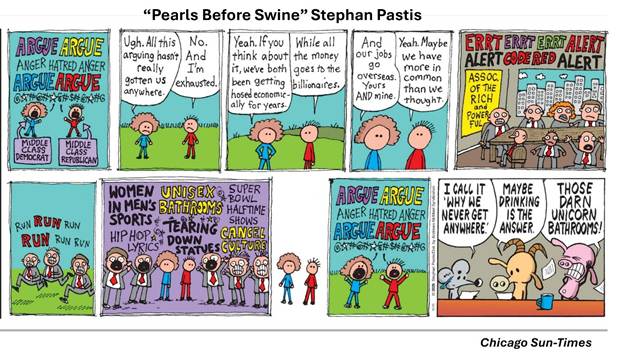
The Democratic outcome two weeks ago was fueled by responding to what people wanted. But a campaign response is different from an implementable policy response. “Medicare for All” is a great campaign slogan. But, Bernie Sanders notwithstanding, it isn’t ready for primetime. It is not simply a matter of working out the details, which are many and very thorny, but it is also a matter of making sure that the society is on board. I think the nation is more ready for some form of universal healthcare than at any time in my life. I also believe it has to be sold carefully. Whatever new system might be adopted will have strengths and weaknesses. There will need to be extensive conversations about those and real attempts to communicate with a broad swath of folks about what they want. On anything as central to people’s lives as healthcare, there will need to be a deep level of public acceptance of the specifics.
The same is true for most of the other basic issues.
Somehow, the Democrats will have to make sure the discussion goes beyond “affordability” to include “fairness”. This is not to deny the importance of affordability. And from a political standpoint anything that smells of “bait and switch” will be toxic. But the factors that made America unaffordable for so many cannot be changed in two years and may even require more than six years. And they cannot be changed unless there is a broad mandate.
I believe the election of two weeks ago could be a mandate for fundamental change. What remains to be answered is whether the voters will have the patience to make those changes. The Democrat’s won because people wanted immediate answers for immediate problems. To maintain voter support, the Democrats will have to show a clear road map for where they want to go, including interim steps, and aggressively communicate, including listening, with the American people. If they assume the election result gave them a blank check, they will squander the chance to point America in a new direction.