Mike Koetting October 13, 2036
I recently ran across an article that argued that the United States had far too many premature deaths. The article called it a crisis. This echoed an article from a couple years ago by Matt Yglesias that America’s shorter life expectancy should be a priority because, as he put it, “Dying is bad.”
Whether it’s a crisis or not, it is clear that life expectancies in the U.S. lag behind those of other developed countries and, over time, seem to be falling further behind. In 1980, the U.S. had the 14th highest average life span of countries with populations above 1 million. It has slipped steadily since then, now ranking 38th among countries with more than 1 million people.
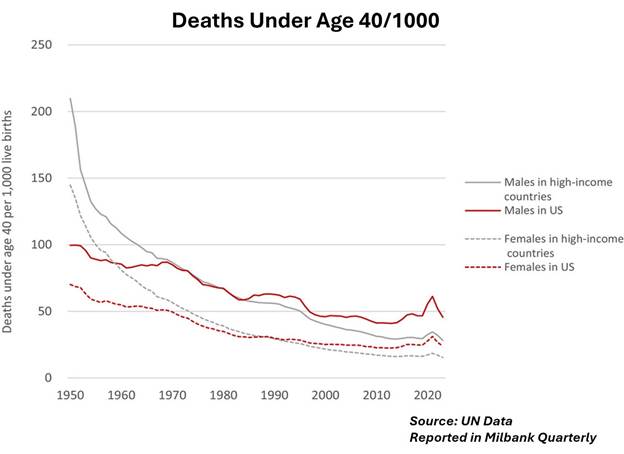
For the most part, life expectancy in the U.S. has continued to increase over this period, just not as fast as the rest of the developed world. The aggregate differences are not large—U.S. average life expectancy was about 79 whereas, say, European countries were typically two to four years higher. The differences between an average life expectancy of 79 and 82 may not seem like a critical difference in the course of long lives. But these numbers disguise what’s going on. In fact, longevity at older ages has generally improved in relation to other countries. The difference in the overall rates arises from higher mortality among young and middle-age people–people who could be expected to live longer and whose shorter lives make a difference.
The following chart compares projected mortality rates before the age of 40 in the US versus an average of high-income countries.
So what’s going on? Why should a country that prides itself on its technology leadership and leads the world in per-capita health expenditures by a ridiculous margin have mediocre longevity?
We can get better understanding by looking at specific age groups.
Infant Mortality
One of the starker differences is at the beginning of life. Infant mortality in the U.S. is just under 5 per 1000. In other words, about five out of every 1000 babies born in the U.S. die before age one. There have been efforts in this area and the mortality rate has continued to fall over time. But in the high-income countries in Europe, infant mortality rates cluster between 2.5 and 3.5. Thus, there are about 2 more U.S. infant deaths per year in every thousand babies than if we had the same rate as these countries.
Youth (1-24)
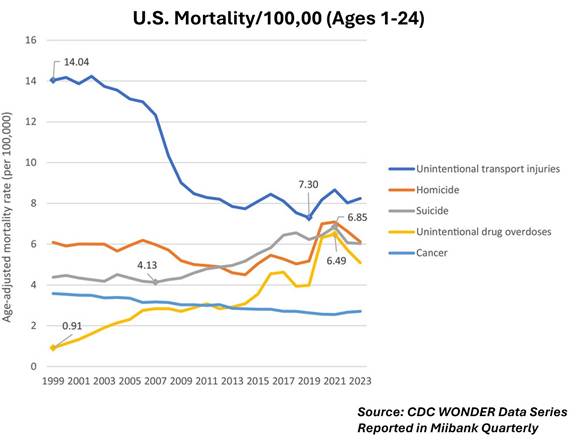
Motor vehicle deaths were cut almost in half between 1999 and 2014 and have remained relatively stable since then. But from 2014 to 2023, all-cause mortality rates for youths increased sharply, primarily as a result of a dramatic increase in drug overdoses, along with a more than 33% increase in the suicide rate. Note, in the chart below, mortality from childhood cancer continues to fall. This is typical of what is happening among traditional pediatric killers.
Young Adults (25-44)
The biggest increases in mortality were among young adults; between 1999 and 2023, aggregate rates of mortality in this group increased by more than 40%. They were driven by a seven-fold increase in drug overdoses, which became by far the most common cause of death in this age range. Suicides and homicides are other large causes. Motor vehicle deaths, which declined precipitously between 2000 and 2014, trended up again. It seems possible this increase in motor-related deaths is related to the same factors driving increase in suicide, drug and alcohol rated deaths. Cardiometabolic conditions—which can include obesity, heart disease, and diabetes—also contribute but are not as large as above causes.
Middle Age (45-65)
Mortality in this age range was a mixed bag. The rate of cancer deaths has dropped by more than one-third. If nothing else were going on, this would have bent the life expectancy curve upward. But there was a lot going on. Heart-related mortality was dropping until about 2012, at which point an increase in hypertensive diseases overwhelmed decreases in ischemic heart diseases. Drug overdose deaths in this period jumped by 900% and by 2023 were the third largest cause of deaths in this age group. Death from metabolic and endocrine diseases (frequently related to obesity) experienced a 50% jump. Alcohol related deaths, though less frequent, increased by 60%.
What to Do: Amelioration Obvious; Solutions Less So
The most immediate response to the lower life expectancy in the U.S. is that we don’t have universal health care—like all the other countries with better life expectancy.
That is certainly a big part of the problem. Numerous studies have shown that with better Medicaid, with ACA coverage, health status and mortality improve. Conversely, we know that states with the most stingy coverage have higher mortality rates, although the correlation is not perfect.
Over my career, I have spent a lot of time thinking about the connection between coverage and outcome. The coverage that seems to make the most difference is not the explicit coverage for specific health issues. If people experience serious health problems and they show up in hospitals, they typically get treated. I think—which is not the same as having data; someone should think of a clever way to study this—the problem arises because people whose health care is dependent on the vagaries of government don’t think of health care as an ongoing process, but as an episodic event when unavoidable needs arise. This is not conducive to good health.
To be sure, the problem cannot be solved by universal health care alone. People with less income tend to have more chaotic lives and, accordingly, higher mortality. This is true in countries with universal health care as well as the U.S. The difference is the resulting U.S. mortality for poor people, especially Blacks, is markedly higher than for poor people in countries with universal health care.
Of course, mortality seems only partially related to availability of health care per se. For instance, other high income countries spend about $1.70 in social services for every dollar spent on health care. The comparable U.S. number is $.56.
Looking over recent changes is U.S. mortality, it is clear that increasing deaths from drug overdoses are a major contributor to lower life expectancy. They are shockingly greater in the US than in other counties.
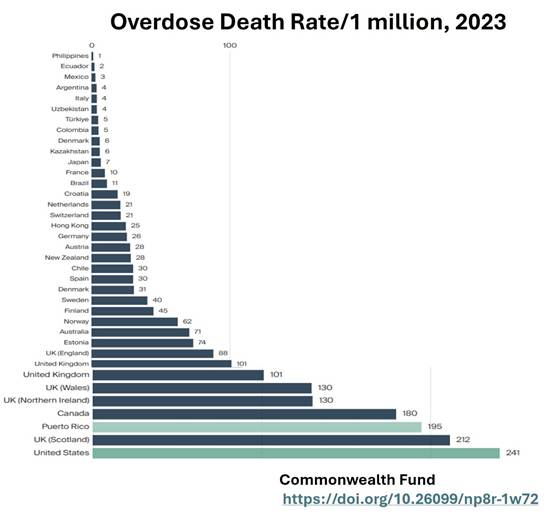
To the extent universal health care would lead to earlier intervention or more comprehensive drug treatment, it could be a factor. But it is probable other factors are at work. Same may be true for suicides—where the U.S. has about 20% more than the other advanced economies. Homicides are mostly outside what conventional health care can do, but they are a big cause of life expectancy differences. The American homicide rate is four or five times as high as the European societies.
Beyond these, it’s a bit hard to see what’s going on. Cancer death rates in the U.S. compare favorably with other countries. And while obesity rates and hypertension mortality rates in the U.S. have been growing, they are not that different from those in other rich countries. Still, the mortality rate in the U.S. remains higher than these other countries
No easy answers. Note also, mortality rates in high income groups in the U.S. are higher than mortality rates among higher income groups in Europe. This is not likely due to differences in universal coverage.
In Short
As can be seen in this sometimes dizzyingly tour through statistics, there is no clear answer to resolving the American life expectancy shortfall. It stems from a number of loosely related issues, some of which have obvious answers and some of which don’t.
It is clear one of the biggest things America could do to address differences in life expectancy is get its drug problem under control. While America has had steep declines in overdose related mortality in the last several years, it is still a significant differentiator between the U.S. and other advanced economies. Unfortunately, identifying this as the biggest issue doesn’t offer much direction on how to accomplish that.
Adopting universal health care is a no-brainer if a country is really interested in the health of its population. The resistance of the U.S. to this is an impressive testimony to the power of established interests to overcome overwhelming rational arguments in favor—better health, lower costs, and reduced human suffering.
Two things the U.S. should not do is cut back on health research and on public health measures, both of which the Trump administration keeps trying to do.
The bright spots in national life span, such as the major decrease in age-adjusted cancer deaths, have been from the successful application of research. Additionally, there have been major improvements in quality of life stemming from recent scientific advances. But, last year, OMB proposed a 40% reduction in funding for the NIH, which received pushback even from Republicans. On top of that, there has been repeated and significant meddling in the process of making grants, resulting in impairment in the ability to do research. One of the particular focal points for the administration is any research that might have “policy implications.” This is nuts. Many of the greatest health achievements of the past century—including reductions in smoking, improvements in motor vehicle safety, cleaner air and water, and control of infectious diseases—depended on research concerning the design, implementation, and effects of laws, regulations, and other policy interventions.
Cutting back on direct public health expenditures is likely to further increase the mortality gap between America and other advanced economies. The absurd assault on vaccinations is the poster child, with growing outbreaks of infectious diseases all around the country. Withdrawing support from the promotion of flu vaccinations will cause more preventable deaths—and a bunch more unpleasantness that might have been avoided. What other outcome could be expected is a mystery.
On balance, what would reduce the mortality gap between the U.S. and other countries is clear, but we are unable or unwilling to pursue it. Why won’t this country protect its citizens as well as other advanced countries do?

