Donald Trump Is an Act of Desperation

By Mike Koetting March 17, 2026

It’s hardly a newsflash that Donald Trump is so singularly focused on his own interests that anything, or anyone, outside those exists only as a potential obstacle.

This is not normal. I can think of no religion or system of philosophy that doesn’t recognize that humans have something in common, have some universal decency and have certain responsibilities to one another. Donald Trump reflects not a shred of these. He over and over reminds us his world is irreconcilably divided between people who are of use to him and people who are “trash.”
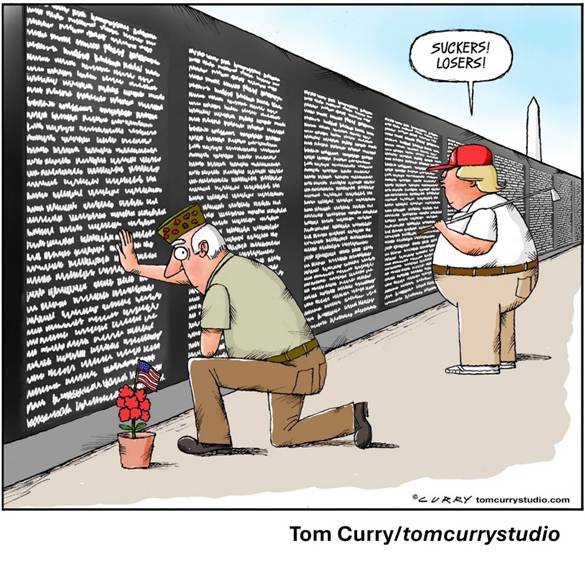
At no point in the history of this country has a man so devoid of common decency—or at least so unwilling to even pretend– been elected to the presidency. Maybe it’s worth spending a minute or so thinking about what it tells us about our society.

I reject the idea that there has always been this great, brooding indifference to humanity lurking specifically in our society. I readily acknowledge that Americans have often in the past defined the category of “fellow human” more narrowly than we do today. But this is true of virtually the entire world. I know of no historical record that reflects a society that sprang into existence with a fully extensive notion of who is indeed a fellow human, and, accordingly, demanded some basic respect. Everywhere this has been a gradual evolution. At some points the US led this struggle, at other times was kicking and screaming to avoid such an expansion. But the complete rejection of the idea of a larger human community is an aberration. Period.

So why have so many people come to accept this behavior from the President of the United States?

My own thinking is that it is a desperate response to both the steady loss of personal agency, primarily due to corporate elites, and to the thinning out of social threads that hold people together. This combination of anger and alienation leads people to lash out on an emotional basis, unrelated to any values or policy.

Loss of Personal Agency

Our lives can be viewed through multiple lenses but perhaps the most pervasive is the economic structures of our day-to-day lives. When we find the economy working for us, life seems manageable. But when that turns every day into a struggle, all the other things in our life are impacted. Riffing a bit off a blog by Dick Dowdell, the underlying machinery of our society has changed over the last fifty years. Three key elements in particular have changed in adverse ways—the richest (and their corporations) exercise more power in individual lives by significantly increasing their role in political life; opportunities for meaningful economic and social mobility have diminished; and individual economic life has become less secure. Whether or not people would articulate these concerns in the same way, a large portion of the society feels the room closing in.

Twelve years ago, political scientists showed empirically what most people feel intuitively: the affluent wield outsize power in determining political outcomes. Citizens United actually went so far as to make this a principle and there is every reason to believe their sway has gotten more powerful since. It is less which party rules and much more that the wealthy are able to maintain the fundamental rule that whatever happens, the rich keep reaping a bigger share.

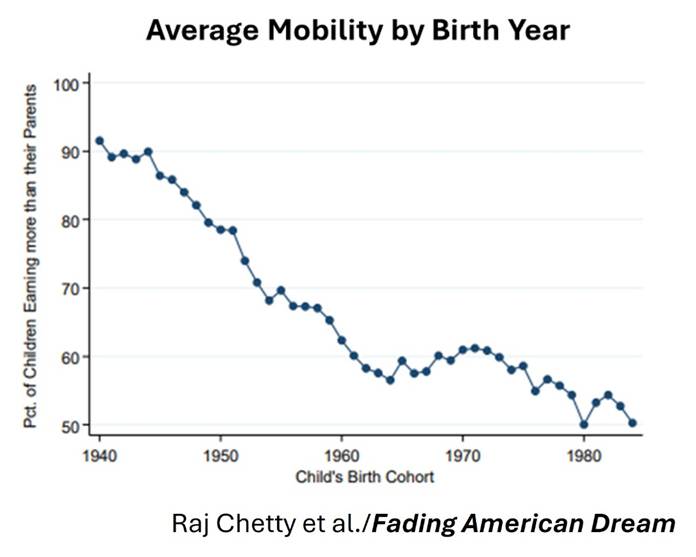
Again, there has been considerable academic work showing that in the middle of the last century, economic mobility was common. As the century went on, mobility declined. Now it’s a coin flip as to whether you will do as well financially as your parents and, insult to injury, the odds are greater that you will if you start relatively affluent. And, in some sense, the issue is even more blunt than whether you make more or less than your parents; the issue is whether you can afford to have your own home
Underlying economic security is similar. If you feel you’re only one accident away from the whole game spinning out of control, you’re much less inclined to think that the existing political order is worth endorsing. Here again, academics provide documentation that when economic uncertainty overwhelms, political values erode. As the authors of one study put it:

When respondents were financially secure, support for liberal democratic principles increased. When respondents were economically disadvantaged, they became more tolerant of illiberal conditions, including biased media, weakened checks on leaders and unequal treatment under the law.

As all three of the conditions referenced above—elite control of public life, lack of social mobility and persistent economic insecurity—became worse over many years, those most impacted stop trusting mainstream parties because things keep getting worse regardless of which is in charge. People intuitively understand that these trends are a result of policy choices that could have been made differently, indeed, used to be made differently. Republicans have done more to impact these dynamics but Democrats have contributed—and certainly failed to prevent them. Should we be surprised, then, if people are willing to take a chance on anyone who looks like he will break the existing consensus, particularly if he reflects their own sense of grievance.

Weakening the Ties that Bind

These concerns are even greater when paired with the overall weakening of the social ties that should hold a society together.

America has never been a cohesive social whole because, unlike many other countries that grew organically over a long period of time, it was an “assembled” country with pieces from all over. But, generally, there have been various veins of coherence that made it possible for people to see their common elements, or at least to find a way to work together. The last fifty years have been hard on that.

Part of what has happened is in fact the broadening of who deserves to get full respect as a human. This is a good and necessary thing. But like any other major change, it produces secondary effects. The assaults by those who make profit from stoking division, which includes Donald Trump, are designed specifically to narrow the bonds among people, to draw lines between some group and the “unworthies.”  Hate can be used to generate money and profits.

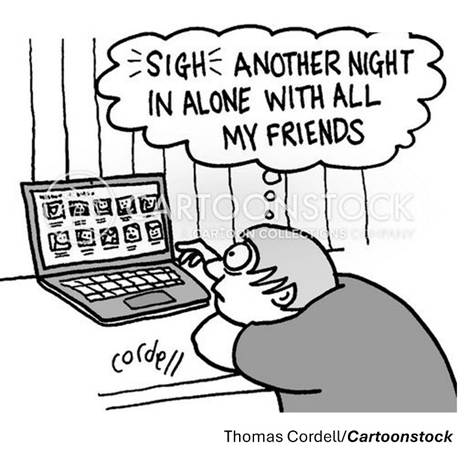
The declining communal nature of our lives makes these divisions easier. The metaphor of Robert Putnam’s book, Bowling Alone, remains powerful—there has been a retreat from activities that bring people together. From civic organizations to bowling leagues, people do fewer things with other people. And this retreat from communal action  has gotten worse in the 25 years since Putnam’s book. The decline in church and unions—organizations with specific communal values—has been particularly steep. Also, this disconnectedness affects the working class more significantly.
These Get Us a Psychopath

The growing anger at the powerless of daily life and the loss of personal connection to the  broader society deadens people sensitivities to what seem like the most basic requirement to be president of the United States—to be a discernibly normal human being.

For some Trump voters, Trump’s indifference to the norms of the broader society was a positive attraction. But I believe these were the minority. More Trump voters were aware of this and accepted it as a downside of his opposition to Democrats–economically, cultural, or both. With various degrees of awareness, they hoped that his pathologies would not go so far as to completely upset the apple cart. Another large group was people who are disappointed at their lives and Donald Trump was apparently offering quick fixes. At the very least he seemed to reflect their visceral sense that something was robbing them. Whether he had correctly identified the people responsible, let alone whether he had either the requisite psychological underpinnings or motivation to successfully change America in their favor, didn’t seem important.

Only the first group got what they bargained for. Oops.

The Moment of Truth

By Mike Koetting October 14, 2025

I believe we are approaching a “make-or-break” point for Trump’s authoritarian impulses.

It’s not a question of what he wants to do. That’s clear. In the last several weeks, he has replaced Federal Attorneys until he found one who would pursue an embarrassingly flimsy indictment against one of his enemies, he signed an executive order that raised the possibility almost any kind of dissent could be treated as “treason,” he posted on Truth Social that Democrats are “THE PARTY OF HATE, EVIL, AND SATAN,” and he lectured the leaders of the Armed Services that their mission included fighting the “enemies within”.

His approach to controlling immigration is increasingly inhumane. His masked marauders have grabbed people off the streets with little regard for their situations or actual legal status. Here in Chicago, along with the wanton cruelty and indifference to legality, there has been a major performance element designed to intimidate: armed border guards patrolling the Chicago River, military marches down Michigan Avenue on a Sunday afternoon and ICE agents rappelling from Blackhawk helicopters into apartments filled with sleeping families—separating children from parents and causing total pandemonium. Now Trump is calling for Governor Pritzker and Mayor Johnson to be jailed.

Continue reading “The Moment of Truth”

Republican Organization Is (Mostly) an Illusion

By Mike Koetting June 10, 2025

How many times have you heard someone say: “Democrats need to get organized like Republicans.” I don’t have any problem with the idea of getting organized. What I find problematic is the idea that the Republicans have some magic template. For the most part, they are as disorganized as Democrats. They have simply hitched their wagons to one of the world’s most accomplished grifters and let him drag them wherever he wants to go. This simplifies organization enormously. To be sure, Trump has accommodated them by making various nods in the directions of long-time Republican goals. But it is erratic, inconsistent, and can be seen as part of an organized plan only through a peculiar lens. See below about Project 2025.

Continue reading “Republican Organization Is (Mostly) an Illusion”

How Many Deaths for Congressional Republicans?

By Mike Koetting May 13, 2025

In Julius Caesar, Shakespeare writes: “Cowards die many times before their deaths; The valiant never taste of death but once.”

Republicans in Congress are today playing out their own version. By failing to take on any of the winnable small battles, they are slipping toward a situation where the entire foundation of the country could be up for grabs. Most Congressional Republicans understand that Donald Trump is playing fast and loose with the separation of powers—and in the process taking away Congressional power.

Continue reading “How Many Deaths for Congressional Republicans?”

Inequality Is Giving Money to Rich People

Mike Koetting                April 22, 2025

Many Americans are white-hot angry at their situation in life. More and more families are having a difficult time making ends meet. The sense that they are no longer fully participating in the promised life can be found everywhere. Two-thirds of middle-class families say they are struggling financially.

It shouldn’t come as a surprise that many families are feeling short-changed since the richest Americans are increasing their share of wealth at the expense of everyone else. This is primarily a result of deliberate policy decisions. The surprise is that so many of the people feeling short-changed voted for an agenda promising more of the same.

In 2023, the total share of income earned by the bottom 90% of workers was less than 50%. In other words, the bottom 90% altogether made less than the top 10%. There is nothing inevitable about such a distribution. Most countries with American standards of living have more equal income distributions. In fact, America used to have a more equal distribution.

Continue reading “Inequality Is Giving Money to Rich People”

What Are the Republicans Thinking?

By Mike Koetting            March 4, 2025

Twice before in my life, I experienced a sensation that our basic political system was in mortal danger. Once in 1970 on the day protestors were killed at Kent State and three years later when Richard Nixon precipitated the Saturday Night Massacre. In both cases, however, the sensation only lasted for a few hours. I found I had a deep-seated conviction that the series of checks and balances would work, even if a bit wobbly for a time.

Today I am finding that confidence waning.

Throughout our history, our system has worked because powerful individuals were willing to be constrained by institutions, by the system of checks and balances that provide some assurance that a small number of individuals can’t ride roughshod over the rest.

It isn’t as if these powerful individuals were all particularly virtuous—some were and others not so much. It was more that they operated in an environment of a shared understanding that if you wrecked the system, what came next would be worse. Democracy is what allows people with differences to work together over time.

So, although there have always been individuals who would have thrown over the institution, other than the Civil War, the broader ethic prevailed. Those who would have done way with these checks and balances have been restrained. A year after the Saturday Night Massacre, a group of Republican Senators told Nixon that he would be impeached if he did not resign.

What is different about today is not so much that Donald Trump would throw over the institutions, but that there are so many people who are willing to let him do so even though they know better.

Many citizens are so deeply alienated by the current moment and feel so powerless they don’t worry about Constitutional considerations. I am disappointed, but I understand.

However, I cannot fathom what is going through the minds of various Republican Representatives and Senators. What is their rationale for allowing Donald Trump so much leeway? It is implausible that they don’t understand they are destroying the checks and balances that have been fundamental to America for 250 years. Do they really believe that putting all the power in the President is a good idea? And while they may be happy that Trump will accomplish some things that they want and whack away at some things they oppose, do they really believe this is a sustainable model for running a country?

Continue reading “What Are the Republicans Thinking?”

Reality Can’t Get to the Table

By Mike Koetting October 10, 2024

Twenty years ago, we were all a twitter about a George Bush adviser deriding “reality- based media.” He may get the last laugh. We in the reality-based world are still struggling. Close to half the electorate is committed to various fables. The delusionary nature of that bubble is clear to those on the outside. But, in the short run, a large part of the nation seems wedded to this cartoon version of the world.

There are plenty of legitimate differences between Harris and traditional Republican positions that should be open for debate. But Trump has simply turned his back on reality-based discussion and, in the process, opened a whole lot of territory in which people can find all kinds of responses and reasons to believe. It also makes it easier for the truly extreme to feel they are licensed.

Continue reading “Reality Can’t Get to the Table”

Vance Is Misleading the Hillbillies

By Mike Koetting October 1, 2024

My wife regularly reads Heather Cox Richardson’s newsletter and from time to time reads potentially interesting passages to me. The other morning I almost got whiplash doing a double take at something JD Vance said a few years ago:

American history is a constant war between Northern Yankees and Southern Bourbons, where whichever side the hillbillies are on, wins. And that’s kind of how I think about American politics today, is like, the Northern Yankees are now the hyper-woke, coastal elites. The Southern Bourbons are sort of the same old-school Southern folks that have been around and influential in this country for 200 years. And it’s like the hillbillies have really started to migrate towards the Southern Bourbons instead of the Northern woke people. That’s just a fundamental thing that’s happening in American politics.

My first reaction was stunned amazement. Was he suggesting, for instance, that it would have been okay if the South had won the Civil War? On second thought, I was struck with how flaccid an explanation he was offering for the “fundamental thing that’s happening in American politics.”

Continue reading “Vance Is Misleading the Hillbillies”

Causes versus Institutions

By Mike Koetting September 17, 2024

Just before taking off on a short trip with our grandson, I read a review in the Washington Post of a political thriller, Charles McCarry’s Shelley’s Heart, that it described as “unnervingly prescient.” While written 25 years ago, plot elements include a highly contested vote count, renegade Arab terrorists, impeachments and a rogue Supreme Court. Sounded just like the thing for a trip to Washington DC.

It was, as promised, an exciting thriller that I had a hard time putting down. It also turned out to be an interesting meditation on the philosophical orientations toward politics and government, specifically, what is the right balance between strongly-held values and maintaining the institutions of governing?

Continue reading “Causes versus Institutions”

Are the Rule of Law’s Foundations Eroding…Or Being Dismantled?

By Mike Koetting June 18, 2024

Over the last several years, I have realized that “the rule of law” is only secondarily related to laws. It is a lot more inchoate and contingent than anything as concrete as a law. At root, it is nothing more—and nothing less—than a vague agreement among a populace that they are willing to share a common project of governing under some loosely agreed upon rules, even if—indeed, because—there are other values they don’t share. Absent that agreement, no laws or no courts can make democracy work.

I suspect at any given time over the last 150 years, there were a discernible number of citizens who viewed some social error so fundamental that this agreement to govern jointly in toleration should be dissolved. But as long as the number willing to carry on was a substantial majority, the agreement sustained and bumbled on to its next crisis.

Continue reading “Are the Rule of Law’s Foundations Eroding…Or Being Dismantled?”