By Mike Koetting October 10, 2024
Twenty years ago, we were all a twitter about a George Bush adviser deriding “reality- based media.” He may get the last laugh. We in the reality-based world are still struggling. Close to half the electorate is committed to various fables. The delusionary nature of that bubble is clear to those on the outside. But, in the short run, a large part of the nation seems wedded to this cartoon version of the world.
There are plenty of legitimate differences between Harris and traditional Republican positions that should be open for debate. But Trump has simply turned his back on reality-based discussion and, in the process, opened a whole lot of territory in which people can find all kinds of responses and reasons to believe. It also makes it easier for the truly extreme to feel they are licensed.
Most of the people who are seriously lost in Trumplican fantasies are people who were inclined in that direction anyway, so it’s not like many people who were planning on backing Harris changed their mind because of Trump’s endless litany of foolish trash. Perhaps some people who wouldn’t otherwise vote might be attracted to cast a vote for Donald Trump either because he is extreme enough to attract their vote or because he appears to offer a kind of security and certainty well beyond what any politician with the vaguest grip on reality could promise. If that were to move enough people in certain states, it may be enough to elect a president. (Rick Perlstein’s article on “the uncommitted” is particularly insightful in pointing out the undecided have nothing to do with issues as we think about them.)

The Real Damage
I believe the more general issue is that since Donald Trump—enabled by spineless Republican leadership—has kept the campaign away from the realm of reality, it becomes impossible to have meaningful exchanges on the issues that as a society we really need to address.
Take the issue of immigration. Trump and Vance have made this a keystone of their campaign, but what is the issue they are actually putting in front of the American people? It can hardly be a question of whether or not to have completely open borders. Virtually no one supports that position, and certainly not Harris. But by constantly claiming that Democrats favor “open borders” this non-reality-based claim continues to the focus of discussion—along, of course, with the absolutely crucial issue of whether the Haitians in Springfield, Ohio are eating pets.
Even JD Vance’s admission that he might have exaggerated that story to dramatize “the suffering of the American people” from immigration is unimpressive. What exactly is this suffering? He has variously mentioned increased social service costs, growing school enrollments and crowded medical facilities. In truth, these can be inconveniences. And the inconveniences fall greater on those who already have their own problems. But “suffering” of the American people? On balance, most Americans don’t think of themselves as “suffering” from immigrants. (The people of Springfield, Ohio certainly don’t.) If you want to think about suffering, imagine Venezuela.

My point here is not simply that Trumplican claims are fantasy. Of course they are, but the significant damage stems from the fact they are jamming our real political channels with this stuff. Immigration is one of a number of important but difficult issues where the answers aren’t clear—either substantively or in terms of how we get consensus for national policy. We really need forums where we can have thoughtful discussion with lots of sensible input if we want remotely stable and democratic solutions.
Consider some of the questions that should be at the heart of discussion about immigration.
Consider some of the questions that should be at the heart of discussion about immigration.
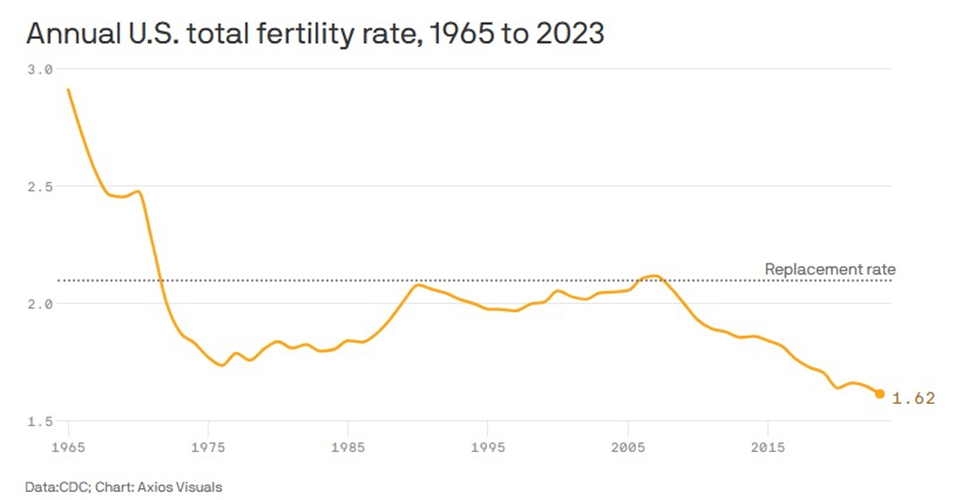
What is the demographic future of the country? The US, like most of the developed world, is not replacing its population. Since about 1970, it has only experienced a few years where the fertility rate was above replacement level. This has tilted the make up of the population considerably older, which will eventually cause serious economic problems. The Trumplican approach is to force women to carry more children. This sort of works. Fertility rates are up 2.3% in states that have taken a hard line of abortions. But support for this approach is extremely limited.
What is our role in addressing the root causes of immigration? Improving border security may reduce the number of immigrants coming into the country illegally, although it won’t reduce it to zero and, in any event, at least half the unauthorized immigrants don’t arrive across the border. People will still come. For most it will be for the same reasons our ancestors came–to find a better life. Which, by the way, is what made America great in the first place. But there are also some really bad governments driving people out (25% of Venezuela’s population has fled, Nicaragua is a repressive state and Haiti is an ungoverned mess.) There are huge environmental problems (Over the last several years there have been frequent, prolonged and extreme droughts in Latin and Central America. In many regions farmers have been brought to their knees). The policy questions that really deserve discussion is how the U.S. wants to respond to these humanitarian crises. This is both an ethical discussion and a practical discussion because sooner or later these issues come back to affect us. It is also not an issue limited to America, which needs to become another element of the discussion.
What to do with the immigrants already here? Trump’s claiming he would organize mass deportations is another example of fantasy blocking the discussion we need to have. This is not a real option. It is absurdly unfair and would create economic and social chaos. In fact, the majority of Americans want a more thoughtful solution. Congress has come close to bipartisan resolution of this issue several times, but each has been stymied by Trump and a hard-core group who would prefer the fantasy of a “pure” America over a realistic solution.
It’s Not the Arguments Themselves
The point here is not that the Trumplicans have no reality-oriented policy on immigration. That is true, but the underlying point I’m trying to make is that by throwing so much nonsense into the discussion, they make it impossible to have any one of many discussions that Americans need to have. On most of these issues—from AI to climate change to Gaza to housing to economic policy to immigration—the answers are not at all obvious. I could make a similar list of questions that need thoughtful discussion for each of the above. And even if some people can come up with workable answers, we need mechanisms for building the political will to turn proposals intelligent enough to make a real difference into real policies. This is what government needs to be about. Answers will not come from shouting campaign slogans at each other.
It has always been true that campaigns don’t produce policy. In the past, there were always real leaders who knew this and behaved accordingly. But the Trumplicans have reduced our political discourse to such baby-babble that there is not even space for adults behind the scenes to cobble together policy that more or less reflects the real world. Even if the ideas Harris or others put forth are good ideas, they would probably be improved by broad and open discussion. More fundamentally, however, there is little chance we can turn policy proposals into real policy without national dialogue that can accept compromise and nuance. When half of the country is beholden to political leadership unwilling to challenge a total fantasy land, the kind of meaningful discussion that allows a country to successfully address even the most crucial issues can’t happen.
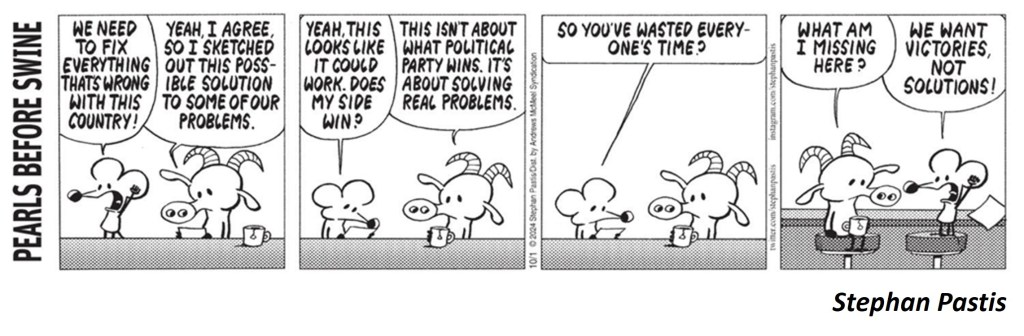
In the end, reality inevitably wins. But there is no one reality; the future is a range of possible realities. A finite range, however. The are real world limitations on the range of possibilities. If we are smart, we can impact the nature of the reality that emerges. But we are letting the opportunities to have thoughtful discussions slip away because the Trumplicans have highjacked the airwaves. Without those discussions, we are limited in how much we can affect the future and how much we are letting circumstances and hidden actors decide. My anger is less at Trump. He’s just doing what a narcissistic wannabe autocrat does. I am, however, furious with the leaders of the Republican Party who have failed to be adults facing the reality of our world. By letting Trump utterly debase our political discussion, they are frittering away our chances to make decisions that could be most beneficial to the entire country. We are all going to be cleaning up this mess for a long time, if we haven’t already forfeited too many chances.


