By Mike Koetting March 3, 2026
It’s a well-known legal adage that hard cases make bad law. The current situation of Iran is a classic case.
The existing regime in Iran is a bad actor. Very bad. They are a menace to their own people—never on fuller display than killing thousands of Iranians in the last few weeks—and are a major destabilizing force in the Middle East. It is hard to imagine the world wouldn’t be improved by their removal from power.
On the other side of the equation is the idea that one country should not interfere in the affairs of another country. This idea has much more currency if there is evidence that the affairs of the country reflect some version of the common will. The evidence in Iran runs counter.
So how should we feel about the intervention in Iran?
My answer: potentially favorable consequences aside, this is a bad thing.
In Undermines the Rule of Law
Again, it’s not like the Ayatollah and his henchmen are contributing to the maintenance of a more just society. No person with a broad definition of human freedoms would lament their removal.
But we are weighing crummy options here: intervene or let the current regime run roughshod over its population in addition to causing trouble elsewhere. While international law is strictly against overthrowing governments of other countries, no society should be allowed to exist in a moral vacuum. Some actions are so repellent they should be stopped. On the other hand, a society should be extraordinarily careful about intervening in another country. The argument against intervention is not one of moral indifference, but the practical consideration of the longer-term implications. It is much easier to start wars than end them.
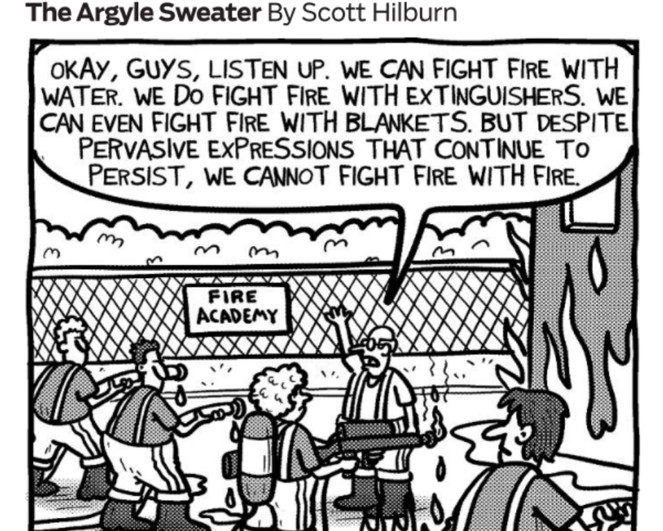
Restraining interventions in other countries supports the principle that one country does not get to decide what happens in other countries simply because it has a stronger military. Denying this principle leads to an escalation of military over diplomatic solutions–to the detriment of all.
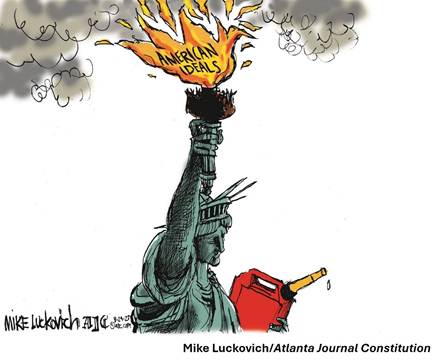
Stephen Miller’s assertion that we “live in a world…that is governed by strength, that is governed by force, that is governed by power” is a prelude to things spiraling out of control. As an empirical matter, he has a point. But that is also the crux of the problem. When a society has huge force and moral certainty, it eventually makes bad decisions for itself and others. This is true even in the presence of general moral benevolence. Despite having been a largely, and important, force for good in the world during the Twentieth Century, the United States made big mistakes when it felt empowered to enforce its will in other countries, Vietnam being the largest, but by no means the only one.
Either way, mistakes will happen. But the default option should be to keep the hell out of other people’s affairs as long as you can, even if keeping a wary eye on them.
Which raises another point. Trump flamboyantly walked away from the nuclear treaty negotiated by President Obama. This was an imperfect deal. Among other things, Iran continued to be a major source of conventional trouble throughout the region. But it was a deal and left open the opportunities for other deals and discussions. When Trump makes it clear that he doesn’t value deals but lives in a “my way or nothing” world, it undermines any notion that a less adversarial approach to relationships is possible. In that context, how surprising is it that negotiations with Iran weren’t going well.
Finally, turning to the domestic rule of law, Trump’s lack of consultation with Congress on this matter is troubling, not to mention unconstitutional. The Constitution clearly gives Congress the sole power to declare war. While presidents of both parties have been chipping away at this over the years, these erosions have demonstrated that when presidents make decisions on their own, the whole country stands a good chance of regretting the decision. This particular case would have been an excellent opportunity to return some power to Congress. It’s not like there was any specific urgency. A more open discussion would have slowed down the rush to bombs and could well have led the Iranians to conclude that a different set of negotiation tactics might be possible.
Innocent People Are Being Killed
This is a by-product of all wars. It is also one of the most compelling reasons why war should be an instrument of absolutely last resort. We don’t yet know who all the casualties will be. But by now everyone is aware of a large number of victims at a girls school. These are the definition of innocent. I get that there are trade-offs between victims created by the regime’s vicious crack-down on opposition (present and future) and victims of an attempt at regime change. Both are lamentable and there certainly is no percentage in counting the deaths as if one or the other being greater proves any point.
And failing to intervene can also lead to deaths. But once America decides to intervene (or, as is currently the case, it is decided for us), we bear the responsibility for the deaths from intervention. It is crucial that we are convinced there is no other option. I am not an expert on Iran. But based on what I hear from people more knowledgeable than me, it is hard to be comfortable there was no other way to get better behavior from the Mullahs. Which means the deaths of war sit more heavily on us.
It Comes from Donald Trump
I will admit from the outset that this is an ad hominem argument, potentially open to arguments of Trump Derangement Syndrome. I will nevertheless stick by it. It is foolish to judge every act, particularly complex acts, as if they exist separate from all the others by the same person. If a person has a history of making decisions based more on their own needs and desires rather than any external yardstick of good, one would be a fool to easily take any action at face value.
Trump’s Venezuela coup is a case in point. He calls Maduro’s removal a blow against tyranny. Okay. Maduro was also a majorly bad guy. But Trump’s next move was to give the keys to Delcy Rodriguez, Maduro’s Number Two and a known supporter of Maduro’s regime while denying any role for Maria Marchado, who has real popular support. There is certainly grounds for suspicion that Rodriguez’ major qualification was a willingness to play along with whatever Trump wanted in the way of oil.
Maybe it’s just coincidence, but Saudi Arabia, another authoritarian regime with whom Trump and his family have significant business interests, are also anxious to get rid of the Iranian regime. Moreover, Trump has always shown an unseemly interest in desiring to look like a strong man. Roughing up a notorious bad actor gives him the perfect showcase. It’s not an ipso facto reason for saying he’s wrong, but it sure calls for a second thought.
The Involvement of Israel
Even in a world of complex considerations, this is a particularly thorny one. Israel has a right to exist. It got birthed in a terribly awkward way and the enmity that came its way from the surrounding Arab states was understandable, albeit unfortunate. Worse yet, over many years, those states have pursued the least helpful course imaginable given that Israel had in fact—like it or not—come into existence.
But, in further support of the argument that wrong begets wrong, Israel’s response to the Arab states over the years has served to further exacerbate an already bad situation, and the entire region became entangled in a race to the bottom. Israel has taken the conflict as a license to pursue whatever tactic it wanted and, even when reacting for good reason, overreacted in ways that often overshowed the original cause.
Yes, it would have been asking a lot of Israel to approach their situation with more recognition of how it came into existence and the limits of that forced birth. It would have required an amazingly skillful set of leaders to thread that needle. But it has done the opposite. It has responded with iron force and behaves as if it had an absolute right to all the land, including, now, the West Bank. When Yitzak Rabin argued for a less bellicose approach, he was assassinated.
The current leader apparently derives his source of power from the Israel uber alles element of the country. The net result is that, despite having a sympathetic, even if blemished, origin story, Israel has turned itself into a rogue state. It is apparently not uncomfortable living outside the bounds of international acceptance. And, while some of the enmity from other states can be dismissed as simply Arab reaction to the loss of Arab lands, or even knee-jerk dislike for White Europeans taking lands from non-Europeans, there is a broader level of discomfort with the idea of a state whose basic posture is might makes right. A lesson the United States might do well to learn, if it is not already too late.
Minimize Harm
This is a lousy state of affairs. I shed not a tear for overthrowing the current Iranian regime, if that is what happens. But I deeply lament the course of action unilaterally chosen by Donald Trump. Not only do I believe it comes from his own warped sense of personal needs, I believe it does not serve the long-run interests of America.
I will acutely resent anyone who tries to paint me in the box that if I don’t support Trump’s reckless actions, I support the Mullahs. No. I support the rule of law and the need to make tough calls that don’t make bad situations worse. Trump’s incursion is all too likely to do the latter.

 Between Hell and High Water