By Mike Koetting March 31, 2026
In my last blog, I argued that people voted for Donald Trump because they despaired the mainstream of either party were effectively addressing the devolving life situation of the bottom two-thirds of the economy.
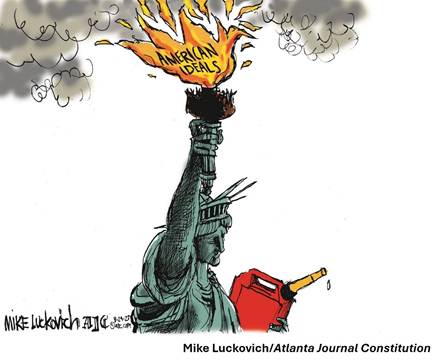
There is no surprise about the traditional Republican Party. For the last century or so, it has made the primacy of capital as its raison d’etre. Trump disguised that with populist talk that sounded different from traditional Republicans and tapped into the voter resentment about both economic and cultural issues. Democrats, on the other hand, have talked more about looking out for the middle class and have passed some useful measures, but they have been unable to project a coherent and sustained strategy for changing the fundamentals of the economic structure. Wealth has continued to concentrate and big corporations are running roughshod over the bottom two-thirds of the economy.
The Path Forward
I believe Democrats can break through the fog of division created by the Trumplicans and solidify for themselves the kind of mandate that FDR created with a concerted strategy that unapologetically commits to reining in excesses by corporations and billionaires and to promoting the welfare of the entire economy, not just the 1% on whom the Republicans are currently showering give-aways.
The New Deal and its successors worked because it actively insured that the economy shared productivity increases with the rest of society. Over the last 45 years, corporations and their owners have eroded these protections. Following Reagan, it became gospel that corporations only responsibility is to the shareholders, which has meant that all decisions are seen through the lens of what enriched their owners.
Oren Cass, a traditionally conservative economist, has argued this has led to the “financialization” of the economy, which is the single largest cause of the soaring inequity. He shows how this has infected every corner of our society.
Neither Clinton nor Obama, unfortunately, directly confronted the fact that maintaining the economic well-being of the entire society requires robust government oversight and instead focused on what would grow the overall economy. They missed that while “a rising tide might lift all boats” that it would not lift them equally—or even close to that. In the absence of countervailing efforts, the economic elite will consolidate power to increase its advantages. And then the advantages of economic growth go almost solely to those who already have wealth.
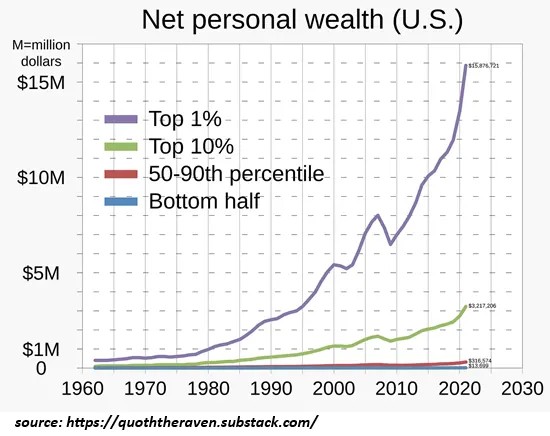
Almost a century ago, U.S. Supreme Court Justice Louis D. Brandeis warned “We can have democracy in this country, or we can have great wealth concentrated in the hands of a few, but we can’t have both.” The current political situation bears this out.
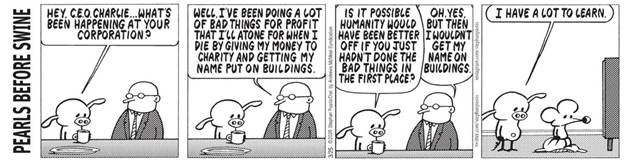
Addressing this will require specific measures to lessen the concentration of wealth in individuals and to narrow the power of corporations to write their own rules for the benefit of their stockholders.
This Is Not an Easy Path
Democrats like to think of themselves as the defenders of the lower two-thirds of the economy. But the growing income and wealth divides make it clear that they have not been able to do so effectively.
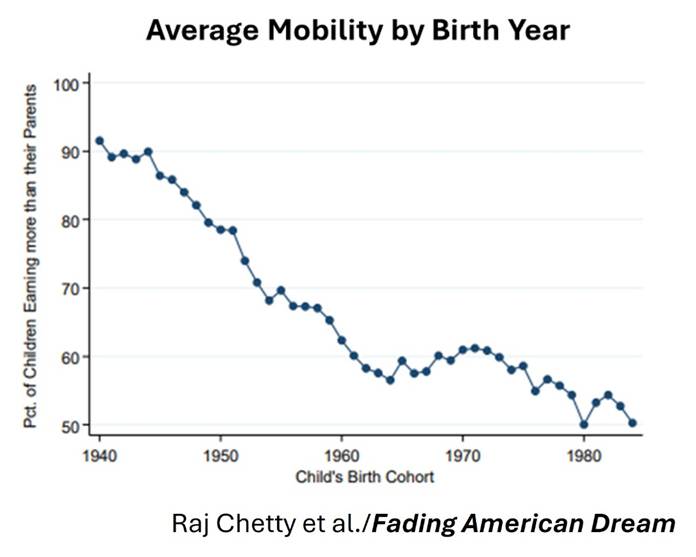
As I suggested above, the biggest problem is that Democratic leaders have been as concerned about maintaining overall economic growth as they have been about the distribution of that wealth. On the one hand, trying to change distribution without continuing economic growth has rarely been a recipe for a successful society. On the other hand, distribution of resources will never become equitable on its own. People who have advantages use them. In many ways this is good for society. But unless limits are created and maintained, a society winds up with the kind of economic distribution shown above.
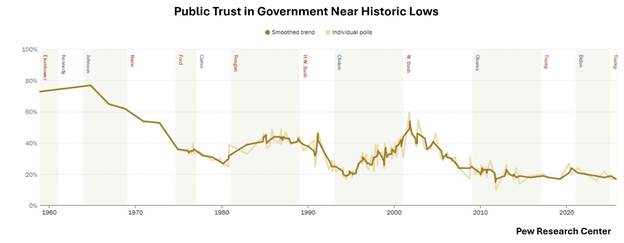
The tension between overall growth and distribution is regularly played out in debates about how progressive the Democratic agenda should be on economic issues. While this is a real issue, it is apparent that to date, Democrats have not had the right formula. As the distribution of wealth has gotten more extreme, the lack of enthusiasm for the Democratic Party has gotten worse.
While one can (and probably should) be skeptical of any single poll, the number of polls that show the voting public is significantly unhappy with the Democratic Party are so numerous and consistent, it is delusional to pretend this is not a problem. Yes, voters do not like Donald Trump. But unhappiness with Trump is not the same as support for the Democrats. By itself, it is unlikely to lead to a lasting majority, particularly once Trump is gone. An economic reset is going to be a long-term project. Without a big House majority and a veto-proof Senate, it is hard to see how this happens. Neither of these is likely by 2028. Which is why there needs to deep support behind a party that is trying to do this.
But, for instance, a recent NBC poll shows that as much as Trump is “underwater,” the Democratic Party fares worse.
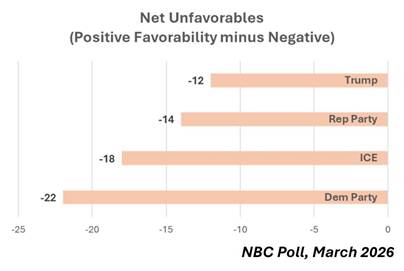
I think this is a function of two things.
First, disappointment that the Democrats have failed to fix the economic situation. Voters don’t expect Republicans to address distribution of income issues. That’s the job of Democrats. And when they don’t do it, they are disproportionately rejected.
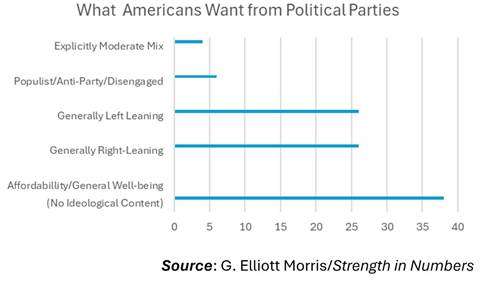
Second, there is a sense among many voters (for one example, see this discussion of a focus group in Pennsylvania) that the Democratic Party has become too focused on meeting the needs of various groups at the expense of supporting the broader middle class. The position of once Democratic Ruy Teixeira may be a bit extreme, but clearly reflects a broader sentiment.
Neither of these criticisms are entirely fair but neither are they entirely without basis. And, whether fair or not, these are clearly sentiments about the Democratic Party held by many voters. While one might argue that the success of Democratic Party per se is not important, the problem is that with our current (kind of stupid) political structure, voters need to choose one of two groups. When they turn on the Democratic Party, they wind up supporting a Republican Party—not only against their best interests, but against the interests of the entire society, as is being played out daily.
The Obstacles Ahead
Democrats first obstacle is to achieve some consensus around taking on corporations and the wealthy, something they have not been able to do for generations.
Part of their problem stems from a real understanding of the beneficial effects on society from overall economic growth. But there is also reliance on the wealthy for campaign funds. Republicans are probably more reliant, but this doesn’t cause a problem for them since their core mission is to protect these people. I don’t know how willing Democrats outside certain districts will be to risk support by buying into a campaign against concentrated wealth. Nor do I know how, if they took that risk, it would play out.
Related, Democratic candidates are often psychically and culturally more at home with the top third of the economy in their daily life. The days of Democratic ward bosses and union leaders who were closer to the working class in social terms are gone; the Democratic base has grown to include a large portion of college educated professionals. While these folks hate many parts of the Trumplican agenda, their overall position in society is comfortable and they are wary of radical changes. They rationally recognize the problems that corporate financialization have brought to the country, but they have many reasons to question what might come next.
All of this can become somewhat self-fulfilling. If candidates and would-be candidates fear that there would be pushback from financial supporters and friends, they might hedge their willingness to commit to an economic reset. Same with voters who fear, despite their own analysis of the facts, that coming across as “too far left” on economic issues would cause them to be seen as “fringe.”
What Is the Alternative?
I assume Democrats would continue their juggling act of supporting cultural progress and being sort of progressive on the economy. In the short term, given the Trump backlash, this should be enough to do well this November and might even lead to a Democratic president in 2028. While those are good things, it is hard to see that leading to major changes in our society. Those require a fundamental break with the status quo.
In the absence of that, the two parties will probably continue splitting up small margins and we will lurch from one party to the other as the voters keep thrashing about looking for someone to address the core problem of American society—the growing inequality that is destroying our democracy. Letting that happen seems morally irresponsible.
Closing Note
Getting a party to unite around a high-level strategy is a sine non qua for achieving a meaningful majority. But it is not sufficient. Voters, even the strongest supporters, also need to believe you have defensible ideas behind the grand strategy and the ability to execute those ideas. And you need a candidate who can carry the message. I hope to address these in subsequent posts. But for the time being, Democrats should start by demonstrating a clear commitment to people over excessive wealth and corporate excess.
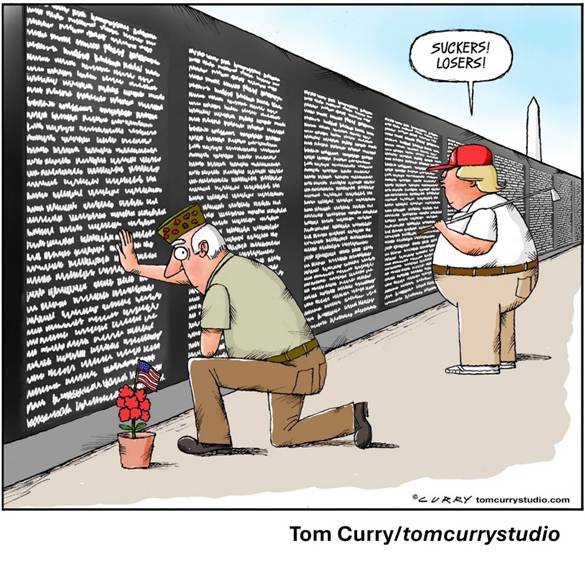

 Between Hell and High Water