Looking Back to the 1968 Chicago Convention

By Mike Koetting     August 24, 2018

Fifty years ago I was with my friend Charlene in front of a hotel on Michigan Avenue, clean-cut with a coat and tie. We were arguing with an alternative delegate to the Democratic Convention from New Jersey. The street in front of us was filled with protesters.

We had been among the crowd that tried earlier to conduct a peaceful, well-organized march starting in Grant Park. But the police had refused and tried to disperse the crowd with tear gas. The crowd did not disperse and eventually flowed onto Michigan avenue, where it remained. Chanting and yelling and closing the street, but otherwise not bothering anything.

Then the police decided they were going to clear the street through whatever means and started to club and mace protesters and, indeed, anyone in sight. The alternative delegate scurried into the hotel, but the hotel’s security would not let us in because we weren’t registered. Charlene and I headed down a side-street to get away from the police—who were now clubbing people wildly and indiscriminately. Suddenly police came at us from all sides. I was clubbed in the head and ducked away from two other swings at me. Charlene wasn’t hit—just pushed around. The Mobilization Committee carted me off to Billings Hospital (as the University of Chicago Medical Center was then known) to get stitched up. Continue reading “Looking Back to the 1968 Chicago Convention”

My Book About the Sixties

By Mike Koetting      August 12, 2018

This a special edition of my blog, featuring my book You Must Choose Now.  You Must Choose Now is the story of my adventures in the Sixties—which I define as the period from the Gulf of Tokin Resolution to Nixon’s resignation. Much of those adventures were of course unique to me. But many of them were part of a broader cultural shift and the easiest way for me to write about that was through the lens of my own experience.
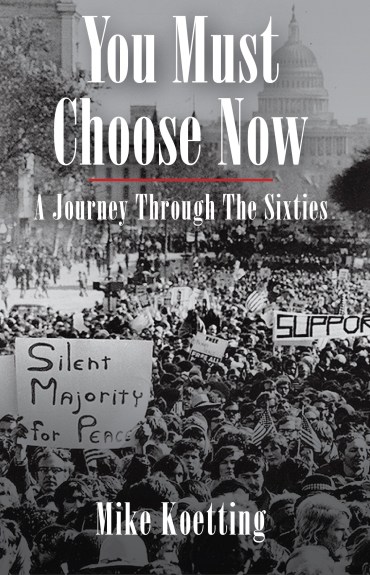
Submission_Cover (2)

It’s fair to say I thoroughly participated in the events of the Sixties—I was an activist, got my head busted in Chicago, lived in a commune, fell in love a couple times, had my heart broken, and smoked a little dope. But by the same token, I was a serious student, never declared war on America and generally was much less “far out” than the collective memory of the times would suggest—a collective memory that was too much shaped by the outliers.

To me, this is the most important part of the story:  not everyone who made the Sixties what they were got on the cover of Life. Many of us just went about our lives making choices—some easy, some difficult—and when the smoke cleared, America was very different. Another important part of the story is linked to the reasons we made those choices. The Sixties were not just a collection of activities—it was a set of choices linked to deliberate decisions about what values to pursue. I believe those values continue to motivate the Sixties alumni—although the country has gotten less friendly to those values, in part a reaction to the Sixties themselves. This irony is part of the story explored in the book.

In any event, if you are interested in the Sixties, I think this book is worth a look—whether it is because you enjoy reliving those days in your mind or because you’re curious about why that one decade had such an out-sized impact on the country.

I would love for all of you to buy this book. I think it tells an important story about that time and how it feels when we look back across 50 years. But I offer a significant caveat.  I haven’t a clue if the book is any good.

You see, this is a self-published book. There are many advantages to self-publishing, but one of the biggest disadvantages is that no one has given it a dispassionate reading and said:  “Yeah, this is good enough that we’ll put some money into it.” Indeed, all the incentives are geared toward convincing you that you should publish it, meritorious or otherwise.

So in asking you to buy it, I’m really flying kind of blind. I am confident it’s not illiterate or anything like that. And I am sure at least some of the stories are mildly interesting. But I have nothing to say about whether it’s worth your money, let alone spending your time on it. It could be completely boring to anyone who isn’t me. Maybe after a couple of you read it and report back, I’ll have a better sense if it’s something that really is of broader interest, or it’s just a vanity project of modest interest to a small circle of friends. If the latter, that’s okay. In fact, that’s the big advantage of self-publishing. I can put it in print and see what people say. And if the verdict is less than enthusiastic, no one loses a bunch of money and I still have a book my grandson can read to understand a little about Grandpa. (Although, for sure, not till he’s older!)

If you’re willing to take a plunge, it’s as easy as getting any other book. It’s available in both e-format and paperback on both Amazon and Barnes & Noble. If you are searching there, you may have to provide a little more information than usual (e.g. title and author) and maybe remind them it’s a book. I suspect your local bookstore could also track down a copy for you without much trouble…but I can’t guarantee that. If you have trouble or questions, drop me a note. I want to know how this works and my publisher, Gatekeeper Press, promises to help troubleshoot.

If you do like it, tell some friends, get your book club to read it, etc.  There’s no chance I’ll make any money on this, but like anyone who thinks he has a story to tell, I want people to hear it.

A final thought. Recently I got together with several of the people who are significant figures in this book. We met up in Denver, where we all had lived in the Josephine Street Commune. While waiting for folks to converge, I ducked into the Colorado History Museum. I was struck by this paragraph, which concluded their introduction to one of the exhibits:

Preserving our history is an act of shaping our future. History’s stories reflect the ideas, achievements, and challenges that have defined us today. If we listen, they can help us decide who we want to become tomorrow.

I don’t know how well my book does the above, but that’s what I was trying to do.

David Brooks’ Brain Fart on Decentralization

          By Mike Koetting                 August 5, 2018

I have, generally speaking, become a David Brooks fan. But his July 30 column in the New York Times was so outstandingly wrong-headed that I am devoting today’s post to rebutting it.

The gist of this column is that politics in America have become too “Washington-centric” and, since national governance is grid-locked by partisan politics, we should embark on a “radical decentralization of power” to other units of government.

Brooks is wrong in his diagnosis of the problem and even further off in his proposed solution. Continue reading “David Brooks’ Brain Fart on Decentralization”

What Should We Want from Trade Policy?

By Mike Koetting          July 25, 2018

My last post suggested that, while very few of us will be experts on trade policy, as long as this is a major issue, citizens probably have some obligation to have ideas beyond vague catch-words. This post makes some suggestions, borrowing heavily from people who really do know a lot about this issue–specifically Robert Kuttner in various articles and, particularly, a Foreign Affairs article by Timothy Meyer and Ganesh Sitharaman. Continue reading “What Should We Want from Trade Policy?”

A Non-Expert Considers Trade Policy

By Mike Koetting          July 16, 2018

Needless to say, I’m not expert on trade policy. But with the issue at the front of every media report, it is hard to avoid. And equally hard to determine what one’s own position should be. Both political parties find adherents of every view within their party. So even with a souvenir program, it’s pretty hard to guess where someone is going to come down on these issues—let alone whether that position makes sense.

Not knowing much, it seems to me that the logical place to start thinking about trade policy is to ask what a country wants from its trade policy. But even with a simple answer to that question, to help the country obtain maximum benefit from its trade, it doesn’t take long to throw to up one’s hands at the complexity of the thing. It’s more than the obvious fact that in a $20 trillion economy there are millions of moving parts. The whole conceptual base is swampy. Continue reading “A Non-Expert Considers Trade Policy”

My Identity and America

                                           By Mike Koetting          July 3, 2018

In preparation for the Fourth of July, the Washington Post recently asked its readers to describe how they identified themselves and what did that mean about being an American. Those seemed like good questions for a Fourth of July post.

****

I believe the most fundamental thing about how I identify myself is an idea: All men are created equal. (And, just so there isn’t any question, that means all humans, not just males.) Continue reading “My Identity and America”

Science and Defining Life

By Mike Koetting      June 12, 2018

The February 5th issue of this year’s New Yorker included a long article by Rachel Aviv on the question of what constitutes death. The article was organized around the saga of a 13-year old California girl, the victim of a profoundly tragic surgical mishap. She was subsequently declared “brain dead” but her parents refused to accept that verdict and moved her to New Jersey, one of the two states that have laws allowing families to reject the concept of brain death. She remains there, her breathing supported by a ventilator. Continue reading “Science and Defining Life”

Healthcare & End of Life: Modest Proposals

By Mike Koetting               June 4, 2018

As I noted in the last blog, I am skeptical that we can save a lot of money at the end of life. If that is our primary goal, I think we are likely to be disappointed—and might well wind up further reducing quality of life. I believe the goal should be improved quality at the end of life without spending more. That may be attainable. Not that I have neat solutions that would readily translate into a compelling legislative program. Rather what I am seeing is two, kind of fuzzy thought clouds, in which various approaches reside. These can be summarized as encouraging different attitudes and more aggressive palliative care. Continue reading “Healthcare & End of Life: Modest Proposals”

Healthcare and the End of Life

By Mike Koetting       May 27, 2018

In virtually every conversation I have about health costs, someone says:  “But isn’t the real problem all the money we spend in the last year of people’s lives?”

Well…sort of…but not exactly.

First, end of life costs do not explain America’s uniquely high healthcare costs. The distribution of American costs by proximity to end of life is no different from other developed countries, if anything lower as a percent of costs. America’s costs are high for other reasons. Continue reading “Healthcare and the End of Life”