Progress on Reducing Violence in Chicago

By Mike Koetting November 25, 2025

Today’s post focuses on fighting gun violence in Chicago, although the issues have national resonance.

The good news is that Chicago gun homicides have decreased significantly since their recent peak in 2021. This is true in most of the nation, but Chicago’s rate of decline was greater than the national average. This is not, of course, due to Operation Midway Blitz, as the Trump administration has ridiculously claimed. It was under way well before then and links in part to specific actions taken in the city and state.

It is still too high. The loss of life and disruption to the community is, and should be, unacceptable. It is also a political problem because ”crime” is a major issue for many voters, even if they aren’t keen on the Trump approach

Accordingly, we need to better understand what is happening.

Larger Environment of Gun Violence

Ludwig Jens is a U of Chicago professor who has studied gun violence extensively. I think he is basically right when he says most gun violence is not as a result of any rational calculation, but stems from ill-thought out, emotional reactions. Stricter punishment laws are not likely to make a difference. Rather, the degree of gun violence is a function of factors that operate together—the availability of guns, the overall stress of poverty, and various deterrent factors.

Availability of guns in Chicago is a mixed bag. On the one hand, Illinois has adopted relatively stringent laws to narrow the availability of guns—requiring reporting from private sellers; banning ghost guns, assault weapons and high-capacity magazines; and strengthening red flag laws. It is likely that these have made a difference in gun availability. On the other hand, there are already a very large number of guns in circulation. It will take a long time for this supply to diminish significantly. Moreover, Illinois is an island surrounded by states with very loose gun laws. A significant percentage of recovered crime guns were purchased out of state.

Jens is understandably pessimistic that America will actually adopt meaningful gun reform on a national basis, so the effect of individual state laws will always be compromised to some extent. He is likewise pessimistic that America has the wherewithal to really make major dents in poverty, and, even if the will and politics were present, it would take a long time for the consequences to be reflected in street-level behavior.

All of which underscores the importance of deterrence efforts. Two major efforts in Chicago have contributed to the overall decline in homicides. A third possibility, economic development to get more people on the street, a correlate of reducing crime, has not yet had as much impact.

Violence Interruption

The first of these efforts, which get most of the most attention, is the substantial investment in violence interrupters. Violence interrupters are people with “street cred”—often former gang-members or ex-convicts—who patrol hot-spot neighborhoods and insert themselves to prevent emotional reactions and retaliations from boiling over into violence. Chicago was one of the early proponents of this process, starting more than 20 years ago. (Some of the early work has been reflected in a moving documentary from 2011, The Interrupters.) Over the years the investment has increased, both from government and from private sources, most strikingly a recent $100 million commitment from a group of civic leaders.

As a consequence of these investments, there are several organizations that either have substantial networks or serve as an umbrella for smaller organizations providing these services. Overall, they are now observing more than 200 hotspots around the city and close-in suburbs. This also includes monitoring social media since some of this violence has roots in social media spats.

There are many accounts of how this works. A Northwestern University study found violence dropped 41% in hotspots targeted by peacekeepers and 31% in neighborhoods they patrolled over the past two years. It is hard to ascertain how much of this drop is specifically due to interrupters as opposed to other factors, but all observers are comfortable they are part of the solution.

Additionally, there are organizations that work with victims of violence. These include some of the same groups that sponsor interrupters and some more specialized groups, such as Chicago Survivors that coordinates with police to respond to all homicides in Chicago. This entails working with families of victims and helping with grief—and with immediate needs for this difficult period. They also provide clinical services for children and youth who have been traumatized by the murder of a family member or friend.

Improved Policing

This has not necessarily involved more draconian policing. It has focused, instead, on coordination and information.

The centerpiece of this effort is a joint task force that brings together 11 law enforcement agencies including the Bureau of Alcohol, Tobacco and Firearms, the Chicago Police, the Cook County State’s Attorney, the FBI, DEA, and others. The task force meets every day and reviews information on all guns used in crime in Chicago. Assigned personnel analyze access multiple databases to establish connections to other gun crimes and patterns of use. This information is used to assist in ongoing criminal investigations or prosecutions, establish patterns of gun trafficking and related crimes, and ensure the data is getting incorporated into national data bases to feed into other efforts. This has resulted in numerous arrests, such as the recent arrest of 41 people and recovery of a large number of guns.

John Schmidt, a former Associate US Attorney General who oversaw implementation of the Violent Crime Control and Law Enforcement Act of 1994, and remains active in violence prevention work, says this is a level of coordination and activity that Chicago has never previously experienced. Not to overstate the obvious, but this daily, fine-grained work is diametrically opposite to the blunt, bravado induced PR stunts of the Trump administration.

Another Problem—Switches

In the middle of this progress, a new problem is emerging—“switches.” Switches, as many of you know, are small devices—about the size of an ice cube—that can be inserted in Glock handguns to turn the gun into a virtual machine gun. The results are lethal. Not only can a Glock with a switch fire 100 rounds in 5 seconds, the rapidity of the fire destroys the accuracy of the gun. For instance, a shooting outside a Chicago night club in July resulted in hundreds of rounds, four deaths, and wounding of 14 others, many of whom were not involved in the feud between two rappers that seems to have sparked the shooting.

Although technically outlawed as machine guns, they are widely available. It is apparently possible to order them through the internet. (Simply entering “buy switch for gun” in Google yielded several sites that said they would sell switches. I didn’t pursue it any further, so they may have been “switch bait”—so to speak.) Because they are easily hidden and transported, they are available on the street. When the 41 people were swept up in the investigation described above, authorities also confiscated 64 switches.

Glock has responded to the swirl of law suits and bad PR by creating a new line that it claimed would not accommodate switches. It is too early to tell for sure, but internet chatter suggests that the while the new design makes it marginally more difficult to install a switch, it is far from impossible, as the manufacturer originally claimed.

In short

There is definite progress on reducing gun violence in Chicago. This is encouraging. But much remains to be done. Not only is the absolute level unacceptable, but it also remains high relative to, say, New York or Los Angeles. My guess is that continuing to improve policing, particularly the coordination of policing and prosecuting resources, will yield the most short-term gains.

Longer term, economic development is critical. I also think that working with young people to help them develop coping mechanisms other than violence is a good investment.

It is unfortunate that America remains so wedded to guns. Part of this is an ideological obsession that is tied into all kinds of other issues. Part of it is a classic arms race problem—”the other guy isn’t disarming”. The latter is particularly thorny because there are already so many guns in circulation and they do not wear out quickly. All of this is made worse because the gun industry is a non-trivial part of the American economy, generating over $90 billion in revenue and perhaps as many as 400,000 jobs.

Regrettably, the American fascination with guns is not likely to go away. So we will have to continue to play “whack a mole” as old issues remain and new ones, like switches, emerge. We are never going to get the violence rate down to comparable countries, but we have seen we can do better. We simply have to do more.

The Reality of a Progressive-Populist Alliance

By Mike Koetting November 11, 2025

In my last post, I suggested that at least one way forward is some kind of populist-progressive alliance. Although more thinking about such an alliance raises some concerns, as last week’s election results illustrate, this is probably the way forward.

Obvious Convergence on Economic Issues

The primary basis for such an alliance is the concern over economic issues. We are currently in an anomalous situation where the stock market continues to boom. And while numerous other macroeconomic indicators are not plunging, the underlying realities are increasingly wobbly and the stress for many individuals and families acute.

For those with high incomes, life remains good. The below shows consumer spending by the top 20% of income earners continues to grow, but in the last two years, spending by the bottom 80% has flattened out or even started to decrease. Given the underlying inflation, this means that 80% of the population are cutting back on discretionary spending. (The actual situation is probably worse since credit card debt and defaults are both rising.)

A graph showing the growth of a number of people

AI-generated content may be incorrect.
Moreover, layoffs are rising, new jobs are being added at a slower pace, and inflation is creeping back up. The healthcare situation will become truly grim for those with coverage under the ACA or Medicaid, which together account for 22% of the population. This will also worsen the situation for the 8% of the population with no insurance. All of these will force up rates for private insurance, which will eventually be reflected in smaller salary increases, increased co-pays or both.

In short, a very substantial portion of the population has reason to be concerned about their economic situation. Consumer confidence is hovering around all-time lows. Converging around this problem should be axiomatic.

It’s Not so Simple

The problem is that people put similar facts in different contexts.

For instance, traditional populists have a more expansive idea of “elites”. It seems to them an “elite” is any group of people perceived as acting against their interests or beliefs. This is how they come to dismiss client scientists or public health officials as part of the elite. Populists often focus on elites exercising power through “corrupt” politicians, which leads to a distrust of government that runs counter to the reality that addressing their economic concerns requires an activist government. They also distrust big corporations, but they are equally, or more so, suspicious of “socialism” which seems to them like another elite that will push them around.

Progressives, on the other hand, are typically more focused on a critique of the economic structure that explicitly distrusts capitalism. Doesn’t necessarily reject it, but is deeply suspicious of its motives, means and some of its outcomes, such as the extreme inequality found in America. This leads to a much stronger embrace of government as the logical anti-force to capitalism.

A more encompassing problem is that populists tend to have a narrower concept of who is a “real American” and therefore worthy of government considerations. Conversely, a much wider definition of who belongs is a critical element of progressive thought. Critics have dismissed current incarnations of attempts to widen the circle as “identity” politics. This is a very careless shorthand. No doubt there have been excesses committed in the name of “identity” and not all prescriptions have worked. But there is also a real difference, even if the lines are ambiguous, between people who feel comfortable with expanding the idea of who is a “real American” and people who don’t.

There is also the problem that many people who are populist in their economic agenda, find the Democrats “arrogant” or “preachy”. Easy to see where this comes from. Mistakes have been made. But it is also true that part of what people describe to pollsters as “arrogance” or “preachy” is a consequence of citing experts or established facts. Or facts that people find inconvenient or unpleasant. A measurable portion of the discomfort with DEI initiatives stems from being asked to recognize that the unsavory underside to our history continues to have an impact. Calling that “preachy” sure sounds a lot better than saying “I don’t want to hear about how Blacks have been mistreated in the past because someone might think that should have some bearing on the present….and my life is difficult enough already.”

All of this funnels into a more general problem of a lingering toxicity to the “Democrat” brand. One recent study suggest attaching the label “Democrat” to someone, even someone with an explicitly economic populist agenda, could lower their support by 11 to 16 percentage points. What else could account for Sherrod Brown’s loss to Bernie Moreno, a Trump-backed businessman with several wage theft legal actions against him. This is nothing short of insane, but it’s the world we’re in.

The Path Forward Is Tricky

Erza Klein, among others, have suggested that the way forward is for candidates to distance themselves from the brand of the national party.

I get that people have specific, and sometimes legitimate, arguments with the Democratic Party. But I think it is harder for candidates to distant themselves from the national party brand than the commenters seem to think. And perhaps of dubious moral value.

Take what I believe is the core question: who should be considered worthy of government protection. This is a big deal for people who are really concerned about making the circle as large as possible. The Democratic Party as we know it—for better and worse—has come to embody that instinct. Most members of the party are not likely to say “Oh, I can put that on hold to make a better alliance on economic issues.” Roosevelt got away with that, but the world has moved too far to pull it off now. (Matt Yglesias has a very relevant discussion on the complexity of this issue.) People can be strategic and not emphasize certain issues as they work in the political world. They can even speak out against excesses in ”wokeness”. But, at the end of the day, Democrats are committed to a broader circle. And people who are worried by “the other”, know where progressives stand. We’re kidding ourselves if we think we can simply go quiet on the last 60 years of our history and people will think we are somebody else.

I think it is also hard to decide certain issues can simply be put on hold indefinitely. I would put environmental concerns at the top of this list. We are talking about things that are likely to reshape the world in the most profound ways imaginable. Deciding this issue is optional is irresponsible, even if most people don’t want to think about it, and certainly don’t want to have to vote on it.

Of course, and this is the central dilemma of participating in the world through politics: if you can’t get elected, the righteousness of your policy positions goes for naught.

Last Week’s Elections

Republicans lost just about everything there was to lose. When Democrats flip Republican seats in the Mississippi Legislature, it’s clear something is up.

Democrats ran on the issue of affordability, or, more accurately, the lack thereof. It’s a unifying issue. It sidesteps the issue of who is a real American. It’s particularly good since the current President ran on exactly that issue but hasn’t delivered. In his CBS 60 minutes interview last week, he made one stunning lie about the economy after another. Turns out, you can’t fool people who actually tote up the bills at the end of each month to see if they are still solvent.

So affordability is a good issue. Nevertheless, despite a few encouraging wins in Georgia and Mississippi, it remains to be seen if this will persist and be enough to overcome the reluctance to actually vote for Democrats in many parts of the country.

I am also concerned that “affordability” is unconnected to any broader view of the economy. I understand the political attraction, but to actually make life more affordable for most Americans is going to require a major restructuring. Sure, there are low-hanging fruit—let’s roll back the huge tax breaks given to the wealthy in the Big Beautiful Bill. But actual, sustainable, affordability will require top to bottom changes. These will take time, nuance and real governance.

Still, whatever gets us started is a good thing. Holding out for winning elections with a comprehensive economic strategy makes looking for the tooth fairy seem sophisticated. If running on “affordability” creates enough populist-progressive alliance to win elections, I’m for it. It also draws in people who don’t fit neatly into the traditional populist grouping—think Black and Latino working class voters.

I am in general agreement with Eric Zorn, a Chicago blogger, who suggested that Zohran Mamdani ran on a platform that was probably unachievable. But, he continued, “The real test will be if, by next summer, New Yorkers feel that he’s working collaboratively, productively and transparently with his department heads and other elected officials to improve life in the city.”

I think that will be the most we can hope for—and indeed, the standard to which we should hold officials accountable: Are they making people feel the government is actually working competently for them. That could sustain a populist-progressive alliance that will make a real difference.

The Unnecessary Scarcity We Tolerate Is Tearing Up the Country

By Mike Koetting October 28, 2025

I’ve been thinking that Abundance, the Ezra Klein-Derek Thompson book, has the right idea but the focus is too narrow.

The Klein-Thompson book starts with the observation that scarcity is a choice. It then proceeds to assume that the way out of the scarcity trap is to make it easier to create more stuff so that all may experience the abundance of what our technology can produce. This clearly has an element of truth. They correctly identify bottlenecks in our current production of social goods and they are right that there is no political appetite for “degrowth.” So power to their suggestions.

That said, however, they miss the urgency of the situation. A large chunk of the population is furious. Trying to remove obstacles to creating greater supply of desired goods, while laudable, is simply not a solution commensurate with the degree of anger in the body politic. I think Michael Hirschorn, in a recent New York Times op-ed piece, has a better handle on where we are: “Trumpism is more than politics. It’s an emotional gas-main explosion, from people who felt unheard, patronized, left behind.”

The Problem

Start with the fact that the United States routinely does poorly on comparisons of happiness among countries. Hardly anyone pays any attention to these comparisons. In part, because Americans can’t imagine things being too much different and it’s easier to just dismiss the comparison on the grounds that other countries are too different to be relevant. (“Well…they’re so homogenous” is a common blow-off response, as if having diversity were somehow innately opposed to happiness.)

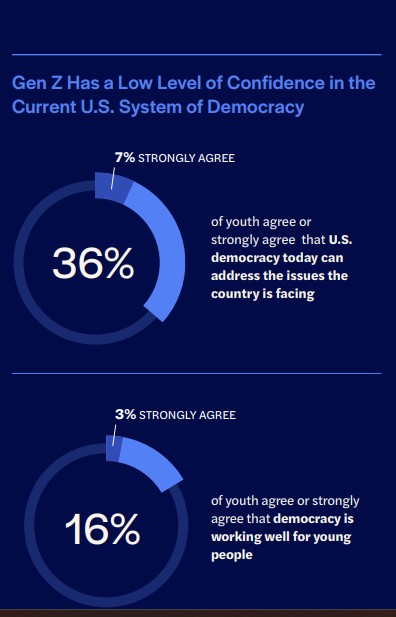
Even if the specifics of these comparisons don’t work exactly, there is something straightforward about thinking of political situations as a measure of the general happiness of the population. Does anyone really believe the extreme degree of political alienation in the United States is unrelated to the fact that the United States predictably ranks near the bottom of the happiness index?

This in turn, I believe, is related to scarcity. Probably not absolute scarcity– on many measures Americans should be happy with their economic situation. But the scarcity reflected in how many Americans feel threatened by the uncertainty of their situations. The sense they have to work too hard to get there, that the well-off get more well-off at their expense, and that they are only a step away from the precipice.

Sources: CBS News     Cornell Medical School     CNN      Newsweek    CBS News     Peterson Foundation    National Institute on Retirement Security

Fear of things falling apart has particularly toxic effects. It makes people fearful and fear causes people to behave badly. The degree of unhappiness with this situation is indeed the gas build-up to which Michael Hirschorn refers.

Direction of Solution

America is the wealthiest civilization that has ever existed. There is something fundamentally wrong when, despite a reasonably good economy, a large portion of the population feels that their well-being is under constant threat.

This is the problem of American abundance. It is not being shared. And the elite pretend that the degree of social precarity is somehow virtuous.

Restoring a sense of protection in America will be a Herculean effort. The tolerance of scarcity is woven into every part of the American political economy. No wonder Klein and Thompson want to approach this by simply building over the existing structure, like a homeowner adding a room to avoid facing problems in the core structure.

The difficulty of achieving a less precarious society will not, however, keep voters from demanding it. It is why people are supporting Zohran Mamdani in New York City and is why so many supported Donald Trump. The latter of course represents a badly mistaken idea of what would improve personal situations. But the fact that so many voters misread Trump’s intention does not diminish the popularity of what he was selling. Make America Great Again is nothing more than a promise to recreate the comfort of a time that is deeply missed, even if it never fully existed.

Leadership of the Democratic Party—which is extremely lukewarm around Mamdani– is making a different mistake. It seems to think that somehow moderating aspirations will win over voters. This is on balance wrong. It will preserve some of their voters, but at the cost of a larger portion of the electorate.

I am acutely sympathetic to the problem of leaders who look down the road and ask how various proposals could actually be carried out. It makes sense to be leery of promises you don’t know how you would keep. But the most necessary change is achievable. That is a sense that we are really going to tackle these fundamental issues in a communal way, even if—perhaps especially if—it means offending corporate elites. This is necessary not just for electoral reasons, but because our society is fundamentally out of line. Societies can only withstand so many gas explosions.

What’s perhaps encouraging about the current situation is that there may be opportunities for a Progressive-Populist coalition. Looking back over American history, some of the most favorable and lasting changes in American society were made with this alliance–at the beginning of the 20th Century and then again in the New Deal programs.

The protections from these programs have worn away over time. People are again becoming desperate to feel a greater degree of economic security. And a sense that their lives have as much value as the richest. I don’t think taking the slow road of supply abundance is quick enough. It should be done. But society also needs to put in place a broad set of limits on corporations and big finance and a greatly enhanced safety net that softens people’s fears and resentment. To do this will require broad, populist support. I don’t know how to exactly shape this package, but I am pretty confident it won’t be by being either too careful about core proposals or by trying to solve problems a large portion of the electorate doesn’t care about.

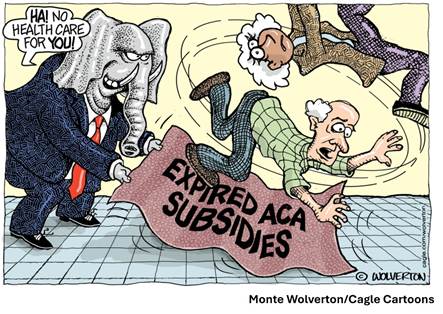
Maybe it is easier than it seems. Trump himself ran on cartoon versions of these goals. There is now an increasing disruption in the Republican Party between those who hold the old Republican orthodoxy of making all government the enemy and those who take a more sanguine view of the role of government. Marjorie Taylor Greene, for instance, surprised many people with her full-throated support of the Democrats’ willingness to shut down government over the Obamacare subsidies. Other Republicans, particularly those more recently elected, are also voicing more support for government programs designed to bolster lower, working and middle class Americans. While there is a core MAGA base committed to anti-progressive ideas, some of Trump’s populist supporters are beginning to wonder where their true interests lie.

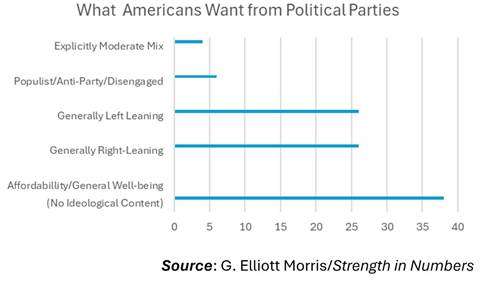
It is becoming daily clearer that trying to see the world through the lens of Democrat vs Republican is really clouding our view. We don’t yet have a good alternative for systematizing our understandings, but we need to be realistic that a large portion of the electorate is rejecting both political parties because, it seems, neither party can give them the security they are looking for. It is true that Democrats would have come a lot closer if they had not been systematically obstructed by Republicans. But that’s insider-baseball to most voters. They aren’t getting what they need and they want it. They will vote not by party line, but in favor of which candidate seems to best understand what they need and commit to getting the country there. In fairness, that’s not a bad strategy—although it’s better if they have a realistic assessment of the intent of various promises.

At the end of the day, it comes back to what makes people happy. An interview with a Finnish man about why their country was rated first for happiness, summarized it well.

Really. These are not beyond the reach of the richest country on the planet.

The Moment of Truth

By Mike Koetting October 14, 2025

I believe we are approaching a “make-or-break” point for Trump’s authoritarian impulses.

It’s not a question of what he wants to do. That’s clear. In the last several weeks, he has replaced Federal Attorneys until he found one who would pursue an embarrassingly flimsy indictment against one of his enemies, he signed an executive order that raised the possibility almost any kind of dissent could be treated as “treason,” he posted on Truth Social that Democrats are “THE PARTY OF HATE, EVIL, AND SATAN,” and he lectured the leaders of the Armed Services that their mission included fighting the “enemies within”.

His approach to controlling immigration is increasingly inhumane. His masked marauders have grabbed people off the streets with little regard for their situations or actual legal status. Here in Chicago, along with the wanton cruelty and indifference to legality, there has been a major performance element designed to intimidate: armed border guards patrolling the Chicago River, military marches down Michigan Avenue on a Sunday afternoon and ICE agents rappelling from Blackhawk helicopters into apartments filled with sleeping families—separating children from parents and causing total pandemonium. Now Trump is calling for Governor Pritzker and Mayor Johnson to be jailed.

Continue reading “The Moment of Truth”

Government Statistics for Policy

Curated by Mike Koetting September 30, 2025

I’ve been on vacation the last two weeks, so I don’t have a new post. But to fill the vacuum that would otherwise be created in the universe, I am posting this collection of relevant quotes on the above topic.

Continue reading “Government Statistics for Policy”

Attacking Medical Science

By Mike Koetting September 15, 2025

Every once and a while, you’ll run across an article about a bunch of teens absolutely trashing a local school. You’ll shake your head and wonder, “What the hell is this about? Okay, they don’t like school. But this doesn’t make any sense.”

What Trump and his Republican enablers are doing to the American scientific enterprise is remarkably similar, except with results that are going to be a lot worse. It’s a bit hard to tell exactly how great the damage will be given the uncertainty of what actions will withstand court challenges, what administrative actions will be taken to circumvent courts or where the juvenile in charge will change his mind. But working on this essay made it clear to me it is even worse than you probably imagined. Media covers it one event at a time, without stepping back to see the whole catalogue of damage. Likewise, the more you look at it, not only do you realize it’s more dangerous, but you also realize it is even more senseless than appears.

Continue reading “Attacking Medical Science”

Old Political Order Fading; Future Is Scary

By Mike Koetting September 3, 2025

David Brooks, taking anguished stock of the depredations of Trump and the Republicans, on PBS NewsHour, wondered why there aren’t more people in the streets. This is a question I have often asked myself. And am not the only one. What Trump and the Republicans are doing is so destructive of the spirit of democracy as to demand vigorous response.

But if the attack on the ideals of America is so fundamental, why aren’t there more people in the streets?

Continue reading “Old Political Order Fading; Future Is Scary”

AI’s Practical Concerns-Part Two

By Mike Koetting August 19, 2025

Today’s blog is the second of two posts about AI. It’s not about whether AI is good or bad for society. That’s a worthwhile discussion and I expect it to remain a hot topic for the foreseeable future. These posts, however, are based on the observable reality that, like it or not, it’s coming.

These posts focus on some practical questions about its arrival. Part One looked at some of the economic impacts; today’s post considers environmental issues and questions of security and reliability.

Continue reading “AI’s Practical Concerns-Part Two”

The Practical Implications of AI – Part One

By Mike Koetting August 5, 2025

Today’s blog is the first of two posts about AI. It’s not about whether AI is good or bad for society. That’s a worthwhile discussion and the answers likely to be endlessly debated. But these posts assume that, like it or not, it’s coming. (Whether it lasts or not is a different matter, but we’ll get to that later.)

The point of these posts is to ask some practical questions about its arrival.

Risk #1: Blowing up the Economy

Continue reading “The Practical Implications of AI – Part One”

Why Do We Tolerate the Crypto Scam?

By Mike Koetting

Republicans in Congress declared the week of July 14 as “Crypto Week” with the intent of passing three bills on crypto currencies as part of a push to boost and legitimize the U.S. cryptocurrency industry by giving it a regulatory framework that’s lighter than what traditional financial assets and institutions face but at the same time creates an aurora of legitimacy. All three of these bills passed. One, the so-called GENIUS Act, had already been passed by the Senate—with 18 Democratic votes– and Trump has signed it into law. The other two also passed, but face an uncertain future in the Senate. Not surprisingly, the value of existing cryptocurrency soared with the attention. Bitcoin, the best known cryptocurrency, hit an all-time high.

The details of these bills aren’t anywhere near as important as the fact that crypto is being treated seriously. There is no compelling reason for cryptocurrencies and profound reasons why they should simply be ignored. Or banned if ignoring them turns out to leave too many risky possibilities in play.

Continue reading “Why Do We Tolerate the Crypto Scam?”