By Mike Koetting June 23, 2026
As we approach the Fourth of July, there will be a great deal of celebration of the best ideals of democracy and the government that has sprung forth from our initial documents. Important as they are—particularly in these times when they are so severely threatened—I figure enough other people are writing about those. Instead, I use a particular case to illustrate how the broad policy visions of our democratic process get incorporated into specific policy choices and concrete decisions. The themes set direction; the specifics of these decisions determine the actual impact of government on people’s lives.
****
Disposing of Coal Ash
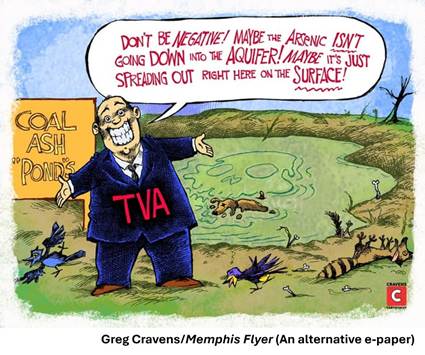
Coal ash is the highly toxic residual product from burning lots of coal, mostly at the site of coal-burning utilities. I didn’t know what it was before an article in last week’s Chicago Tribune on the local impacts caught my attention. I assume most Americans know as little as I do. Turns out, coal ash is really nasty stuff. For a long time, no one paid any particular attention to it. Mostly it was simply spread around near where it was burned but a large amount was placed in specific dumps, often in pools to mitigate the toxicity. This came to public attention in 2008 when a retaining levee in Tennessee collapsed, releasing over one billion gallons of toxic sludge into nearby rivers.
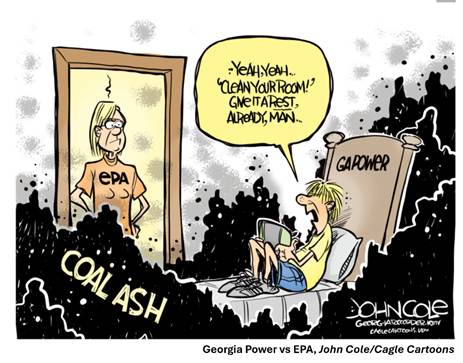
Although regulations to address this issue were drafted within the year, numerous legal (and political) challenges delayed the actual adoption until 2015. However, within months of Trump taking office in 2017, the EPA moved to delay the enforcement of those rules. The pendulum swung the other way when Biden took office and, despite a blizzard of law suits, the EPA reversed the Trump 1-initiated delays in new rules–issued in April, 2024. Within the year, the EPA, now back under Trump, began backpedaling and, recently, proposed a substantial roll-back.
So what is the average citizen to make of this? On the one hand, concerns over high utility costs are widespread. It is true that requirements for remediation of coal ash dumps would require material costs and, in themselves, would add nothing to electric output. On the other hand, while I am by no means an expert on such things, I have not seen a single comment to the effect that coal ash is not as dangerous as described.
Who is best suited to determine what set of trade-offs yields the optimum results?
One theoretical construct is that within the administrative branch of government there are a core of experts relatively insulated from pollical influence who make such decisions. But that’s a very hard sell. In the first place, it is hard to get experts who understand the full set of implications and trade-offs. Environmental scientists who are well suited to decide how various levels of toxins in groundwater impact the surrounding population, may not be so good at determining the economic consequences of requiring various levels of clean-up. This leads to a sense, sometimes deserved, that the experts are so narrowly focused they can’t see the bigger picture.
From there, it is an easy hop to believe that elected officials, who have broader purviews, should make more of the decisions. The more democratic nature of such a process has appeal. Citizens don’t typically understand the pointillismic nature of governmental impacts on their lives and want elected officials to deal with broad sentiments. If they are feeling oppressed by rising costs, they want leaders to fix it. The details are not particularly important when they are casting votes.
However, in focusing on the “big picture,” political leaders can overlook details. But details are important. How concentrations of toxins from coal ash in the water supply impact the people using that water does make a difference. There is no way of avoiding the sisyphusian task of finding the best balance among competing goods, one policy at a time. At least in good faith efforts. If someone has decided that one goal or another should be allowed to run rough-shod over other goals, consequences be damned, decisions become easier, though rarely better in the long run.
The issue is further complicated in America by the role of the courts in determining administrative actions. The number and complexity of lawsuits on coal ash disposal is head spinning. Literally dozens of different courts have been involved in looking at one aspect or another of these regulations. It’s not at all clear whether courts are the best place to hash out such issues—most of the cases apparently get resolved on procedural issues (which are things lawyers and judges know a lot about) rather than substantive issues. And that’s before even considering the astounding amount of money involved—which leads to suspicions this approach tilts the process in the direction of those with more resources. With a large enough war chest you can keep most regulations at bay indefinitely, certainly long enough to get to a more friendly administration
What Is the Solution?
As usually the case, it’s easier to describe the problem than solve it.
In virtually every situation there will be competition among differing goals—in this case, safety for one group of people versus higher cost for a larger group. (There are those who like to skirt the zero-sumness by focusing on the earnings of the corporate owners. Fair enough, as far as it goes. Even in a perfectly socialist world, there would still be tension between production and safety. The entire history of industrialization provides graphic evidence.)
We like to think these issues are better settled “democratically”. But that is excruciatingly hard to put into practice. The idea of representative democracy gets strained when the number of technical decisions become so large—an inevitable consequence of greater population density and technological complexity. Elected representatives cannot be experts on the range of issues facing society, nor are their constituents particularly tolerant of complexities. Moreover, capital has apparently limitless funds for lobbying and we have allowed special interest groups to have an outsized role in elections. The voice of big money tends to paper over more nuanced technical expertise.
That said, there are two things that clearly help protect our society—a relatively independent civil service and a free, and local, media.
The Role of Civil Service
There is a strain of thought that wants to freely replace people administrating rules after elections. Their argument is that the election expressed the will of the people and therefore the elected should be allowed to put people in charge of all these rules who will carry out the promises they made in the campaign.
The argument is not without merit. As noted above, it is not uncommon for the unelected experts to become too narrowly focused or to become too entrenched in their ideas of how their particular piece of government should operate. Or they may have, consciously or unconsciously, become captured by special interests.
Nevertheless, I am of the strong opinion that the existence of an independent and largely permanent civil service is essential for a society to navigate, however imperfectly, between competing goals. It is appropriate that there are changes at the top of agencies after elections. But this will work better over the longer haul if supported by professionals who do not change with every election. Their experience and knowledge base will help avoid painful mistakes that someone with more ideology and less experience might make. (If DOGE had asked anyone, they might have known that cutting the portion of the Department of Agriculture devoted to preventing screwworms in our cattle wasn’t a great idea.)
I concede that creates a bias toward people who are more disposed to government intervention. Those who are more concerned about excess government interventions are less likely to choose a career in government. So be it. I believe in free enterprise and recognize that excessive regulation can impede good ideas. But I also know that capitalism trends toward common good only in the broadest sense…and only if is saved from its own impulses to maximize return at the expense of others. Politicizing civil service is a dangerous idea.
An Independent Media
It is equally important that there be an independent media to spotlight where the conflict of goals has gotten too far out of balance. This is more than a series of slogans and the consolidation of the media under the control of a few very wealthy families raises many alarm bells. The nation will be much worse off if those in power are no longer terrified to hear that crews from” Sixty Minutes” are in their lobby.
Local media is where issues that are impacting specific situations or groups of people get identified. It was an article in The Chicago Tribune on coal ash disposal in a local community that got me looking at the entire issue. Without that, I would never have given coal ash a thought. In that context, the serious loss of local media is particularly concerning. Perhaps local blogs will pick up some of the burden. For instance A City that Works in Chicago and the Political Peach in Atlanta are local blogs that provide detailed news on specific policies and, as such, contribute to focusing government on the real needs of citizens. But these are both products of urban areas that still have decent local media. I don’t know if there are similar efforts outside urban areas, where the loss of local media is the greatest.
Conclusion
While it is obvious that the actual impact of government on our lives is expressed through a series of incremental decisions, in the rhetorical windstorms around elections it is easily forgotten that each of these decisions involves specific trade-offs among divergent goals. As society becomes ever more densely integrated, these choices have ripple effects beyond the most obvious consequences. It takes conscious effort to develop mechanisms for addressing these concrete decisions in a way that best serves the entire population, not merely the loudest.


I especially appreciated your championing the idea of a committed, professional work force, hopefully staffed with long term, competent and politically independent government workers — precisely what we can expect to lose at the DNI with Bill Pulte’s initial objective of a overseeing a mass firing.
LikeLike
I especially appreciated your championing the idea of a committed, professional work force, hopefully staffed with long term, competent and politically independent government workers — precisely what we can expect to lose at the DNI with Bill Pulte’s initial objective of a overseeing a mass firing.
LikeLike