By Mike Koetting June 6, 2023
I’ve been thinking about urban violence for a while—I am on the board of some gun violence reduction organizations and my wife has been involved for years with an organization providing services to families of homicide victims. Despite my concerns, I sometimes find myself slipping into too much resignation to the killing.
For some reason, however, my attention was arrested when, recently, a Chicago policewoman was murdered in an apparent robbery as she got home from her shift. The Chicago Sun Times’ coverage included the following.
The suspect is 19 years old. Court records show the man’s first adult arrest came in July 2021 when he was caught with a gun equipped with an extended magazine after police responded to a ShotSpotter alert and stopped a car in Grand Crossing.
The charges were dropped in November 2021.
Less than a week later, he was arrested again after allegedly throwing his mother and two televisions down the stairs of their Auburn Gresham home and flattening one of her car tires. A protective order was granted, but the charges were eventually stricken last December.
As that case was pending, he was indicted in June 2022 on felony gun charges, records show. He pleaded guilty to a single count of aggravated unlawful use of a weapon in January and was sentenced to two years probation and 50 hours of community service.
He was also arrested last September when tactical officers forced their way into a home in the 11200 block of South Indiana Avenue, and he was found sleeping near a “ghost” gun with an extended magazine, records show. The charge was dropped days later.
I don’t know the stories around the specifics, but the litany of prequels was familiar. Something about this particular reading sparked a thought, perhaps more an emotion: Given what we know, are we really playing all the cards in our hand? Or maybe we are just playing them poorly. Whichever, it is simply wrong to accept this is the best we can do.
Seeking further ideas, I rummaged around for a book on urban violence that had been recommended to me, Thomas Abt’s Bleeding Out. His book did not claim to offer a magical cure. But it made a strong case that, yes, we could do better.
Here’s a Plan
Abt focuses explicitly on what can be done about the violence in America’s poor, urban neighborhoods. He concedes he is not addressing all gun violence because other types have different causes and, presumably, different solutions. But more than half of all homicides take place on urban streets and are both a consequence and a cause of the poverty in the neighborhoods with highest risk.
His recipe for reducing urban violence doesn’t correspond neatly to anyone’s political agenda, but sure makes sense to me. The book was written for general consumption and I highly recommend it.
Abt’s starting spot is that we have to focus on the problem of stopping this violence—as the book’s title suggests, to stop the bleeding. This would seem axiomatic, but it often gets lost in the politics around the issues. He argues this does not depend on a dramatically increased police presence or on long term solutions; it depends on specific, concerted action from a relatively limited number of actors with no immediate goal but to stop the violence, which, by the way, he argues is a pre-requisite to any longer run strategies being successful.
His recipe has four elements:
- Focus
- Balance
- Fairness & Competence
- Patience
Focus. There is a large amount of data that shows that even in poor communities most of the violence is committed by a relatively small percentage of the population, and a segment generally easy to identify. (The suspect in the murder described above is an example; getting caught with an illegal gun is a strong predictor.) Likewise, most of the urban violence occurs within very specific geographic parameters. While people who live outside minority neighborhoods tend to think of the entire neighborhood as dangerous, residents and people looking at the data know there are specific “hot spots” within those neighborhoods. Focusing resources on these people/areas will pay the highest return.
Balance. There needs to be a balance of enforcement strategies and other kinds of supports. Over and over, it has been shown that aggressive policing by itself will not solve the problem of urban violence. By the same token, even huge amounts of social supports will not solve it either, at least in the short run, and that is the time frame in which the affected neighborhoods live and die. This is not to deny the importance of addressing root problems of racism, poverty and related ills; but it is important to remember that is a longer run project. In the shorter term, we must specifically identify people who highly likely to become a purveyor of violence. When identified, they must be offered supports to change directions. If they are unwilling or unable to accept social support, there needs to be an appropriate course to get them out of the community.
Fairness & Competence. Abt actually includes competence as just one element of fairness. Although the other elements of fairness are every bit as important, I wanted to call-out competence. There are many reasons why police community relationships have degenerated. But one of the factors is the lack of community confidence that the police are doing a good job making their communities safer. And when the community loses trust, it creates a vicious cycle: without trust, people are less willing to cooperate with the police and matters cycle down. In the incident alluded to above, even though the ShotSpotter (a computerized surveillance mechanism) picked up the shooting, it still took 30 minutes for police to arrive. On the other hand, even though the shooting took place in the residential neighborhood where the officer lived, there were no 911 calls. Neither of these suggests a healthy police-community relationship.
Competence, of course, has a broader reach than confidence, although the two work together. For instance, nationwide, since 1976 Black homicide clearance rates have steadily declined, while clearance rates for other ethnic groups increased. Hard to sell this as either fair or competent.
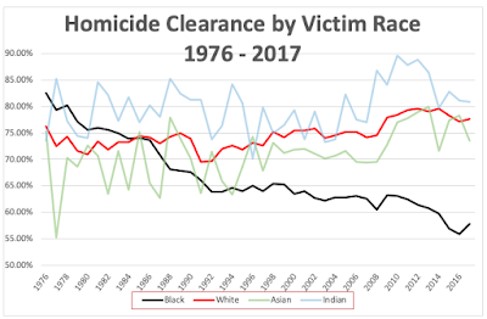
Source: Murder Accountability Project
Patience. These strategies will take some time to play out. They need to be applied consistently without expecting an immediate drop in violence levels. And they can’t stop if there are improvements. When priorities fluctuate, management changes, and structures morph, it is less likely that a program will be able to accomplish complex and difficult goals. One hopes to eventually get to the underlying problems, but that is a longer struggle. Stopping the violence is a goal in itself.
Can We Actually Do These Things?
Unfortunately, this prescription is full of things that America doesn’t do well. For instance, it is very difficult for the country to pick narrow targets, gather data in actionable ways, and then act on it fairly and transparently. That becomes particularly hard when the targets are predictably members of a minority group. No initiative to reduce urban violence is going to succeed if it cannot start out recognizing that young Black men are by far the most likely to be both perpetrators and victims of such violence. This is not racism; it is a fact. If anything, it’s an indictment of the racism that created the situation. But if the goal is to actually make a difference, railing against the appearances is not going to help. Likewise, using that as a reason to lower investment in stopping the violence is seriously counterproductive. Communities of color desperately want more policing. They are the ones suffering from the violence. They just want focused, balanced, fair and competent policing.
Focus also means targeting resources where they will make a difference. This must be data driven. And it means some areas will get more resources. Some communities will see this as “unfair”—and there will be political pressures to even-out resources. But what is really unfair is that some communities have to live in real fear. Sticking to the data is essential.
Another obstacle for these steps is that their implementation requires nuance. We have proved beyond doubt that if “focus” leads to an overly-generalized sense that all Black young men are predators, it is counterproductive. This is where principles of balance and fairness become so important. Balance is important at the community level as well as the individual level. If a community believes that there are being disproportionately policed, but otherwise under-resourced, bad feelings develop. Communities need to understand the plan and, as possible, have input. On the ground, focused deterrence needs to have accurate data, be well targeted, and carried out with respect. While it is likely that causality goes both ways, the neighborhoods with the largest distrust of the police are those with the most violence. Conversely, as violence goes down, trust improves.
Patience is another problem for American policy approaches. Part of the problem is the hopeless diffusion of authority. A national government that is apparently in permanent brain cramp, fifty-one states (including DC), 3,000 counties and more than 20,000 municipalities, not to mention competing bureaucracies at all levels, many marching to different drummers because of patchwork priorities from state and federal funding sources. A recent review of Community Policing in Chicago illustrates the degree of inconsistency in its approach, leaving both police and communities disillusioned. An Atlantic Monthly article reviewing application of Abt’s suggestions shows nationwide how hard it is to keep on a nuanced, focused, balanced and fair program—even when it seems to be working.
Obstacles notwithstanding, I believe Abt’s prescription makes sense. It isn’t a solution to the entire problem of gun violence. Indeed, it won’t solve all urban violence. As one looks around the country, it is clear that some cities have much lower homicide rates than others. It is hard to link their outcomes in a systematic way to the principles Abt suggests. But it is clear they are doing some things different from other cities. And isn’t just having more or fewer policemen. Differences is in policing strategies are critical. Abt’s suggestions are a good template for assessing what strategies will work.
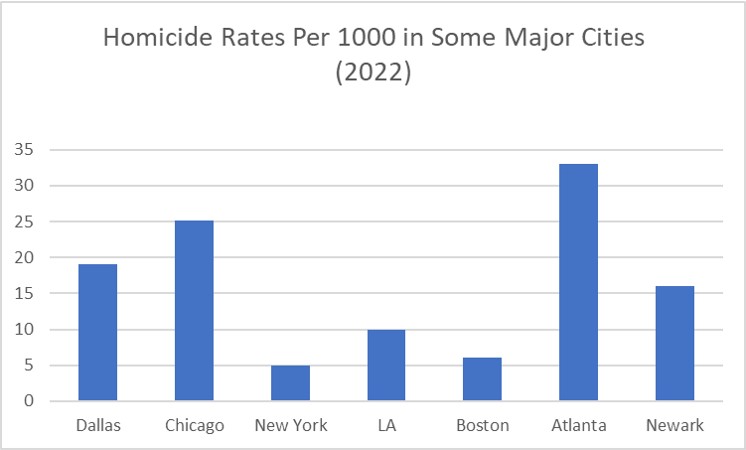
Source: Rochester Institute of Technology/Center for Public Safety Initiatives
I was struck by a quote in Abt’s book from a White suburban mother who had become active in stopping urban gun violence. She said she was now less afraid of her own kids getting shot, and much more worried about them growing up in a country where people weren’t worried about Black or Brown kids getting shot. We need to stop the bleeding.

 Between Hell and High Water
I’m impressed. Tough topic. No quick fixes.
Ira Kawaller
(718) 938-7812
Check out my blog here: https://irakawaller.substack.com/ irakawaller.substack.com/
LikeLike