By Mike Koetting February 3, 2026
This is the third, and for the moment, final post in my series on how we are failing to prepare the next generation for a fulfilling life. The first two posts focused on broad, but tangible issues, the economy facing young people and the confusion of post-secondary education. Today’s post is about something more diffuse but arguably more important—failing to create a sense of a robust future in young people.
Brief History of the Future
The idea of “the future” is a relatively new idea in history. All the ancient religions had some sense of the magic and mystical beyond day to day, mundane life. And all had a broad notion that fate served some people better than others. To create some degree of protection against the fickle fingers of fate, they conjured rituals and rules. But this was not “future” as we think of it; it was simply the awareness of the random distribution of events from a relatively limited set of possibilities.
There were always various ways for young people to “seek their fortune”. But this notion didn’t require any expansive idea of what the future might look like, merely a sense that you would get more of what was there.
The idea of the future begins to take on the coloration by which we know it at the time of the Enlightenment. At first it was a more philosophical idea of an evolving sense of moral progress. Some of the early immigrants to America, for instance, had a sense of seeking freedom—although most were simply seeking to improve their material conditions.
Only in the 19th century do people start to see technological and scientific innovations changing the ground rules of life with the idea that the overall situation of humans might be materially better over time. The magnitude of this change is hard for us to fully appreciate.
As pointed out by Stephen Ambrose in Undaunted Courage, at the time Thomas Jefferson completed the Louisiana Purchase, the fastest way to get around was a horse. It hadn’t changed in millennia after millennia. There was no reason to assume it would ever change. But within one century, railroads crisscrossed the United States, cars were puttering around in cities and the Wright Brothers had taken their first flight.
Since then, change has been a constant. And with it, the assumption that life in the future would somehow be better. By and large, it has been. On most dimensions of human life, things are simply better. All the usual caveats apply, but it is hard to deny the general trend.
It feels like that trend is under threat, and, I believe, it feels particularly so to young people.
It’s Not Just the Material Things
It is not unreasonable to focus on material things. Industrialization has made life much easier, life spans are up, and creature comforts have expanded beyond the wildest imagination of previous generations. In many ways, the average person in the developed word enjoys a more luxurious life than the nobles of the Middle Ages…or probably even than the Roman emperors.
The rub is that how those get evaluated is not unrelated to the social context. Two elements in particular are crucial—fair opportunities and protections. This gets complicated because these two exist in tension with each other. People value the opportunity to get more than average, even much more. But at the same time, they expect some degree of protection to keep them from falling too far below the average, an average they assume will continue to improve as it has over the past two hundred years.
Judging from that time period, it appears this mix creates a degree of dynamic stability which is a great environment for innovation and economic growth. The expectation of improvements, the sense of rewards, the rule of law to make sure rewards from innovation are shared, and the bedrock assumption that the rules will stay more or less the same make the whole machine work remarkably well. Not just here in America, but in large parts of the developed world. And, conversely, when these contextual elements are missing, countries don’t develop.
What’s currently happening in America is shredding that framework. On the one hand, there remains the promise of great opportunity. But it feels much more predetermined. The idea that everyone can rise has been replaced by the idea that winners get wildly rewarded and the rest are on their own. For most people, by their mid-20’s it’s pretty clear whether they have won or lost. A few will successfully buck that trend and some will be deluded to ignore the signs, but the vast majority will know whether they are on the elevated track or left behind.
When this happens, the whole idea of “the future” collapses. Maybe there will be neat things in the future, but those will be available mostly to the top tier in the society. And maybe, after a few election-cycles, the country will decide it’s a good idea to put more props under the bottom rungs of society as a means of maintaining order. But the idea of “the future” as a societally shared possibility will wane because the focus will have shifted from creating opportunity in a shared framework of fairness to making it possible for winners to take all.
Ominous Portends
There are plenty of signs that this is impacting young people in a very unfavorable way.
A relatively small, but culturally significant example. There is substantial skepticism about the future of Social Security. One study found that about 45% of Gen Z and 39% of millennials believe they will not get a dime of the Social Security benefits they have earned. In another study, 76% of Gen Z and 76% of millennials anticipate they will need to continue working in retirement because Social Security will not pay enough. The erosion of confidence about Social Security reflects a suspicion that this is a society they cannot trust.
Environmental concerns represent a special case for young people: they will have to live with the consequences in a way us oldsters won’t. Contrary to my initial expectations, there is not much difference among age groups about the importance of addressing climate change. A substantial majority of all age groups believe it is a problem, but in all age cohorts there is a material number of people who believe it will have more positive impacts and, a smaller number, who doubt it is happening.
What does seem to be different is that younger people are more resigned to the impact. One third believe that it will be difficult to continue to live where they currently do and almost 40% of them believe it is too late to do anything about climate change.
Given their relative resignation about key issues, it is hardly surprising there is lack of enthusiasm for the entire idea of democracy, a governing approach I believe is essential for maintaining the kind of future I hope for. A 2023 survey by the American Public Media Research Lab found that only 27% of Americans aged 18 to 25 strongly agreed that democracy is the best system of government. A subsequent study of young people found that, although there was still support for idea of democracy, belief in the efficacy in the current working of government is anemic, as is their support for any political party.
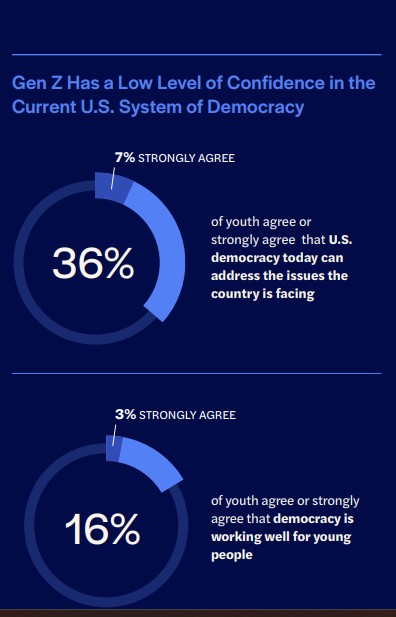
All of this is creating an inhospitable future for young people. A national poll from the Institute of Politics at Harvard Kennedy School reveals a generation under profound strain, as young Americans report deep economic insecurity, eroding trust in democratic institutions, and growing social fragmentation. For many 18- to 29-year-olds, instability — financial, political, and interpersonal — has become a defining feature of daily life, shaping their outlook on the country and their own futures. Almost 60% of young adults report a lack of meaning, purpose or direction.
The mid-twentieth century was an unusual time because it was a period when society made a deliberate set of choices to make the availability of a good life more equitable. Rules were enforced. Markets were competitive rather than extractive. Wealth accumulation faced real limits. Excessive concentration of wealth was treated as a democratic threat. This was not the result of some inevitable political or cultural evolution. It was a result of political decisions that were supported because they delivered for such a large sector of the population. The owners of capital never believed this was a settled matter. They understood this for exactly what it was: a system designed to restrain them.
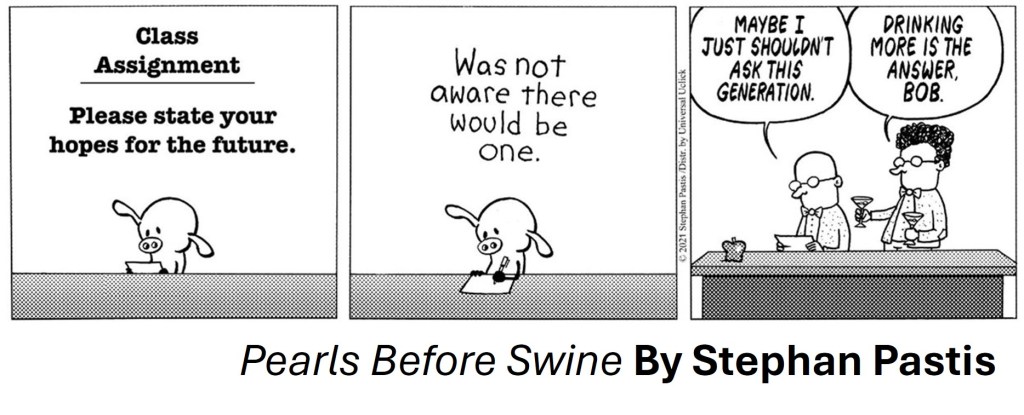
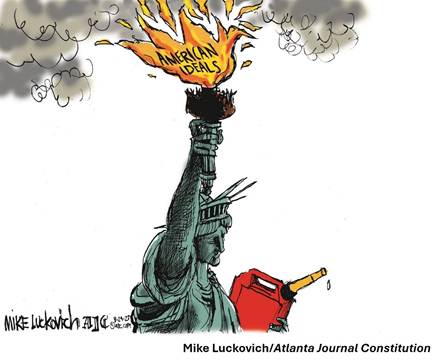
And now that system is in danger of coming apart entirely. This is the key question: will the U.S. be a place with strong economic guardrails or will it succumb to the will of extreme capital? Allowing unlimited futures of a small segment of the population, dampens the future for much of the population. The sense that life gets better, that the fruits of science, technology and innovation will be shared, seems more uncertain to younger people—and with it their view of the future has much closer horizons.

 Between Hell and High Water