By Mike Koetting October 14, 2025
I believe we are approaching a “make-or-break” point for Trump’s authoritarian impulses.
It’s not a question of what he wants to do. That’s clear. In the last several weeks, he has replaced Federal Attorneys until he found one who would pursue an embarrassingly flimsy indictment against one of his enemies, he signed an executive order that raised the possibility almost any kind of dissent could be treated as “treason,” he posted on Truth Social that Democrats are “THE PARTY OF HATE, EVIL, AND SATAN,” and he lectured the leaders of the Armed Services that their mission included fighting the “enemies within”.
His approach to controlling immigration is increasingly inhumane. His masked marauders have grabbed people off the streets with little regard for their situations or actual legal status. Here in Chicago, along with the wanton cruelty and indifference to legality, there has been a major performance element designed to intimidate: armed border guards patrolling the Chicago River, military marches down Michigan Avenue on a Sunday afternoon and ICE agents rappelling from Blackhawk helicopters into apartments filled with sleeping families—separating children from parents and causing total pandemonium. Now Trump is calling for Governor Pritzker and Mayor Johnson to be jailed.

The accumulation of norm-breaking activities is so great it is simply not possible to pretend this is business as usual. One or two of these? Perhaps. But the steady and consistent similarity between what Trump says and does and the rise of every other authoritarian ruler is undeniable. Donald Trump is transparent in this lack of regard for democracy and his desire to be despot. We are past the point where people of good faith can avoid acknowledging Trump’s tendencies.
Which brings us to this point. For Trump to attain the authoritarian powers he seeks requires the support of many enablers. There are of course true believers—think Stephen Miller and Russel Vought—who see the authoritarian road as the only way to impose their beliefs on a society not otherwise likely to accept them. But the real lynch pin is the larger elite who are primarily focused on their self-interest. Steven Levitsky and Daniel Ziblatt concluded in How Democracies Die, democracies depend on the willingness of this larger political elite to hold the line against authoritarianism.
These folks are now trying to assess whether to stick with Trump—as they did for the first ten months of the term—or start to put distance between themselves and an uncertain hand. As David Frum acidly puts it in The Atlantic, the survival of our democracy depends less on the moral integrity of members of the political elite, the dubious nature of that having already been established, but more on their assessment of where that will take them.
Barring unexpected developments, I believe it will come down to a question of whether the 2026 elections will be allowed to proceed relatively uninhibited. We have any number of indications that left to his own devices, Trump himself is willing to tilt the system as much as needed. And while it is hard to predict how an election a year from now will play out, it is not hard to see Trump (and his enablers) getting worried.
The Early Warnings
Despite his claims of “historically high popularity,” there can be little question that his popularity, never particularly high, is declining. It is hard to determine how much weight to give to polling these days, but when there is so much, with such consistency, it is hard to not to believe there is some signal. Several factors seem relevant.
Across a wide range of polls, Trump’s approval rating is dropping. The drops aren’t dramatic but are widespread and consistent. Trump’s overall approval always depended on a hard core of supporters plus a group of soft supporters. These soft supporters had various motives, often nothing more than unhappiness with Democrats. It now appears that Trump’s soft supporters are going soft on him. For instance, more than 60 percent of Republicans younger than 45 say things are on the wrong track, a 30-point deterioration over the three summer months.
On virtually any specific policy issue, there is fairly general disapproval. The Budget Bill is wildly unpopular—and that’s before the real impacts take hold. Some Republican House members are afraid to hold town-halls in their district because of the anger. Even Trump’s handling of immigration, which has always been a strong suit, is slipping. People are still skeptical of immigration, but they also believe that in general immigration is good for the country and strongly oppose harsh and poorly targeted measures, especially those attacking Dreamers and others who have been in the country for a long time. The decline is especially large among Latinos and young people, groups where gains were key to Trump’s 2024 victory.
Disapproval is even higher on more general “suitability for office” issues. Almost 70% if respondents say Trump trying to exercise more power than previous presidents and most of them see that as a bad thing. Clear majorities think he has used his office inappropriately.
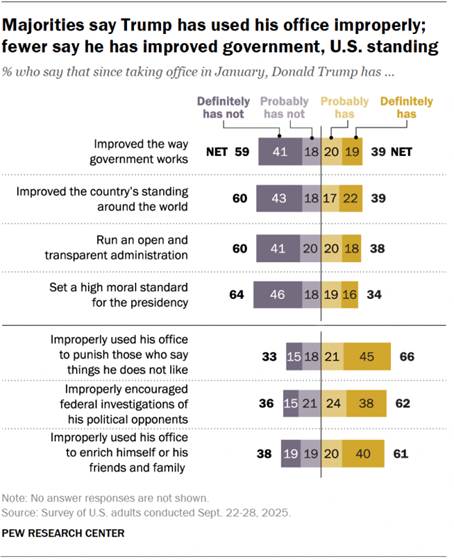
Some surveys are even more pointed. One shows that nearly two-thirds of Americans believe that Trump is corrupt and nearly 70% believe he is dishonest.
Probably reflecting all these specific issues is a yawning gap in how many Americans strongly support Trump versus how many strongly disapprove. At the beginning of the year, there was rough equality between strong Trump supporters and strong disapprovers. As the year has gone on, the Trump disapprovers have become more disapproving while the proportion of strong Trump approvers has withered.
There is also an issue of how this plays out in other circles. Virtually all the business community in Chicago—typically conservative and circumspect–has spoken strongly against the incursion of Federal forces in Chicago. I would be surprised if things like ABC being virtually forced to return Jimmy Kimmel isn’t making corporations think twice about getting too subservient to Trump.
Where This Leads
Again, it’s not clear how polling opinion translates to votes, particularly for an election a year away. And while there is considerable opposition to how Trump is doing things, he nevertheless may feel “more right” to people who are still worried about crime, immigration and the economy. Democrats have been unable to galvanize around new standard bearers or shake the feeling they not in synch with the rest of the population.
But let’s suppose that six months from now the polling looks solidly anti-Trump and there is a good chance Democrats will take one or both houses of Congress. How does he react?
He could let events play out in a straightforward way. After all, he is ineligible for another term. He might find it harder to run as many grifts, but he would still have plenty of opportunities. This, however, does not seem like Donald Trump, with his bottomless appetite for more and his frail ego. My guess is he goes well beyond his plea for more favorable districts in some Red states and takes some measure that is more directly intrusive in the election.
And there is the make-or-break moment.
I wouldn’t expect Congress in its current make-up to stop it. The margins are close in both houses and it is possible a handful of Congress people could be seized by an attack of conscience. But it is probably too late for that. In a close election (or primary), Republicans absolutely need an enthusiastic turnout by the MAGA base. They would be more worried about losing that, particularly in the very gerrymandered House.
I rather expect that in relatively short order, the issue would be before the Supreme Court. Needless to say, I have no idea what form any of that would take, let alone what the justices would do. For the past 10 months, SCOTUS has been bending around the issues like a circus contortionist. Although they have given Trump a number of significant wins, Roberts’ main strategy seems to be to avoid the ultimate show-down. When they can’t see a path to supporting Trump, they have hemmed, hawed, and sent back to lower courts (which have substantially ruled against Trump).
I don’t see how the delaying tactic would work on an election related case that has very finite time limits. I think at that point SCOTUS would have to choose between Trump or democracy.
I don’t know what they will choose—it would obviously depend on many specifics. But I think in the end, the example of “Peanut” Tillman is mostly likely to win out.
Charles “Peanut” Tillman was an All-Pro defensive back for the Chicago Bears. He had enough money when his playing days were over, but he wanted to do something that was good for the community and drew on his physical training. He became an FBI agent.
Two weeks ago, he announced his resignation from the FBI after eight years. He said he loved the job, but he didn’t think the things they were being asked to do now were right. He said: “‘‘I want to be on the right side of history when it’s all said and done.”
I think Roberts wants to be on the right side of history and he will bring enough of the other conservatives along. Alito and Thomas are hopeless, but the rest will see that no one ended up on the right side of history by supporting authoritarians.

 Between Hell and High Water