By Mike Koetting September 3, 2025
David Brooks, taking anguished stock of the depredations of Trump and the Republicans, on PBS NewsHour, wondered why there aren’t more people in the streets. This is a question I have often asked myself. And am not the only one. What Trump and the Republicans are doing is so destructive of the spirit of democracy as to demand vigorous response.
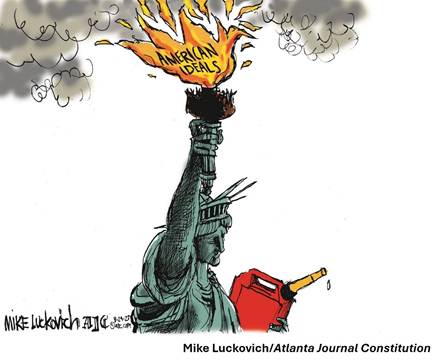
But if the attack on the ideals of America is so fundamental, why aren’t there more people in the streets?
The Missing Ingredients
There are surely a number of reasons, with different ones having different saliency for different groups.
For openers, there are a non-trivial number of people who don’t like equalitarian democracy and are just as happy to see it being trampled upon. Then there are people who nominally approve of the idea of democracy, but don’t like some particular application and are willing to let all kinds of other things slide to have their itch quelled.
Probably the largest group is those for whom “the spirit of democracy” is an abstract idea that doesn’t have anything to do with their day-to-day lives. I have long contended that most people see the world in three groups—us, them and politicians—with politicians being a vaguely annoying group of people that you simply put up with like ants at a picnic. Even those who might have a clear idea of what is at stake might downplay the situation, rationalizing that elections haven’t been canceled or there has been no outright confrontation between Trump and the courts or Congress.
Still, those factors–which pretty much apply to any country, any time–don’t really explain the relative quietude of our current situation. Provocations less serious have triggered massive reactions at other times. People have often concluded that their government is not representing their ideals and taken to the streets. Those eruptions haven’t always worked, particularly at first. However, an impressively large portion of them have, either on their own terms or in setting the stage for subsequent policy.
One thing I believe contributes disproportionately to the relative lack of overt public pushback is that these concerns have not fired the imagination of young people.
Almost all the great protest movements in history have had significant youth involvement, sometimes as foot soldiers, sometimes as leaders. I assume this is because young people see things more intensely, less clouded by all the pragmatic concerns that hobble their elders. They can burn with passion and turn it into action, bold, creative, vivid action. Or perhaps they feel they have a greater stake in the future and less to lose in the present
Today, however, while there is some youth involvement in anti-Trump protests, it seems considerably less than I would expect.
What Is Going On?
Thinking about young people as a single group may be more confounding than helpful. There are those young people you expect to be protesting and those from whom you wouldn’t expect it. Young males without college degrees, for instance, seem to have high distain for the current political order, but without any obvious vision of what they would prefer, except different. I wouldn’t expect them to be in the street protesting the erosion of democratic principles.
On the other hand, there are a lot of college students and recent college graduates who, in other times, would be the leading edge of protest. As best we can tell from polls and interviews, they like Trumplican policies even less than their elders. The below Pew survey shows young people in general tend anti-Trump and educated people in general trend anti-Trump. I couldn’t find a cross-tab that separated young people by educational status, but considering the two groups independently leads one to suspect there is a very high degree of Trump-disapproval in that cohort.

Polling results, however, are not always great at predicting action. I was surprised to find that polling during the Vietnam War era showed opposition was apparently greater among older people than younger people. Yet we know the most virulent opposition to the war came from young people. While some support from older folks was instrumental, it was the Children’s Crusade that made the issue a defining one. Likewise, the Civil Rights revolution, while unthinkable without leadership from some older people, relied heavily on a core of young activists like John Lewis and the thousands of college students who conducted sit-ins, rode buses and went South to register voters.
So why is this group so quiet about Trumplican atrocities. I know from parents of young adults who would be likely candidates for overt opposition, their kids have mostly given up on the established political parties. They think those parties have been so ineffective in addressing their concerns that neither of them deserves support. It is not clear if they believe the Trumpian attacks on democracy are simply another example of how awful our current political process has become or if they believe nothing they could do would be worth the effort.
How Worrisome Is This?
Very I would say. From two perspectives.
First, it seems these young people don’t have sufficient appreciation of the fundamentals of democracy to be outraged at having them threatened. Young people’s lack of appreciation for democracy is often operationalized as a lack of understanding the structural elements of our government. While this is certainly true, I think it more about understanding the spirit of our government. Why preservation of minority voice is essential for the long-term sustainability of a democracy or why it is impossible to have democratic government without compromise and, while there are absolutely critical freedoms, why no freedoms are absolute. If people don’t understand how and why these underlying philosophical concepts are essential to our democracy, they are less likely to be upset when they are threatened.
Second, as a society we should be concerned that the majority of young people do not feel that the country is prepared to support them. A poll of 18-29 year-olds conducted by Tufts University found only 36% of young people agree that US democracy can address the issues the country is facing, and only 7% “strongly agree” with that sentiment. A mere 16% think that democracy is working well for young people. It is simply wrong for a society to be so unsupportive of its future.
To be sure, this slide in the lack of faith in democracy is something that has been going on for a while and is not strictly limited to young people. It is, however, a particular American problem. The following meta-analysis of questions about public support for democracy over the last 25 year shows that the decline in America stands in distinct contrast to other developed countries

Claassen and Magalhaes/Public Opinion Quarterly
How This Translates into Political Realities
It seems like we have moved to a point there the American political world can no longer be divided into Democrats and Republicans. There are, with all the usual caveats of creating groups given fuzzy data, now three groups—Tumplicans, Moderates (drawing both historic Democrats and Republicans) and another inchoate group, which may or may not eventually solidify into a party. This group is broadly progressive, in places, very progressive, and closer to the historic Democratic Party. But it isn’t committed to the Democratic Party. Democrats continue to operate under the fantasy that if they can just come up with the right message, this group will vote Democrat. Maybe. Sometimes. They don’t like Trump (and most of his policies) but will vote for Democrats only to the extent they appear willing to respond to their own needs. As an entity, the Democratic Party doesn’t speak to them.
This general state of affairs is borne out by the fact that when it comes to new voter registrations, even in states where you can pick party affiliation, the largest group of voters opted to not choose a party. Tellingly, a lengthy analysis of new voter registrations in the New York Times was so focused on the slight advantage of Republicans over Democrats in new registrations, that they didn’t seem notice the biggest group of new voters were people who took the time to register but declined to pick a party. It seems this group is alienated from traditional politics because the last 20 years has made them hugely uncertain about their future, particularly with regard to economics. They are inclined toward progressive ideas but are more concerned with what kind of life they will be able to lead.
I have no idea what comes next. One can imagine a political platform that would excite much of this third group. But I can’t imagine selling it to either of the other two groups, though for different reasons. I’m guessing this third group will continue to participate in politics on a transactional basis—that is, voting for whomever appears more likely to meet some specific need of the moment, or maybe not voting.
Unfortunately, such an approach is not consistent with developing and following a broad set of political principles. The future of American democracy is very unsettled not only because the Republicans are attacking from the top but also because the spirit of democracy is flagging throughout the electorate.

 Between Hell and High Water