Mike Koetting April 22, 2025
Many Americans are white-hot angry at their situation in life. More and more families are having a difficult time making ends meet. The sense that they are no longer fully participating in the promised life can be found everywhere. Two-thirds of middle-class families say they are struggling financially.
It shouldn’t come as a surprise that many families are feeling short-changed since the richest Americans are increasing their share of wealth at the expense of everyone else. This is primarily a result of deliberate policy decisions. The surprise is that so many of the people feeling short-changed voted for an agenda promising more of the same.
In 2023, the total share of income earned by the bottom 90% of workers was less than 50%. In other words, the bottom 90% altogether made less than the top 10%. There is nothing inevitable about such a distribution. Most countries with American standards of living have more equal income distributions. In fact, America used to have a more equal distribution.

According to a study by the Rand Corporation, in 2023, if the distribution of income were the same as it had been in 1975, the 90% of the Americans not in the top 10% would have received $3.9 trillion in income above the $12.5 trillion they did receive, a roughly 30% increase in total income. Instead, this money went to the top 10%.
In fact, if the distribution of income—not the total amount, the distribution—had stayed the same between 1975 and 2023, the bottom 90% of American workers would have had $80 trillion more dollars in this period than they received. Instead, that $80 trillion has gravitated to the top 10%.
Tax policies and various government support programs dampen some of the inequality in income. But even taking these into account, economic inequality has increased materially since 1980.
Although there are multiple contributing factors, the distribution of income and other benefits are enormously shaped by actions or inactions of governmental structures. Franklin Roosevelt and the New Deal Democrats launched an era where society became more equal. The actions of Ronald Reagan and other Republicans reversed that trend. We have been in a fifty-year period where society has become more unequal.
To repeat: this is a result of specific policy initiatives, all of them supported by the Republican Party, sometimes with Democrats complicity, more often over Democrats objections. Correspondingly, Democratic initiatives to increase equality have been consistently opposed by Republicans.
This is not arguable. One party is the party of increasing equality and one party is the party of increasing inequality.
The current policy initiatives of the Republican Party—led by Donald Trump and his merry band of billionaires with the full support of the Republicans in Congress—are focused on moving income and social benefits to the top 10%. It does this with tax policies that deliver substantially greater tax breaks to the richest, cutting spending that benefits people outside the top 10%, and eliminating regulations that restrain banks and corporations from actions that might otherwise limit the income of the top 10%.
This is only the most recent manifestation of a trend that has been in place since Reagan and enthusiastically supported by Republicans every chance they get.
It is certainly the case that people vote for political parties for reasons besides economics. Still, it is a bit of a head-scratcher that so many people continue to say the Republican Party does a better job with economics. Sure, if you’re in the top 10%. But for the other 90% there is a real question as to why so many of them keep voting for a party that has pledged to make the distribution of the nation’s resources more unequal.
It’s not as if people aren’t concerned about the inequality. Majorities in both parties keep telling pollsters that they think the rising degree of inequality is a major concern. Even larger majorities think that the very rich have too much influence in government and are not taxed sufficiently.
This disjunct between what people say concerns them and what they vote for is hard to understand. Even if it hadn’t been obvious from the past 50 years of Republican actions, Donald Trump, Elon Musk and the host of billionaires who backed him made their agenda clear from the outset. Lower taxes for them, fewer regulations and less government support for people who weren’t rich.
The electorate seems to have forgotten Woody Gutherie’s observation that “Some will rob you with a six-gun and some with a fountain pen.”
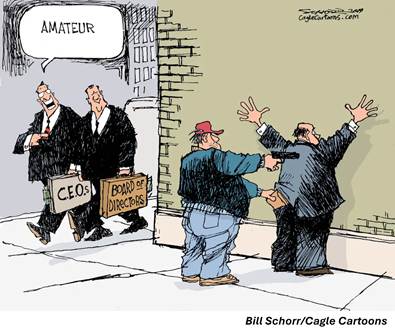

 Between Hell and High Water