By Mike Koetting June 10, 2025
How many times have you heard someone say: “Democrats need to get organized like Republicans.” I don’t have any problem with the idea of getting organized. What I find problematic is the idea that the Republicans have some magic template. For the most part, they are as disorganized as Democrats. They have simply hitched their wagons to one of the world’s most accomplished grifters and let him drag them wherever he wants to go. This simplifies organization enormously. To be sure, Trump has accommodated them by making various nods in the directions of long-time Republican goals. But it is erratic, inconsistent, and can be seen as part of an organized plan only through a peculiar lens. See below about Project 2025.
In 2012, Mitt Romney lost what Republicans thought was a winnable election. They told themselves they needed to get organized, so they undertook an extensive study of what happened and what they should do next, commonly called “The Autopsy.” The idea was that this would create a roadmap to get the Republicans back into power.
Then came the 2016 primaries. Donald Trump ignored the recommendations of this report, dissed the Republican establishment, and ran on his own special brand of lightly veiled hatred and unvarnished flim-flam. He won, and “The Autopsy” was quickly forgotten. The abstract ideas had no traction against a real, live candidate who scratched the itches of so many people.
Then there is Project 2025. Many people see this as the kind of plan Democrats should be developing. Frankly, I doubt it persuaded more than a handful of votes. Many voters never heard of it and even voters who had heard about it had nothing more than a Red/Blue understanding. Donald Trump loudly insisted he didn’t know anything about it. This was of course a lie, but it underscores how little he thought of it as a vote-getting proposition.
Project 2025 was simply a more elaborate list of things certain hard-core conservatives have been pushing for since FDR, although with an extra veneer of Christian nationalism. Indeed, toward the end of the Reagan administration, a group of conservatives issued a report that significantly foreshadowed Project 2025. It lamented that the professional government kept Reagan from exercising his true conservative impulses. They therefore pushed for a more robust Presidency. Of course, since Democrats held the presidency 16 of the next 28 years, had those folks they gotten their wishes, policy would have been more erratic and America’s position in the world eroded—as it has under Trump when people perceive the critical stabilization element of the “Deep State” is weakened.
Moreover, although many things in Project 2025 may come to pass, I don’t think that should lead anyone to believe that the plan itself that made the difference. The apparent impact of Project 2025 seems to have stemmed from two after the fact attributions.
First, it provided rationalizations and specifics for Donald Trump’s desire to amass power to himself and to get rid of obstacles to being able to do whatever he wants. This is not based on any ideology other than “L’etat c’est moi.” Whatever the plan had called for would be okay with him as long as it gave him more power.
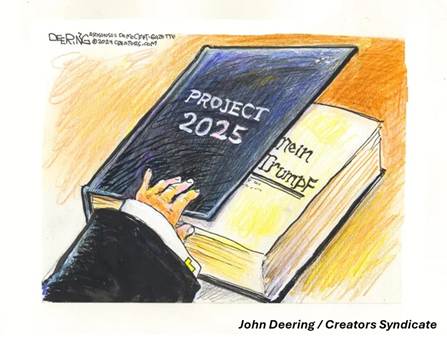
Second, this was a collection of goals and ideas beyond the stronger Executive that appealed to groups—evangelicals, White culturists, and extreme capitalists– left out of the Democrats most obvious goals. Trump continues to implement some of these ideas because they are popular with his base or they benefit him, not because of the existence of Project 2025. Even without Project 2025, he would have supported some of these things because these are the people who brought him to the dance.
In short, I don’t think a Democratic version of Project 2025 would be any more important in 2028 than simply working with their existing constituencies.
Trump certainly has benefited from the right wing media universe. However, this is not a result of Republican planning. It is more a function of profit seeking by folks who understand there is good money to be made peddling lies that support the prejudices of a segment of the population in ways mainstream media never would. Yes, this gives Republicans an advantage. But there is no way Democrats could—or should—replicate.

Redistricting is one part of Republican planning that did make a real difference. After the 2010 census, Republicans unleashed REDMAP, a concerted effort to shift state legislatures towards Republicans. It was well funded by mega-wealthy and corporate sponsors, such as tobacco which contributed millions. It took full advantage of new computer capabilities to devise a map strategy that caught the Democrats largely unaware and unprepared. The results were that the 2014 election shifted 20 state legislative chambers from Democrat to Republican. The newly Republican legislatures then used the same computer information to redraw state maps that were enormously favorable to Republican interests, and will be for years to come. The results make it extremely difficult for Democrats to compete in many state legislative contests, including elections for Congressional Representatives.
After the 2020 census, the redistricting fights consumed a lot of energy, but did not result in a decisive change. Democrats were able stave off major Congressional losses by their own redistricting maneuvers in Blue states and some favorable court battles elsewhere. Michigan joined a number of other states that have independent redistricting commissions and created a much fairer map, that led to a change of legislative control. These offset smaller changes in the opposite direction elsewhere.
But the situation that will follow the 2030 census is a cause for concern. Based on data through the first four years of the decade, there is the possibility for a material shift of Congressional seats. If migrations from Blue states to Red states continue at the same pace, the South will gain nine seats in the reapportionment of Congressional districts after the next census — the largest single-decade gain for the region in history. This would have significant implications for the Electoral College, making it even harder for a Democrat to win a presidential election.
It’s not clear to me what kind of planning should be done in preparation. Since much of the population growth will be people of color, younger people, and people in urban areas, there are some possibilities for Democrats as these populations are historically good for Democrats. (For instance, San Antonio’s newly elected mayor is a Filipino American woman who is openly gay.) It might be possible to move at least Georgia and North Carolina into the Democratic column, and Arizona and Nevada as well. In 2024, however, Republicans made inroads in all those groups that were historically Democratic. So this is definitely an area where Democrats need to plot and execute a strategy well ahead of 2032.
I can only hope Democrats have the wherewithal to study the map legislative district by district, pick priorities, and invest enough to win in those places that can swing the election. I suspect what matters has a lot less to do with general platform issues and messages, and much more with getting the attention of specific people in specific localities. If Democrats can’t do that, Republicans of some variety will be in charge for the foreseeable future.

 Between Hell and High Water
Dear Mike,
Thoughtful and very helpful. We who think of ourselves as intellectuals probably put too much emphasis on ideas. I may not be around in 2032, but I sure hope the Dems get their shit together before then.
Lee
>
LikeLike