By Mike Koetting October 1, 2024
My wife regularly reads Heather Cox Richardson’s newsletter and from time to time reads potentially interesting passages to me. The other morning I almost got whiplash doing a double take at something JD Vance said a few years ago:
American history is a constant war between Northern Yankees and Southern Bourbons, where whichever side the hillbillies are on, wins. And that’s kind of how I think about American politics today, is like, the Northern Yankees are now the hyper-woke, coastal elites. The Southern Bourbons are sort of the same old-school Southern folks that have been around and influential in this country for 200 years. And it’s like the hillbillies have really started to migrate towards the Southern Bourbons instead of the Northern woke people. That’s just a fundamental thing that’s happening in American politics.
My first reaction was stunned amazement. Was he suggesting, for instance, that it would have been okay if the South had won the Civil War? On second thought, I was struck with how flaccid an explanation he was offering for the “fundamental thing that’s happening in American politics.”
What Works
There is an obvious sense that one element of the current political split is a replay of the Civil War. It isn’t just the racism. While important, the racism is more a symptom of the fundamental problem of the “Southern Bourbons”—their deep, inbred belief that they are superior human beings. The top of the food chain, the endpoint of evolution. That’s the belief that allowed them to really believe that slavery wasn’t an issue; it was divinely appointed.
I recently read Eric Larson’s Demon of Unrest about the events leading up to the firing on Fort Sumpter in Charleston Harbor. It was unsettling to read the private writings of the members of the South’s high society and realize that their arguments supporting slavery weren’t rationalizations or sophistry. They really believed this stuff. A non-trivial amount of their umbrage at the North was simply that they felt even raising questions about the morality of slavery was insulting their honor. Abolitionists were an affront beyond what honorable gentlemen could be expected to suffer. Being opposed to chattel slavery was apparently the hyper-woke activity of the era.

One-hundred fifty years later, these “same old school folks” still believe they not only know what’s best for the country, but literally define what’s best. Their idea of what is meant by American culture is the only idea that matters. When Vance says, as he did at the Republican National Convention, that America is not an idea but “it’s a group of people with a shared history,” he is talking about the Southern Bourbons and their clear notions about how a society should be ordered.
What He Doesn’t Say
On the other hand, as analysis, this is radically incomplete. It fails to recognize that the “Southern Bourbons” aren’t “the same old folks”. They aren’t just Southern and definitely aren’t planters rooted in the land. True, the underlying sentiments are the same: our white, Christian ethic is ordained by God. But today’s “Southern Bourbons” are an alliance between the remanent of that class and a mega-rich cabal that, rhetoric notwithstanding, is most fundamentally devoted to capital, wherever it can be found. Without their considerable funds, the Bourbon ethic would have no more traction than trying to restore the Bourbons to the French throne. These folks have the same righteous certainty about the correctness of their positions–anyone challenging them is “hyper-woke”. But their focus on history and culture is a cover for their untrammeled belief that their money is proof of their own superiority, though often cloaked in arguments about “meritocracy.”
Contrary to Republican rhetoric, the people supporting the so-called Southern Bourbons are quintessentially “cosmopolitan” since their money comes from capital—which knows no national boundaries. Whatever they say, they follow the money. Their overriding interest is rate of return. Their primary concern for America is that they have a base of operation where they can be lightly regulated and taxed less than in other venues. Like the original Southern Bourbons, they may convince themselves this is about the superiority of their culture, but cultural arguments designed to support radical inequality are self-serving camouflage.
As a point of accuracy, I should note this new amalgam does not include the entire globalist capital class. There are those global capitalists who are in fact “woke” on social issues—that is, they believe people should be allowed to make choices consistent with their own values rather than being forced to accept the Bourbon White, Christian nationalist ideas. But on economic issues, they mostly follow the same problematic sentiments as their less woke friends, although perhaps with more awareness of the downsides of all-out capitalism.
The Hillbillies
Why, then, would the “hillbillies” side with the Bourbon-capitalist alliance? In the Civil War, although the majority of Southern families did not own slaves, they were all tied into an economic (and social) network that revolved around the slave trade. Support for the South in the Civil War made sense for everyone living in the South.
There is no such economic connection today, so why would the hillbillies be migrating toward support of this new Bourbon-capitalist class?
It’s about the changing nature of society; they correctly perceive the American life they knew is slipping away. It is harder and harder to be part of the “good life” and social disruption is everywhere. People are unhappy.
To benefit from this unhappiness, Republicans have made concerted efforts to convince them that what is eroding American life as we knew it is “woke activism”, which, to be sure, changes many of the outward manifestations of the culture. The Republican’s main goal, however, is to deflect attention from the real culprit, the inherent nature of capitalism to innovate and disrupt, which has been put on steroids by global development. The ongoing transition to global capitalism—which is no more a function of Democratic policies than the tides are a function of Congressional action—leaves many of the “hillbillies” behind. The ability to move jobs to places where workers make less, combined with the endless capitalist imperative to reduce costs and the ensuing technological changes that undermine human agency, renders many unable to find a place in a society they recognize and unable to control the events of their life.
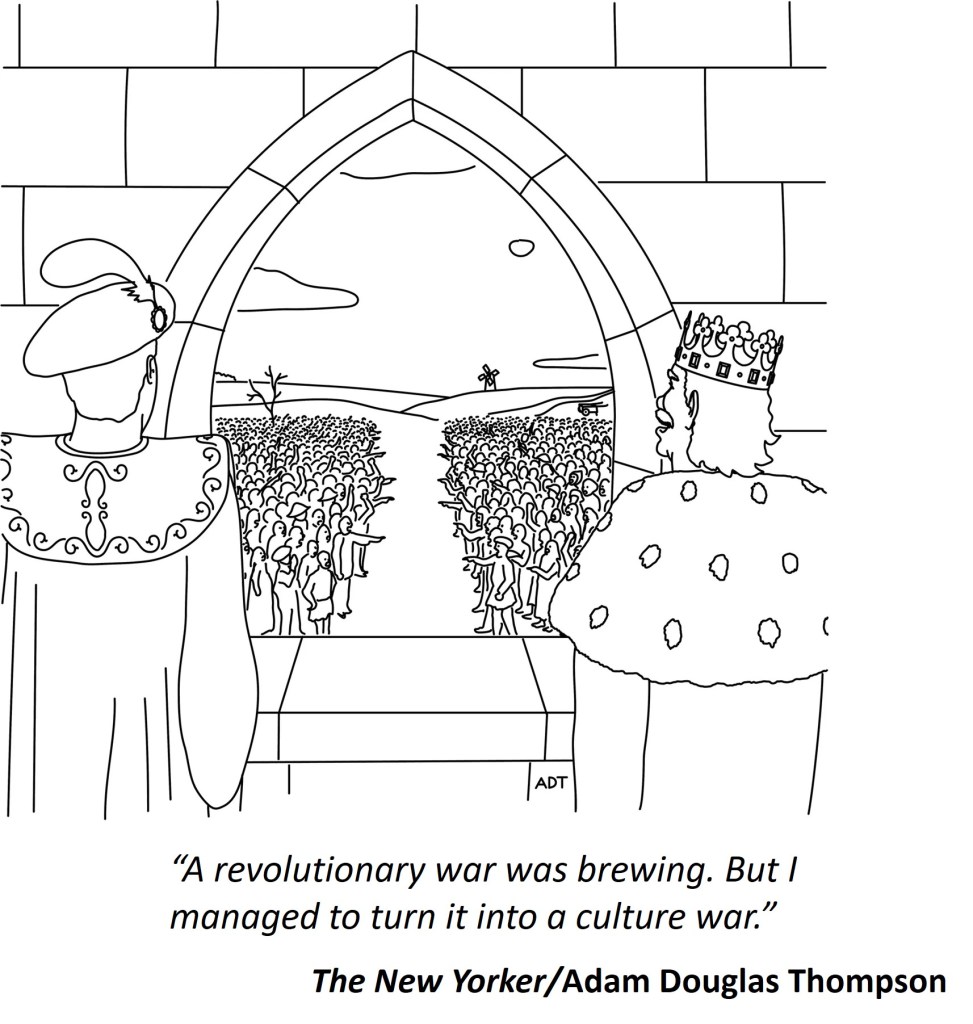
The willingness of some people outside the power structure to side with the Bourbon mentality is also a function of how the economic transitions undermine certain cultural myths that were so deep in our society that most people didn’t notice them. As more and more of these erode, people don’t know how to define themselves. When discussed in abstract terms, particularly by those whose self-definition is safe, it is hard to find real sympathy. But, as the late Steve Goodman said, “It ain’t that hard to get along with somebody else’s troubles.” Humans are highly social and when the rules for how one is part of the group have been changed to devalue you, you are existential mad. Arguing that the rules were never fair does little to assuage. People, especially men, need either radically different circumstances or a new way of self-definition. Neither is on offer. The traditional roads to economic advancement seem closed and, with them, the roads to stable marriage. This is as fundamental as it gets. No wonder Trump-Vance have a 13 percent lead among men. Even young men seem to be leaning to Trump.
While Democrats are more likely to take ameliorating steps, there is little about their pitch that suggests fundamental answers and a lot about the insistence on speaking for minorities, women, immigrants and LGBQ that seems like salt in the wounds. Even when there are sympathetic words, Democrats can’t help themselves from believing the hillbillies are deplorable–hopelessly wedded to racist, misogynistic and xenophobic notions. All of which becomes a vicious cycle because as people are pushed out of their traditional social roles, in the absence of functional alternatives, they do become these things.
The Trump/Vance approach validates those concerns. It is not like they have proposals that would actually push back the depredations of global capitalism. But they give real credence to the concerns, make fun of Democratic cultural concerns and pound on their chests to pretend they can fix things. And, at this point, it seems to the hillbillies that taking a chance on blowing up the existing machinery of power is preferable to the current condition.
JD Vance, who as a former venture capitalist knows he is selling snake-oil, still believes the hillbillies will line up behind the new Bourbons. As far as men go, he may be right. The question will be whether that’s enough to win, especially since the hillbilly women are a whole lot less certain.

 Between Hell and High Water
Thanks, Mike. A convincing synopsis of our current desperate political moment.
LikeLike
Excellent analysis! Thanks.
LikeLike