By Mike Koetting January 30, 2024
When it comes to policy, most of our thoughts get focused on specifics—will Trump be elected again, will Congress reach a deal on immigration, will the Supreme Court strike down the Chevron deference, and so forth.
Not usually up for discussion is whether the background framework in which these issues get addressed will remain more or less the same. We simply assume it will. Intellectually, we know it changes over time—and that specific policy choices have a greater or larger impact on it—but we also don’t usually stop to consider how soon there could be changes that might drastically alter our barely conscious decision rules. We just assume that life will be more or less the same as it is now.
But maybe that’s a questionable assumption. What if we are entering a period when some of the most fundamental pillars of our hidden policy framework start shifting? The rest of this post address four areas that play an outsized role in shaping the parameters of political choices and that I believe are about to undergo material changes. None of these are new to this blog, but I can’t shake the feeling that changes are getting closer…and more likely to be profound.
Resource Attenuation
Many people, including this blog, have pointed out the world’s supply of fossil fuel is limited and it will be exhausted some day. Gone. Over. Like, really, not available. When that day will come is vigorously debated. But it may be a clue when the U.S Energy Information Agency says that their analysis suggests we probably have sufficient global oil through 2050, but beyond that “there is substantial uncertainty.” That is 25 years away. Is that really long enough to completely change the most fundamental element of the world’s economy, particularly when so many in the world’s biggest energy user are willing and able to obstruct change in myriad ways. Most people apparently think it’s too far in the distance to worry about.
They may be fooling themselves by imagining we are taking about an abrupt end to oil. Oil will not suddenly disappear at the same time everywhere. Smaller changes will start to add up. Shrinking resources will make remaining oil more expensive. And the location of the oil will be relevant—large supplies in Russia or China might not be as available to us as oil in US or Canada, and we are reaching the end of the oil shale boom here. (Which may have implications for Middle East policy.)
Nor is oil the only natural resource that can run out: copper. lithium, you name it. They exist in only finite amounts and most of the high quality, easy to extract supplies of these are no longer in the U.S. There are infinite possibilities for the world to become a much nastier place as economies start to run out of necessary materials. And, parallel, all the extended supply chains around the world we have come to depend on may become much less reliable.
Environmental Instability
Even before we actually run out of oil, we may be overcome by its use. There is no realistic chance to keep the world temperature below 1.5 C more than the pre-industrial age average–or below 2 C, for that matter. We know the consequence will not be good; we just don’t know how bad. Pretending this is no big deal—the default option of those who are not ready to make material changes, which is pretty much everybody—is risky. This could a big deal. We know that temperature shifts in the past have led to some very major changes.
Same with the amount of plastic in the ocean, the extinction of species, and the decreases in air quality. All of these will have impacts that we are only beginning to understand.
Again, this will not be felt the same everywhere. Which is problematic, because the people with the most impact on changing conditions also have the resources to best shield themselves from the impact. People who live in Southlake, TX or Palm Beach, FL take it for granted that air conditioning is a requirement. They will notice that the cost goes up because of higher temperature—many will blame the government—but they will go on avoiding the impact of a hotter world in a way unavailable to the poor in India.

Source: World Inequality Lab 2023 Climate Inequality Report
The idea of “environmental impact evaluations” has become a debated topic, largely because no one really wants to know the environmental impact since typically the impact is unfavorable. I readily concede that adverse environmental impacts need to be carefully weighed against positive outcomes. Hitting the right balance is excruciatingly difficult. It is particularly unfortunate that our mechanisms for making these kinds of decisions are so clunky, a condition that is both cause and effect of the need to make these tough decisions in a world where politicians are so averse to hard decisions.
Danger of Growth
Both of the above considerations point to the need to radically reconsider the idea that economic growth is the sine qua non of our society. This concept is even more hard-wired than the two above trends. That economic growth might not be sustainable is, simply, unthinkable.
But if we have to slow the rate of energy use—both because it is becoming less available and it is killing us—how can this be done without slowing the rate of economic growth? The rhetorical answer is easy, “Green Growth”. But the least reflection suggests the weakness of this rejoinder. It is absolutely the case that some technologies are more renewable and some cause less harm. But unless investments in those technologies reduce investment in other technologies, the net impact is to increase energy use because all renewables require some exogenous energy. So far, there is no “Green Growth” comprehensive scenario to continue growth without breaking the planetary bank. The awful truth is that “Green Growth” is probably an oxymoron that points in the roughly right direction, but not clearly enough that we can steer by it.
Of course, economic ‘degrowth” isn’t like to get political traction any time soon. Just try to imagine a candidate for anything on a platform to slow economic growth. There is no political role in the U.S.—and probably most of the world—for advocating less growth. Leaders know that the polity will simply not accept it, even if the alternative is supporting politicians who make patently ridiculous promises. Moreover, if there is no growth, there is no acceptable model for addressing economic inequality except redistribution. But the elites strenuously oppose redistributions and another substantial portion of the population believes that they would lose in any redistribution, that the promised redistribution was simply a trick for politicians to hold on to power, or that even if there was redistribution, they wouldn’t get their fair share. So we promise “all boats will rise” on the basis of economic growth.
It seems any serious rethinking of the role of growth will only happen when the above two trends make it inescapable. Given the “unthinkability” of that day, there is no good reason to expect we will create a new framework for rational decision making until after a lot of things are up for grabs.
Frustration with Inequity
Unlike the fixed place of limitless resources and growth in the American mental map, attention to equity has fluctuated. Between roughly the Great Depression and the election of Ronald Reagan, the American economy had something of an egalitarian ethic. It was uneven, to be sure, with concern for Blacks, Indians, immigrants and many rural Americans being episodic, at best, but there is no denying the importance of equity concerns in that period. Reagan—and the Republican elite who wanted less equity, with a backhanded assist from educated Democrats who were suspicious of Blue Collar sentiments—shifted the mental map. Government and taxes were bad, unions were an impediment to growth, and billionaires deserved their money because they made life better. The results were predictable. Archie Bunker had it exactly right: “Trickle down” was really “Tinkle down.”
World sentiment on equality is, literally, all over the map. Global inequality, fueled by growth in American inequality, has also grown. Globalization—that is to say, the greater internationalization of trade—has for the most part improved life at the bottom of the distribution to a modest degree, but has led to more inequity both across and within countries.

It is hard to say where this sentiment is going to take societies. In the U.S., it’s clear people are fed up with “the elite.” The expression of this frustration—supporting authoritarian politicians who are openly committed to furthering the economic divides—seems counterproductive, but apparently distaste for “the other” outstrips any coherent thought process. In the Global South the frustrations are leading to a constant flow of migration that is upsetting traditional policies. The rise, for instance, of right-wing governments in Denmark, Sweden, the Netherlands and, possibly, France, shows the disruptive power of this anti-immigrant sentiment. But the rise of anti-immigrant parties in the United States or elsewhere isn’t likely to stop the immigrants. According to the National Intelligence Agency, international migration is likely to continue increasing for the next several decades as people in the Global South decide the opportunity for a better future outweigh the risk.
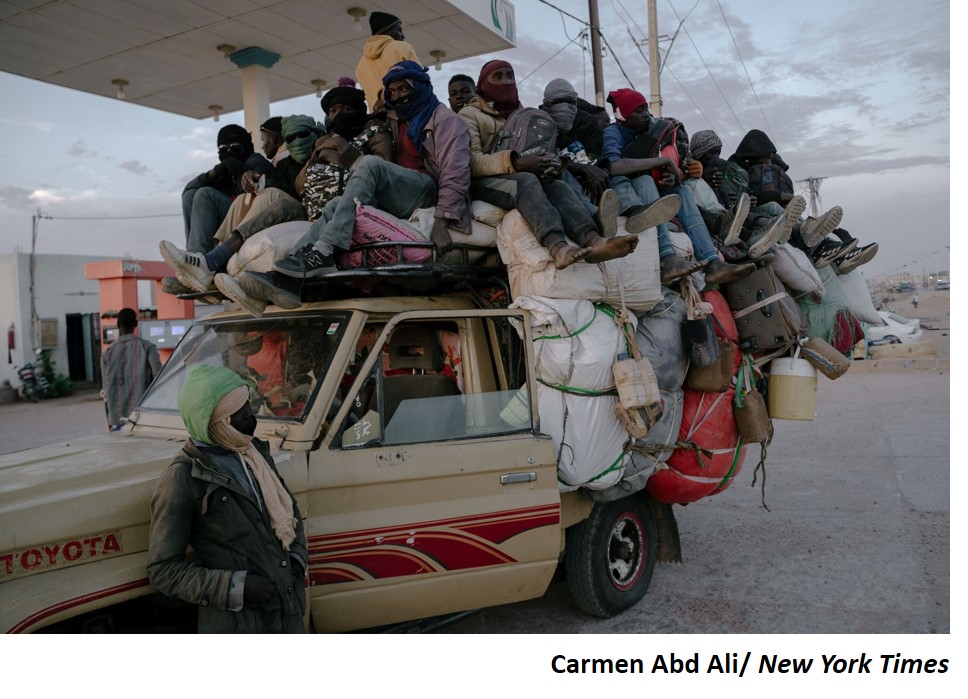
It is very difficult to predict where frustrations with inequality is likely to take us, but it is clear there is a great roiling that should become part of the new policy framework…if only we knew how. It is also the likely case that if worsening environmental conditions start to constrain growth, inequality will deepen further, exacerbating tensions in all directions.
In short…
Arguments about specific policies are important. But when the taken-for-granted framework in which policies have been historically viewed is changing, the framework may be more important than the specifics. I believe our mental maps are badly out of synch with the way the world is evolving. We are careening down a mountain road looking at a map that was created before the rock-slide and the washing out of the bridge.

 Between Hell and High Water
As we’ve come to expect, well written and thought provoking.
You do make me think that a move to nuclear energy is probably more likely that many expect – which, unless it kills us, could really help.
Be well.
Ira Kawaller
(718) 938-7812
Check out my blog here: https://irakawaller.substack.com/ irakawaller.substack.com/
LikeLike
I wish I had more of a real framework for thinking about nuclear energy. I don’t know how we get from here to there without it…but I don’t really know enough to know how risky it is.
LikeLike