By Mike Koetting October 24, 2023
There is no shortage of immediate crucial issues for contemplation such as the dysfunction in the U.S. House and the threat of a complete meltdown in the Middle East. But I wanted to write about our Black legacy tour of the Deep South while it was still pressing in my mind.
At the instigation of a good friend, she, her husband, my wife Barbara and I visited some of the important sites of Black history in the United States. We started at the Whitney Plantation outside New Orleans, a plantation that has been restored to focus on the lives of the enslaved people rather than the masters of the house, and ended at the National Civil Rights Museum in Memphis, built around the remnants of the Lorraine Motel, where Martin Luther King was assassinated.
The trip included a string of terrific museums and several other sites. All were spectacularly done and unleased a flood of facts, ideas and emotions. It would be impossible to summarize everything I learned or felt in a blog this length, but there were threads in the experience.
Situation of Blacks Was a Whole Society Project
The first thread is how much what happened to Black people in this country was a choice. Slavery was not inevitable. It did not “just happen”. The people who were slaves were not slaves before we enslaved them. Slavery was a process committed, day after day, not just by plantation owners, but by an entire social arrangement that supported the existence of slavery, an institution made and sustained by men and women all over the country. Hence the need to refer not to slaves—as if that was the essence of their being—but to enslaved people, because they remained enslaved only by the concerted action of others over a long period of time.
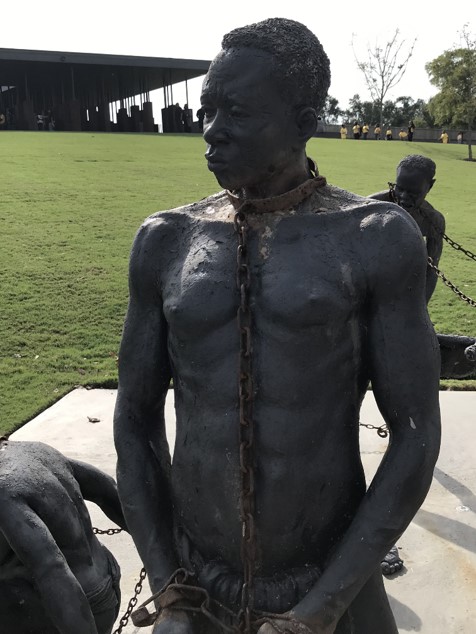
Auction of Enslaved People/National Memorial for Peace and Justice
In the same sense, it is necessary to acknowledge the importance of slavery to the national economy. Initially, New York, and other Northern seaports, were important gateways for slaves. Even after the Transatlantic slave trade was prohibited in 1807, the North was a full economic participant in slavery. Northern bankers financed the slave trade, built ships, shipped cotton and produced the clothes for the enslaved. In the mid-1800’s, more than half of the goods shipped out of New York were products of Southern states. In 1860, the total value of the cotton industry—predominately the value of enslaved people—was greater than all the assets of manufacturing and railroads combined. In fact, during the Civil War, the mayor of New York City proposed seceding in order to preserve commercial connections to the South.
While there certainly were abolitionists in the North, overall the North tolerated the mechanisms that supported slavery. Numerous legislative compromises, Supreme Court decisions—the Dred Scott decision that denied the Blacks had any claim to citizenship being most outrageous–and acquiescing to the Fugitive Slave Act, which had “slave catchers” roaming Northern cities right up to the Civil War.
Contrary to the way the story is often told, while the Civil War was completely about slavery from the Southern perspective, the North did not generally consider it a crusade against slavery. It was more a desire to preserve the Union, including Northern wealth generated from cotton. Lincoln’s initial offer was that slavery could continue if the Southern states would not secede. There is abundant evidence of Northern soldiers grousing that they did not want to risk death to free slaves. The Emancipation Act, while probably reflecting some of Lincoln’s actual sentiments, was mostly a tactical maneuver to hinder the South’s military effort.
After the war, Northern support for Reconstruction was, at best, lukewarm. In 1877, just a dozen years after the Civil War, the settlement of the disputed Hayes-Tilden election saw Republicans agreeing to withdraw federal oversight of Southern states in return for awarding Hayes the election. This happened even though the Northern Republicans knew full well that as soon as the troops were gone, Southerners would be free to pursue any policies they wanted against the formerly enslaved. There was no great Northern outcry. Indeed, part of Hayes rationale for withdrawing federal support was the lack of Northern will to continue to support efforts to protect formerly enslaved people.
Not that Reconstruction was doing an outstanding job of helping the formerly enslaved people become full-fledged participants in the American culture. Some aid was available, but for the most part they were left on their own to scrape together economic survival in a very hostile world. At the Mississippi Civil Rights Museum, there was a panel on emancipation that quoted a formerly enslaved person as saying: “When the troops told us we were free, we started singing and celebrating and we did that for two days and then we looked at each other and said: “What did we really get?’”
As Jim Crow took over after the withdrawal of federal oversight, the South moved to recreate as much of slavery as possible—sharecropping, preventing voting, prison contract labor, under-education of Black children, and more. Lynching became a powerful tool to ensure Blacks knew their place. The Memorial for Peace and Justice (aka, “The Lynching Memorial) makes horrifically clear it was not just the number of lynchings, but how they were used to strategically intimidate the Black population. The North turned a blind eye.
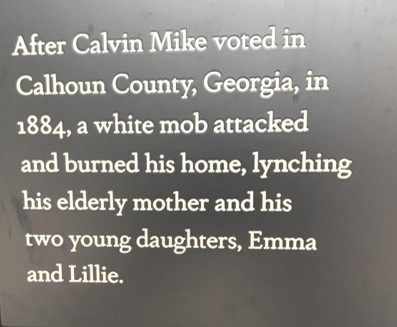
Description of Lynching/National Memorial for Peace and Justice
It is also important to keep in mind that at the time, 90 percent of the nation’s Blacks lived in the South. So it was much easier for the Northerners to ignore what was happening there—which most did. Given incidents such as the 1919 Chicago race riot (because a Black teen swam into the White area at the beach) or other Northern riots against Blacks, there is little reason for Northerns to think they were exempt from what has happened to Blacks in America.
Change Was Hard Won
There have been many changes worth celebrating over the past 75 years, but it would be a mistake to think these were a “foreordained” outcome because of rhetoric about freedom by the country’s founders. Or that it happened because one day someone stood up in a White Citizens’ Council meeting and said: “You know, I think we’ve been reading the Constitution wrong.” The changes happened because Black people—sometimes with White allies–suffered, resisted and persevered against a larger society. As Martin Luther King said, “Freedom is never voluntarily given by the oppressor; it must be demanded by the oppressed.”
And it was. For virtually as long as there were enslaved people in America, there were slave revolts. As soon as given a chance to fight for their freedom, enslaved Blacks enthusiastically enlisted in the Union Army. During Reconstruction, they struggled to retain rights in a society where all the instruments of power belonged to the White society.

Memorial to Executed Members of Rebellion/ Whitney Plantation
But the struggles never stopped. We saw stories of attempts to win voting rights in the 1930’s. Many Blacks simply gave up on the South and took a chance on starting over and migrated North. It wasn’t till after WWII that the Civil Rights movement as we know it started to get traction. And it happened only in bits and pieces, each hard won.
It wasn’t just Supreme Court decisions. After Brown vs. Board of Education in 1954, actual desegregation had to be achieved one school at a time, which is to say one group of families—a handful of tough, brave children, supported by a community–willing to take the abuse. School by school.
Registering to vote was still perilous. But all over the South, people took chances and tried. Some lost jobs, some were heckled, some lost houses, and some were shot in their own driveway for the audacity. The Supreme Court ruled discrimination on interstate bus lines was illegal, but it took Freedom Riders who endured beating and attacks to actually claim that right. Rosa Parks went to jail for the right to sit where she wanted on a bus and for months the entire Black community in Montgomery walked everywhere instead of using buses. In Birmingham, children were attacked with dogs and firehoses because they wanted the right to shop equally in downtown stores.
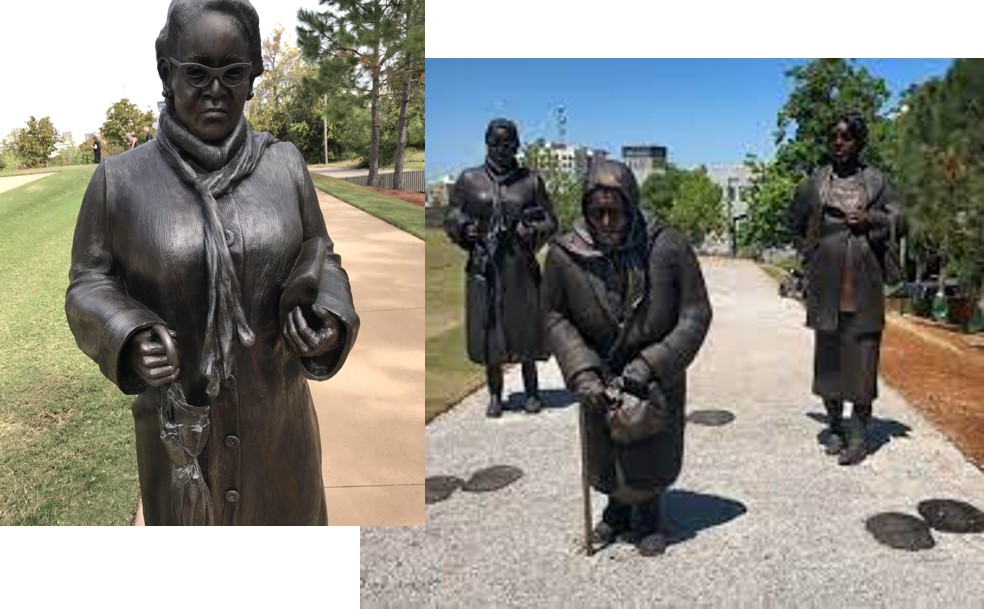
Women Walking during Montgomery Bus Boycott/National Memorial to Peace and Justice
These are stories we all know. We tend to assign them to the “old news” category. But we don’t spend enough time thinking what it might actually have been like. The real danger, the real fear. We know how it turned out and we perhaps too easily think of it as simply the “moral arc of the universe bending toward justice.” But we don’t spend enough time thinking about how hard it was to actually bend the arc. There is no reason whatsoever to imagine it would have bent on its own.
Tying Them Together
What ties these two threads together is the necessity to remember what really happened. The effort to sweep the realities under the rug is abhorrent and those who would do so for political gain should be assigned to the furthest ring of hell. We need to remember, not to drum up hostilities, but to remind all of us that humans have an almost infinite capacity to accept what is as right, however wrong it actually is. To remember that sometimes it takes mighty courage to move a society in the direction of a more perfect union. In remembering the sacrifices, we are not fanning past flames but we are together reaffirming the goals so we can move forward together. Medgar Evers said, “Freedom is never free.” He was right and it our duty to remember the constant and ongoing costs of achieving it. My gratitude to the people who created these memorials and, more so, to the courageous people they commemorate.

Mike Be/Studio Be
****
For the Record
These are the places we visited:
- Whitney Plantation. Edgard, LA, about an hour outside New Orleans
- Studio Be, an active arts studio commemorating Black life, New Orleans
- WW II Museum, New Orleans
- Mississippi Civil Rights Museum and Mississippi State History Museum, Jackson MS
- Medgar Evers House, Jackson MS
- Edmund Pettus Bridge, Selma, AL
- Riverfront and State Capitol Grounds, Montgomery, AL
- National Memorial for Peace and Justice (aka “Lynching Memorial”), Montgomery, AL
- Legacy Museum, Montgomery, AL
- Michelle Browder Sculpture Garden, Montgomery, AL
- Birmingham Civil Rights Institute, Birmingham, AL
- National Civil Rights Museum, Memphis, TN
Background
- How the Word Is Passed, Clint Smith (2021)
- The Warmth of Other Suns, Isabel Wilkerson (2010)
- Selma, movie (2014)
- Prosecution of the 16th Street Church Bombing, U-tube (2016)

 Between Hell and High Water
Good piece. Pity it would be against the law for a teacher in Texas or Florida to distribute it to their classes.
Ira Kawaller
(718) 938-7812
Check out my blog here: https://irakawaller.substack.com/ irakawaller.substack.com/
LikeLike