Commentary on Policy and Politics–which includes pretty much everything
Author: mkbhhw
Mike Koetting’s career has been in health care policy and administration. But it has always been on the fringes of politics. His first job out of graduate school was conducting an evaluation of the Illinois Medicaid program for the Illinois Legislative Budget Office. In the following 40 years, he has been a health care provider, a researcher, a teacher, a regulator, a consultant and a payor. The biggest part of his career was 24 years as Vice President of Planning for the University of Chicago Medical Center. He retired from there in 2008, but in 2010 was asked to implement the ACA Medicaid expansion in Illinois, which kept him busy for another 5 years.
As I am restarting after a break, I thought it might be a good time to make a really high-level review of the three things I identified as core issues for the country and the world when I started the blog, six years ago:
Dealing with vast inequity of resources among people
Radically revising our relationship with the environment
Rethinking the nature of work
It is my impression these are still the critical issues. Moreover, it also seems there is a fourth major question that didn’t seem as omnipresent six years ago.
I wasn’t planning to write a blog in August, but when I ran a across an article on how “drug coupons”—a relatively arcane item that I will describe below—drive up drug costs, I couldn’t resist. It is such a perfect illustration of why our healthcare is so complex and the costs so absurdly high. I felt it was like a little tear in the circus tent that allowed you to see inside to watch the circus-like complexities of our health system.
Today being the Fourth of July, and less than 18 months from the next election, it’s as good a time as any other to offer my overview of where we are in the American political wilderness.
I think the short version is that for the last three years we’ve been hovering around a tipping point: one way leads, however gradually, to political sanity. The other, probably less gradually, to a radical change in American life. In either case, the specifics are murky, but I have a feeling the next 18 months will call the question.
I just returned from a (too short) visit to Paris. We used the Metro extensively. The stops are plentiful, the trains run every few minutes, the stations are clean, everything works and the people use it—even us tourists.
Part of the secret is the relatively compact nature of Paris. Building that kind of rail density in Chicago would be prohibitively expensive. But, it seems, building any transit in the US approaches prohibitive expense.
I’ve been thinking about urban violence for a while—I am on the board of some gun violence reduction organizations and my wife has been involved for years with an organization providing services to families of homicide victims. Despite my concerns, I sometimes find myself slipping into too much resignation to the killing.
Most of the concern about automobiles in America centers on their carbon emissions. Today’s blog, however, focuses on a different aspect of the impact of America’s car culture–how parking spaces can become a bad use of society’s resources. It also reminds us that the fabric of our lives is shaped by an invisible, even if in plain sight, network of rules and laws that we rarely think about but that we could change.
Central Cities
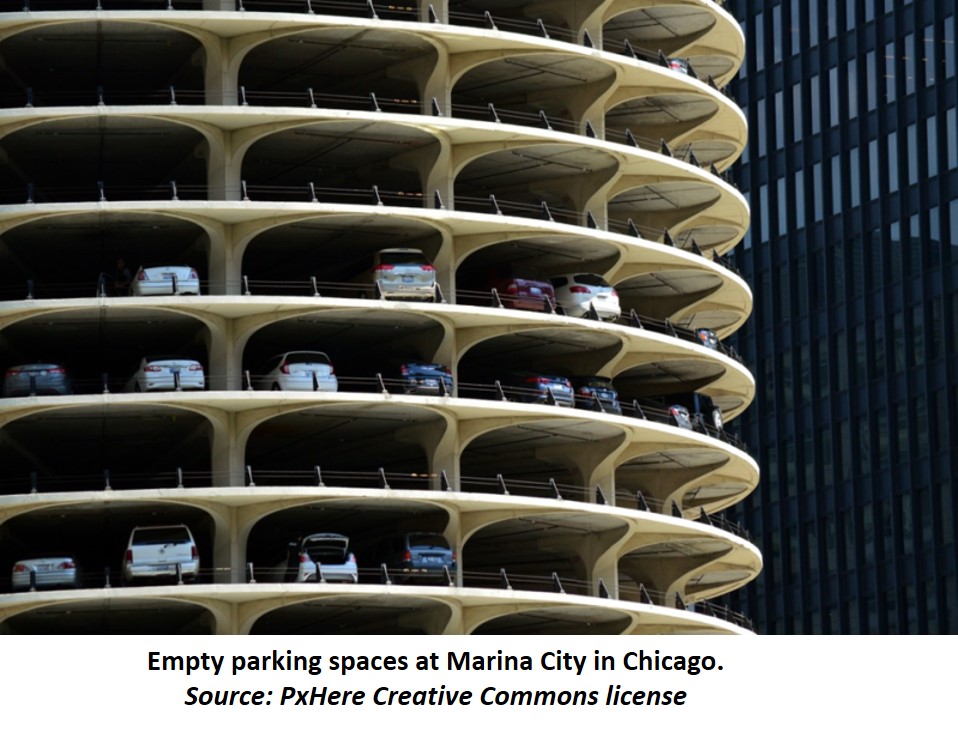
I got started thinking about this issue after reading a blog by the son of a friend on the impact of laws in Chicago creating minimums for the number of parking places required as part of construction. (As a complete aside, I note there is something simultaneously disquieting and reassuring when you start seeing cogent articles from people you knew as a baby.) He argued that mandating parking space minimums imposes a meaningful drag on the real estate markets because, in many circumstances, it is leading to more spaces than necessary. Excess spaces drive up construction costs which increase rents in order to cover the excess spaces. Research in Chicago shows that in the central city, about one-third of all parking spaces in large residential buildings are empty at 4 AM, the expected point of maximum use. This is consistent with the excess rate found in several other cities. These excess spaces are estimated to add 17% to the rental costs in these buildings.
The bill that Republicans (by themselves) passed to increase the debt ceiling limit is a basket of pernicious ideas, including cancelling incentives for alternative fuels that was part of the Inflation Reduction Act (IRA), creating incentives to actually increase use of fossil fuel, cancelling student debt relief, and adding “work” requirements for Medicaid. But, even within this legislative rogues’ gallery, there is one that, more than any other, illustrates the disconnect between Republican rhetoric and their true motives. That is the provision to reduce the IRS budget by $71 billion. This is most of the amount of new funding that was included in the IRA to fix recognized problems in that agency.
Earth Day was Saturday and, as always, it’s an occasion for considering the state of the world. Literally, not figuratively.
The most recent UN report shows it’s getting worse. I’ll bet few of us are surprised.
We all know the trajectory is more or less exactly what scientists have been predicting for years and we assume not a whole lot has happened that would change that. Which, when you think about it, is kind of weird. There’s this thing happening that the best scientists tell us has a high likelihood of causing material damage and we pretty much take it for granted that there is no response remotely commensurate with the problem. Why should that be?
I submit it is because we have become habituated to—indeed secretly demand—a mega-level of hypocrisy on environmental issues.
Maybe it’s an exaggeration to say the Chicago mayoral election run-off was one of the worst political choices I have ever faced. But this is only the second time in my life that I went to the poll to cast a blank ballot.
The national news story of progressive Brandon Johnson against moderate Paul Vallas isn’t wrong, but it doesn’t convey the choice with sufficient texture.
A couple weeks ago, one of the twenty-year old elevators in our building began stopping at random floors unbidden. The maintenance company addressed it. Two days later, it started again. They replaced the entire control panel. That worked—for three days. They replaced the entire panel once more and that seems to have done the trick. For now.
It’s certainly fair to question the overall condition of our elevators or the competence of the maintenance company. But I wonder if there are bigger issues lurking.