By Mike Koetting March 13, 2024
I last wrote about presidential politics in July. Now, we are half-way between that post and the election. The primary season is well under way. Probably time for an update.
The Nominees
The two front runners are still who they were in July—Trump and Biden.
Of course, In July I predicted Trump would not be the Republican nominee. Sure looks like I was wrong. It is true that some people put a lot of money into Nicki Haley. I’m guessing some of that was because they didn’t want Trump and some because they wanted to have an alternative in case Trump imploded. It never crossed my mind anything would dissuade his base, but I simply couldn’t get my head around the idea that serious people would give a pass to a person with all his baggage in a world so fraught with difficulties. I don’t know if the issue is that these people think having a person like him is an advantage or the sense of inevitably has simply worn down those I thought would throw the switch. The glacial slowness of the court system has certainly benefited Trump. The fact that the Supremes agreed to hear the immunity case—however they ultimately rule—was a gift of delay. I always thought that people who said a Trump conviction would deter them were exaggerating the likelihood of their paying attention to the legal system. But I did believe more power players would balk at the idea of a candidate having to bob and weave around court appearances and spend large sums of money on legal defense. I failed to realize that the potential alternative power centers in the GOP had so completely capitulated to the Trumplicans.
I still think Biden will be the Democratic nominee. But, opposite Trump, his position in the party has gotten weaker—despite an objectively strong job performance and a good State of the Union performance. The merciless criticism of his age has taken a toll. Although the media is reasonably good about also calling attention to Donald Trump’s arguably greater cognitive deficits, the damage to Biden is much greater because Republicans simply don’t care. Biden has also been saddled with a mess in the Middle East that alienates key parts of his base. Again, the Republicans don’t care—and to the extent they do care, atrocities against Muslims are fine with them. He might turn this into something good if he can up with a settlement in the next few months. If a settlement is not forthcoming, his only political choice will be to get much tougher with Israel. Where that goes is hard to predict. Finally, it is a fact that Biden’s energy level is observably lower and his projection shakier. On balance, as Ezra Kein summarized it, Biden is a much better president than a presidential candidate.

The idea that Klein, among others, has been plugging is that Biden continue running and then abdicate at the start of the convention. Klein argues that whatever happened would leave the Democrats in a stronger position. Perhaps. However, it makes some herculean assumptions about the ability to switch campaign horses in the 45 days between the convention and the beginning of early voting. It also assumes that the convention—which will have its own bizarre dynamics—would correctly pick someone who vibrates on enough of the diverse channels that make up the party that they would actually do better than Biden. Biden became the 2020 nominee for a reason. The Klein-scenario also assumes that Biden would swallow his ego and go along. And, while no one admits it, it would require his campaign to be secretly conspiring in the construction of a transferable campaign. This does not smell of realism to me.
Odds are a Trump-Biden rematch.
The Election
I don’t pretend to know how the election will turn out—beyond being close. If it is these two, I think Biden will win. But I am less sure of that than I was sure Trump would have been eased out by now, so you can see what that’s worth. There are probably fewer than ten states where voting will make a difference in the presidential election and what will be decisive is turnout in those states. There is a solid core of Republicans who actively dislike Trump. His totals will depend on how many of those vote for him anyway, if they don’t vote, or actually vote for Biden. One early guess suggests about one-third of them might vote for Biden. On the other hand, there are relatively few Democrats who actively dislike Biden and fewer still who could be imagined voting for Trump under any circumstances. Biden’s problem is a lack of enthusiasm and key parts of his constituency may just stay home. Then there are the wacky possibilities raised by third party candidates, who are polling better than at any time since Ross Perrot. Impossible to know the impact of these in a razor close election.
A Trump victory would be nothing short of catastrophic—as soberly described by Robert Kagan, Axios, an entire issue of the Atlantic magazine, and others. Defeating Trump is job number one. Still, I probably spend more time thinking about the context of this election. The country has not been this divided since the election of 1860. The 2024 election has similarities and differences.
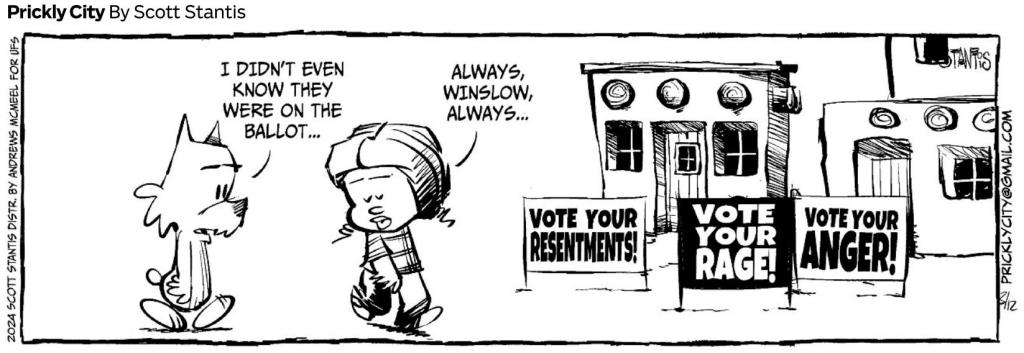
The main similarity is the level of animosity. Political differences have become definitional: substantial majorities in each party view the other side as fundamentally immoral. This has been reflected in political positions, with toxic results. Republicans have closed ranks behind a man who has left no question of his disregard for the traditions and rules of our democracy. The Republicans, to use Mitt Romney’s words, “no longer believe in the Constitution.” This is exactly the essence of a civil rupture.

But there are important differences with 1860. For one, the fault lines in our society are not neatly geographic. To the extent the divide has a geographical element, it is urban versus rural. This in turn mirrors where the locus of economic power resides. Biden won only 15% of the counties in America—many in Red states–but they account for more than 70% of the country’s economic output. Another key divide is more versus less education. Both of these divides are scattered far and wide, a marked difference from 1860 when slavery was congruent with a concentrated set of states and inextricably permeated the economic and social structures of those states. It is also the case that there is no clean policy disagreement, like slavery in 1860. The heat being generated is primarily with regard to emotional issues on both sides whose dividing lines are enormously influenced by minority rhetoric. Paradoxically, it might be harder to reach political accommodation when the markers are foggy, even when there are substantial majorities supporting the outlines of agreements on most major substantive issues. Rapprochement on emotional issues is elusive.
If Trump wins, I am not sure small Democratic majorities in both houses would protect the country. Trump would try to rule without Congress and, If the courts further capitulate to the anti-democratic sentiment of the Trumplicans, it is not clear what difference Congress would make. If the Trumplicans won both houses, Blue states would be obstructed from going their own way. Trumplicans would preempt state rights, similar to the pre-emption laws Red states have used to prevent cities from adopting policies at odds with the Republican agendas.
On the other hand, even if the Democrats, presumably Biden, do win, it’s not clear how they will govern unless the Democrats win an overwhelming victory up and down the ballot, something that doesn’t seem likely. A major subsidiary concern about the Biden enthusiasm gap is that it will, literally, keep people home—and potential support for down-ballot positions will be lost.
While there is absolutely no way forward if Trump wins in November, I don’t see how we get beyond the near civil war miasma on a longer-term basis unless the Democrats achieve large enough majorities to govern decisively–and do so wisely—long enough for the lethal dosages of the Trump venom leach out to where it is possible to reestablish civic society. This is not solely about getting Trump off the stage, but also about seriously addressing many of the substantive issues that made Trumpism an attractive alternative. This will not be easy, as it will require Democrats to also trim some sails. But there is no reason to believe it impossible.
Absent this, probably regardless of who wins in 2024, I can only see the continuation of the decades-long erosion in the idea of government, particularly democratic government. This loss of faith in government has been one of the major wellsprings of Trump’s success. If not reversed, even if temporarily paused, it will lead to more Trump-like candidates. People have little patience for government that seems unresponsive to their needs.
Moreover, in the absence of effective government, further power would concentrate in large corporations. This is not only bad in itself—corporations care much more about their own wellbeing than any larger social structure—but it will further weaken the conviction that democratic government and the kind of society it creates is worth the hassle. The clock could be turned back far enough that a Middle Ages analogy of a weak king with powerful feudal lords is appropriate.
And, so, one thing has not changed since my post last July: This election is more perilous for the country than any since 1860. We will be lucky to avoid disaster.

 Between Hell and High Water
Great piece Mike. Couldn’t agree with you more. The country is at risk for losing. Not only its democracy, but any sense it had for the social good. It defies my imagination how normal people can let this go on. Then again, who or what’s normal anymore. I’m just a dinosaur stuck in the 60’s/70’s.
LikeLike