By Mike Koetting September 26, 2023
For several years now, I have been stock-piling notes for a possible blog on freedom of speech. I haven’t done one, however, because thinking about it always makes my head hurt. The over-riding principles are straightforward and almost universally accepted. But applying them is excruciating difficult. As often the case, Scott Stantis nails it:
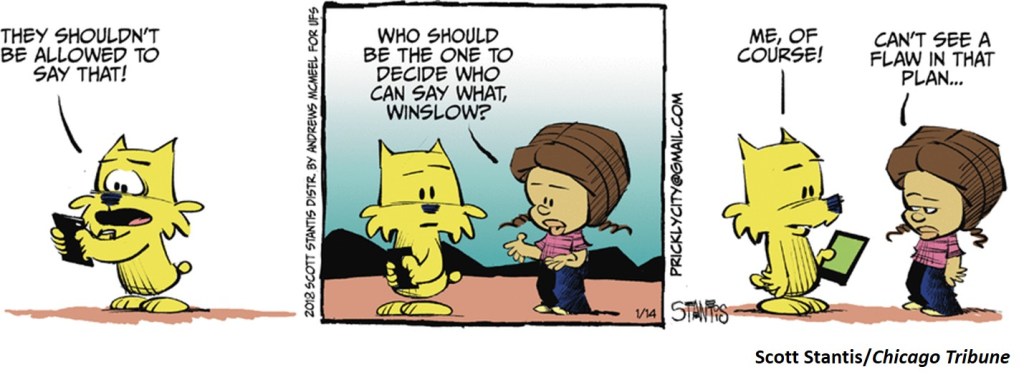
Perhaps someday I’ll write that blog. But in the meantime, I am more concerned about a different problem, which I will call “freedom of ignorance”–the idea that anything one says is as valid as anything else and there are no obligations to consider either the foundations or implications of one’s opinion. Combine this with the ability of people to self-select their media sphere, and society is at great danger from people exercising their constitutional right to never hear any contrary news.
The World Revolves Around Me
My world, at least. And your world around you. It’s just that way. Of necessity, humans’ primary view on the world is through themselves. Nothing surprising or alarming about that. But, and presumably this is one of the things that differentiates humans from other animals, we have the capacity to take in other points of view. Our view of the earth beneath our feet is not a complete prisoner of the fact that it seems flat. We are capable of transcending our immediate impressions or earlier learning.
Unfortunately, having the capacity does not guarantee we will use it. Our belief systems are inordinately shaped by what feels right, including what we were raised with. The natural condition of the human mind is to become a self-reinforcing feedback loop. One mitigates that cycle only with deliberate effort—willingness to suspend first instincts and the discipline to consider alternative approaches. There are obvious differences in people’s willingness to do that.
When it comes to political views, most people settle on a belief system that fits with their first impulses. often what they were raised on. These belief systems are changed only in the face of significant evidence that their original beliefs are insufficient, or even wrong. The secret of Trump is that he not only didn’t challenge people to examine anything, he told them all they needed was to be mad that others were criticizing their beliefs. Many of the flash points where this anger was just waiting to boil over are in fact difficult spots, places with real problems and reasoned differences on how to proceed. At first, analysts kept trying to understand Trump’s success in terms of these real issues, trying to see how the Trumplicans were addressing substantive concerns. But it was never about issues; it was about an emotional response to being told their reality was fine as it was. He was selling easy, simple “solutions” to complex problems that fit in with people’s pre-conceived notions. He told people their “common sense” was better than all the complicated stuff that come from experts. It was “feel good thoughts” in the guise of politics.
His permission has given a material portion of the population freedom to insist on absurd and contradictory things because they seem right and align with primal instincts. The ignorance of these voters is not that the issues aren’t valid areas for concern. It is not that all of the specific reasons for their anger are invalid. It is not that experts don’t sometimes get it wrong, even very wrong.
The problem it is that, with a firm unwillingness to hear facts, they have aligned themselves against solutions that recognize the complicated realities of our society. They have been granted the right to freedom of ignorance, making religion of what Isaac Asimov describes as “the false notion that democracy means that my ignorance is just as good as your knowledge.”
This renders compromise unnecessary, even anathema. That Trump is selling snake oil is not recognized because one of its features is inoculation against contrary evidence, a condition reinforced by media and politics.
There’s Good Money in Ignorance
The text book case is Fox News’ willingness to pander to election deniers, even though they knew better. Tucker Carlson makes the motivation crystal clear when he demands the firing of a reporter for honestly describing one of Trump’s claims. He was unhappy because viewers didn’t want to hear it and it was depressing stock prices.
The point here is simply that Fox (and brethren) make money by delivering a non-stop diet of reinforcement for current beliefs and keeping things from people that might cause them to question their beliefs.
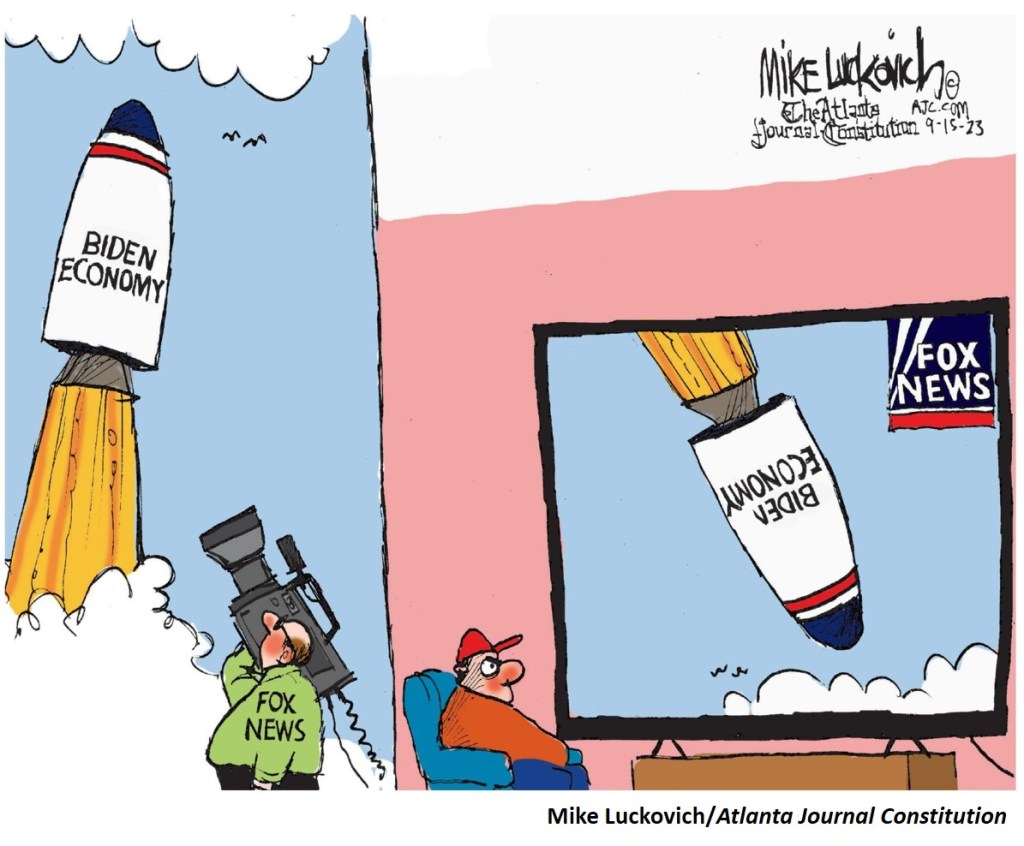
There’s a similar problem at the heart of social media. It makes its money by giving people what they want. In a leaked memo, a senior Facebook executive specifically conceded that they are indifferent to the truth of information, as long as it compels people to use Facebook.
Of course, this is just a high technology application of a trait that is intrinsically human—the tendency of like minds to cluster together. (My circle of friends matches my ideological and cultural beliefs.) Still, social media continues to refine its algorithms to perfect the art of reinforcing people’s bubbles. While the consequences of this phenomenon are greater in the Trumplican sector, it is a problem for every political point of view.
I certainly don’t want to dictate what stories can be covered or how they are covered. And I’m not enthusiastic about making Mark Zuckerberg the arbiter of “truth”. But a society needs some common frames of references. When our bubbles become totally resistant to outside information, adamantly refuse any information that might dent the bubble, the lubricants of democracy get burned up.
There are many legitimate criticisms of the days when three big networks virtually owned the news. Dissent was muted and not everyone was invited in. Still, those institutions all followed a common tradition of reporting the realities on the ground as best they could determine them. For better and for worse, this led to similar versions of the news, which in turn created a widely shared culture. But it was also instrumental in causing the country to adapt, as through its coverage of Civil Rights struggles and the war in Vietnam. Certain realities became inescapable. There is no putting the toothpaste back, but this doesn’t look so bad at the moment.
Leaders Capitalize on Ignorance
Look. I wouldn’t for a second—not even for a nanosecond–deny that all political movements rely on a certain amount of ignorance in their base. But at some point, the reliance becomes indefensible. As reflected in Mitt Romney’s recent comments, most Republican leaders know that the claims of “stolen election” is bogus– as we always assumed. But they refuse to admit that in public. Support for ignoring the facts is no longer incidental and now is a litmus test for survival.
To make matters worse, having adopted ignorance as a core value, the GOP has started to attack those places that study “misinformation.” They make the brain-twisting argument that identifying someone else as lying is dampening that person’s freedom of speech. They are trying to create an “information free zone” for their constituents.
When Ignorance Rules
Discussing things that people disagree on with terms like “ignorance” has a definite whiff of condescension. But at some point, a steadfast unwillingness to even consider any information that runs counter to your beliefs is ignorance. Currently, America is faced with a situation where a material chunk of the electorate simply refuses to accept facts. They are supported by a media environment with a substantial financial interest in catering to their outright hostility to evidence, and have led to the GOP’s conscious decision to sustain this ignorance.

I am in no way making an argument here for censorship. On the contrary. I want to maintain the widest range of opinions possible. But for a sensible discussion, we need sensible opinions. it is now evident that by letting the media market get rigorously segmented, we have given people the ability to self-select into networks that simply screen out adverse evidence. At least right now, I think this “Freedom of Ignorance” is a bigger issue than the traditional problems of “Freedom of Speech.”
David French wrote in the conclusion to his recent New York Times opinion on “The Articulate Ignorance of Vivek Ramaswamy”:
A democracy needs an informed public and a basically honest political class. It can muddle through without one or the other, but when it loses both, the democratic experiment is in peril. A public that knows little except that it despises its opponents will be vulnerable to even the most bizarre conspiracy theories….And when leaders ruthlessly exploit that ignorance and animosity, the Republic can fracture.
****
My development of this post is indebted to a compelling post by Dustin Arand in Medium, entitled “You’re Not Entitled to Your Belief”. If you have access to Medium, you might want to check out his thoughtful takes on the world.

 Between Hell and High Water